

US Anti-Radiation Drugs Market Analysis, Emerging Trends, and Forecast to 2034

The Anti-Radiation Drugs Market is expanding as governments, defense agencies, oncology centers, and pharmaceutical developers prioritize medical countermeasures that mitigate cellular damage from ionizing radiation. Growth is supported by rising cancer radiotherapy volumes, heightened geopolitical and nuclear safety preparedness, national emergency stockpiling programs, and advancements in targeted radioprotective therapies.
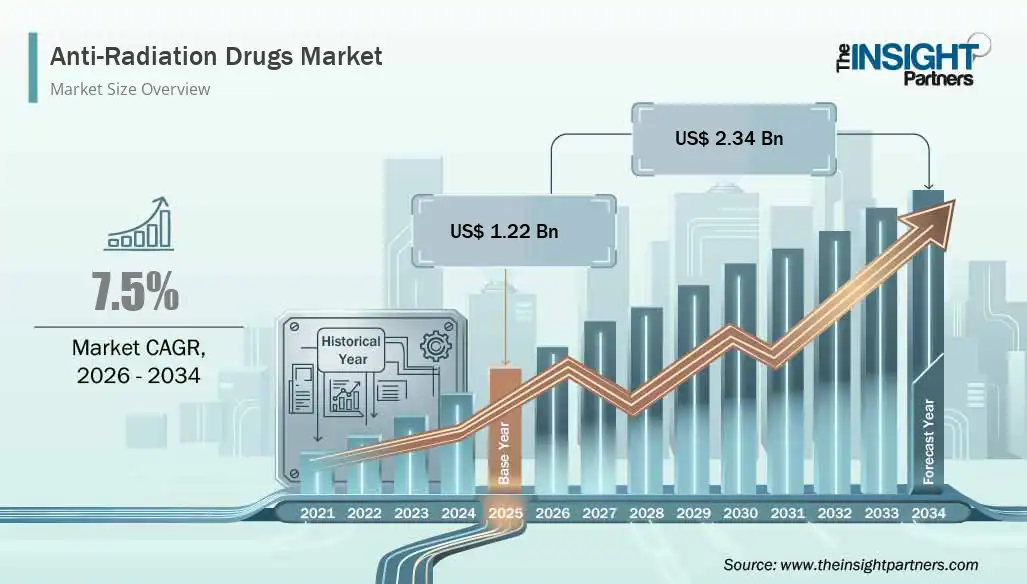
The Anti-Radiation Drugs market was valued at US$ 1.22 billion in 2025 and is expected to reach US$ 2.34 billion by 2034; it is estimated to record a CAGR of 7.5% during 2026-2034.
What is driving the market?
Rising global cancer incidence requiring radiation therapy, heightened geopolitical risks surrounding nuclear emergencies, and government-backed biodefense procurement are the principal growth drivers. Healthcare systems and defense organizations are increasingly focused on acquiring medical countermeasures capable of protecting healthy tissues, accelerating hematopoietic recovery, and reducing oxidative stress and inflammation following radiation exposure.
The market is transitioning beyond traditional chelating agents and potassium iodide toward advanced biologics, cytokines, and targeted small molecules. Pharmaceutical developers are investing in novel mechanisms of action such as DNA repair modulation, immune system stimulation, and thermostable delivery platforms to improve therapeutic efficacy and broaden administration windows. However, strict ethical and logistical hurdles in human clinical trials (requiring reliance on regulatory pathways like the U.S. FDA Animal Rule), compound toxicity profiles, and incomplete mechanistic understanding of delayed radiation tissue injury remain important constraints.
Download Sample Report@ https://www.theinsightpartners.com/sample/TIPRE00040184
Which region leads?
North America leads the global market, supported by substantial federal funding, well-established biodefense stockpiling initiatives (such as BARDA and Department of Defense contracts), advanced oncology infrastructure, and active late-stage clinical pipelines. The United States accounts for the vast majority of regional demand due to ongoing government procurement of FDA-approved acute radiation syndrome (ARS) therapies and biodosimetry research.
Asia Pacific is the fastest-growing region, projected to expand at a rapid pace through 2034. Growth is driven by expanding oncology treatment access, increasing investments in healthcare infrastructure, rising disposable incomes, and national preparedness initiatives across major economies such as China, Japan, and India. Europe holds a significant market share, supported by coordinated civil-defense frameworks, nuclear energy safety protocols, and strong academic and pharmaceutical R&D capabilities.
Which segment leads?
By indication, Acute Radiation Syndrome (ARS) is the leading segment, accounting for the largest share of market revenue. Its dominance is supported by urgent government stockpiling requirements for nuclear or radiological emergencies and the high clinical value of FDA-approved myeloid and megakaryocytic growth factors used to treat radiation-induced myelosuppression. Delayed Radiation Syndrome represents a steadily expanding segment as long-term survivorship care in oncology grows.
By route of administration, Intramuscular and Injectable formulations hold a major share due to rapid systemic bioavailability in emergency and hospital settings, while Oral formulations are gaining traction for ease of mass distribution and prophylactic outpatient use. By distribution channel, Hospital Pharmacies lead the market, reflecting the critical-care nature of oncology radiotherapy support and emergency radiological intervention.
Which companies are prominent?
The market features a mix of established biopharmaceutical leaders and specialized clinical-stage biotechnology firms, including Amgen Inc., Partner Therapeutics Inc., RedHill Biopharma Ltd., Humanetics Corporation, RxBio Inc., Soligenix Inc., Aeolus Pharmaceuticals, Onconova Therapeutics, Enzychem Lifesciences Corporation, and Chrysalis BioTherapeutics.
These companies compete across colony-stimulating factors, thrombopoietin receptor agonists, radioprotective small molecules, and chelating agents. Strategic differentiation increasingly depends on regulatory approval under specialized pathways (such as the FDA Animal Rule), extended post-exposure administration windows, thermostability for field deployment, and securing multi-year government supply contracts.
What is changing in 2026?
In 2026, the market is shifting from reliance on narrow-window emergency antidotes toward multi-purpose, dual-use therapeutics that serve both oncology supportive care and biodefense preparedness. Regulatory agencies and procurement bodies are placing stronger emphasis on drugs with extended post-exposure treatment windows (24 to 72+ hours after radiation exposure) and improved safety profiles.
Developers are accelerating advancements in thermostable drug delivery platforms (such as ThermoVax) that eliminate cold-chain logistics for emergency stockpiles, alongside noninvasive biodosimetry biomarkers that enable rapid triage and personalized dosing after radiological incidents. Procurement decisions are increasingly tied to lifecycle cost-effectiveness, shelf-life stability, and dual clinical utility in mitigating radiotherapy side effects.
What are the major investment opportunities?
The strongest opportunities lie in next-generation radioprotectants and radiomitigators, thermostable formulation technologies, and rapid biodosimetry diagnostics. Investment in novel cellular-protection pathways such as p53 modulation, free-radical scavengers, and endothelial tissue repair can unlock therapies capable of treating both acute hematopoietic injury and delayed organ fibrosis.
Additional opportunities include:
- Dual-Use Oncology Therapeutics: Developing drugs that protect healthy tissue during high-dose cancer radiotherapy while qualifying for government biodefense stockpiling, thereby de-risking commercial revenue streams.
- Aerospace and Defense Applications: Formulating oral, shelf-stable radioprotective regimens tailored for military personnel, aviation crews, and long-duration human spaceflight missions.
- Emerging Market Expansion: Partnering with regional healthcare systems in Asia Pacific to supply affordable supportive-care biologics and radiation countermeasures as oncology infrastructure scales.
Future Outlook
Looking ahead toward 2034, the Anti-Radiation Drugs Market is poised to evolve from a niche, event-driven biodefense sector into a mainstream pillar of precision oncology and national health security. Over the next decade, breakthroughs in targeted biologics, gene-expression biodosimetry, and needle-free or oral delivery systems will significantly improve survival outcomes and simplify mass deployment during radiological emergencies. Furthermore, expanding commercial space exploration and the global resurgence of nuclear energy infrastructure will create sustained, long-term demand for prophylactic and post-exposure radioprotective solutions.
Anti-Radiation Drugs Market Trends, Demand & Growth by 2034
Orthodontic Equipment Market Growth, Size & Forecast by 2034
Bispecific Antibodies CDMO Market 2026-2034 | Growth & Forecast
The Insight Partners is a leading market research and consulting firm delivering actionable insights through in-depth industry analysis and strategic intelligence. The firm supports clients across various industries in making informed decisions by providing comprehensive market forecasts, competitive assessments, and growth opportunities.
Contact Us:
If you have any queries about this report or if you would like further information, please contact us:
Contact Person: Ankit Mathur
E-mail: sales@theinsightpartners.com
Phone: +1-646-491-9876


