

US Glider Aircraft Market Overview: Innovation, Adoption Trends, and Growth Through 2034

Glider Aircraft continue to attract a dedicated global community of aviation enthusiasts, engineers, and competitive athletes. From weekend club flights over local hills to multi-day expeditions across mountain ranges, these machines embody the purest form of human flight.
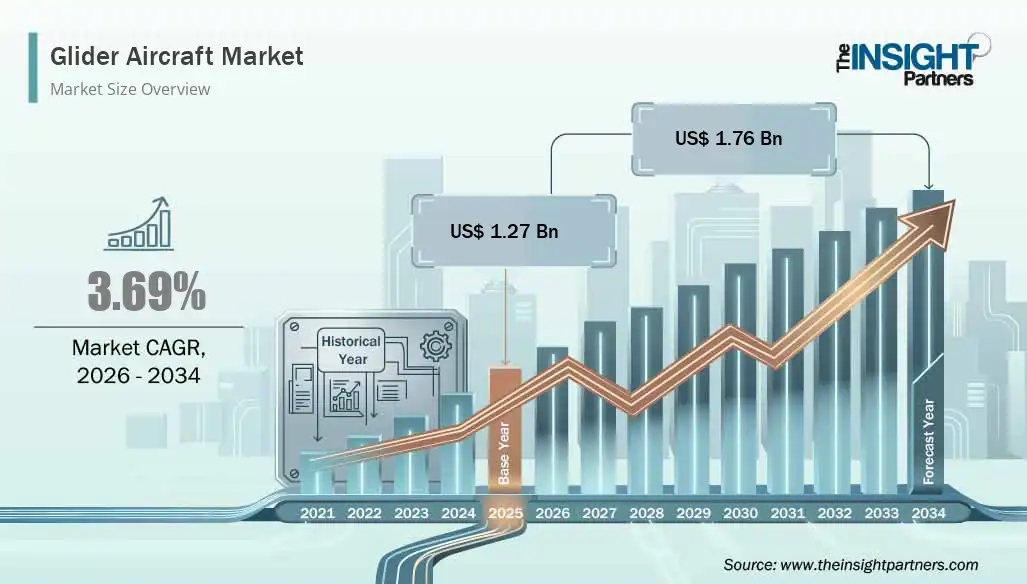
The Glider Aircraft market was valued at US$ 1.27 billion in 2025 and is expected to reach US$ 1.76 billion by 2034; it is estimated to record a CAGR of 3.69% during 2026-2034.
What is driving the market?
Rising demand for low-emission aviation, cost-effective pilot training, and outdoor adventure tourism are the principal growth drivers. Flight schools and military academies increasingly rely on gliders to teach fundamental aerodynamics, energy management, and spatial orientation at a fraction of the operating cost of conventional powered aircraft. Simultaneously, soaring clubs, competitive gliding tournaments, and adventure tourism operators are fueling demand for high-performance recreational and cross-country aircraft.
The transition is moving beyond traditional unpowered, tow-launched designs toward self-launching and sustainer electric motor gliders. Manufacturers are investing in high-aspect-ratio composite airframes, lithium-ion battery integration, and advanced cockpit avionics to extend endurance and operational independence. However, high initial acquisition costs for composite electric models, battery range limitations, strict airspace regulations, and weather dependency remain important market constraints.
Which region leads?
Europe leads the market, accounting for an estimated 39%–43% share. Its dominant position is anchored by a deeply established gliding culture, favorable soaring terrain such as the Alps, supportive airspace policies, government-backed aviation sports subsidies, and a high concentration of premier glider manufacturers. Germany, France, Slovenia, and the United Kingdom represent major hubs for both fleet renewal and new aircraft production.
North America accounts for an estimated 26%–30% share, supported by an active recreational soaring base, military cadet training programs, and growing adoption of electric self-launching gliders across the United States and Canada. Asia Pacific holds an estimated 21%–25% share and represents the fastest-growing regional market, driven by expanding flight-training infrastructure, rising disposable incomes, and aviation modernization initiatives across Australia, New Zealand, China, and India.
Download Sample Report@ https://www.theinsightpartners.com/sample/TIPRE00023778
Which segment leads?
Sailplanes represent the leading aircraft type, accounting for an estimated 55%–59% of market revenue. Their dominance is supported by superior aerodynamic efficiency, lightweight composite construction, and widespread adoption across competitive soaring, flight training, and cross-country flying. Self-launching electric motor gliders are emerging as a high-growth sub-segment as operators seek runway independence without relying on tow planes or winches.
By application, Commercial and Recreational Aviation (including flight academies, aero clubs, and adventure tourism) leads with an estimated 60%–64% share, reflecting high utilization in pilot instruction and sport flying. Military and Defense applications encompassing air force cadet training, tactical reconnaissance, and low-observable surveillance represent a specialized, high-value segment supported by ongoing defense modernization.
Which companies are prominent?
The competitive landscape includes Schempp-Hirth Flugzeug-Vertriebs GmbH, Alexander Schleicher GmbH & Co., DG Aviation GmbH, Lange Aviation GmbH, Jonker Sailplanes, Pipistrel (Textron eAviation), HpH Sailplanes, Stemme AG, Allstar PZL Glider, and Airborne Windsports.
These companies compete across high-performance composite sailplanes, electric self-launching motor gliders, two-seat training gliders, and hang gliders. Strategic differentiation increasingly depends on aerodynamic refinement, battery energy density, electric propulsion reliability, digital flight computers, and scalable composite manufacturing capacity. The list reflects prominent industry participants rather than a revenue-ranked market-share table.
What is changing in 2026?
In 2026, the market is shifting decisively toward certified electric propulsion, upgraded aerodynamic profiles, and expanded composite production capacity. Regulators such as the European Union Aviation Safety Agency (EASA) have streamlined operational approvals and lifted earlier airworthiness restrictions on electric sustainer and self-launching systems, accelerating commercial confidence in battery-powered soaring.
Manufacturers are rolling out next-generation models featuring improved winglets, higher wing-loading capabilities, electric ducted fans, and adaptive cockpit controls designed to broaden pilot accessibility. At the same time, major OEMs are expanding composite factory footprints while specialized maintenance providers are seeing surging demand for airframe refurbishment, avionics upgrades, and airworthiness management for aging global fleets.
What are the major investment opportunities?
The strongest opportunities lie in electric propulsion systems, high-density aviation batteries, composite airframe manufacturing, and flight-training fleet modernization. Investment in lightweight lithium-ion and solid-state battery packs, efficient electric sustainer motors, and rapid-charging airfield infrastructure directly addresses range anxiety and lowers operating expenses for clubs and academies.
Additional opportunities include dual-purpose training motor gliders that allow flight schools to conduct powered and unpowered instruction on a single airframe, as well as unmanned and solar-assisted high-endurance gliders for environmental monitoring, meteorological research, and defense surveillance. Emerging aviation markets in Asia Pacific also offer strong expansion potential for turnkey flight-training fleets, maintenance, repair, and overhaul (MRO) hubs, and localized composite component manufacturing.
Future Outlook
Looking toward 2034, the glider aircraft industry is poised to evolve from a niche recreational sport into a core pillar of sustainable, zero-emission aviation and foundational pilot training. Advances in solid-state battery energy density, AI-assisted thermal and glide-path avionics, and ultra-lightweight carbon composites will progressively expand flight envelopes and reduce lifecycle costs. As global aviation authorities enforce stricter carbon-neutrality and noise-abatement standards, electric and hybrid motor gliders will increasingly serve as commercial testbeds for broader regional electric aviation technologies, ensuring sustained long-term adoption across civil, training, and defense sectors.
Event Stream Processing Market Share, Growth & Demand by 2034
API Management Market Growth Opportunities and Forecast by 2031
Smart Advisor Market Key Companies Profile and SWOT Analysis by 2034
The Insight Partners is a leading market research and consulting firm delivering actionable insights through in-depth industry analysis and strategic intelligence. The firm supports clients across various industries in making informed decisions by providing comprehensive market forecasts, competitive assessments, and growth opportunities.
Contact Us:
If you have any queries about this report or if you would like further information, please contact us:
Contact Person: Ankit Mathur
E-mail: sales@theinsightpartners.com
Phone: +1-646-491-9876
Also Available in : Korean| German| Japanese| French| Chinese| Italian| Spanish


