

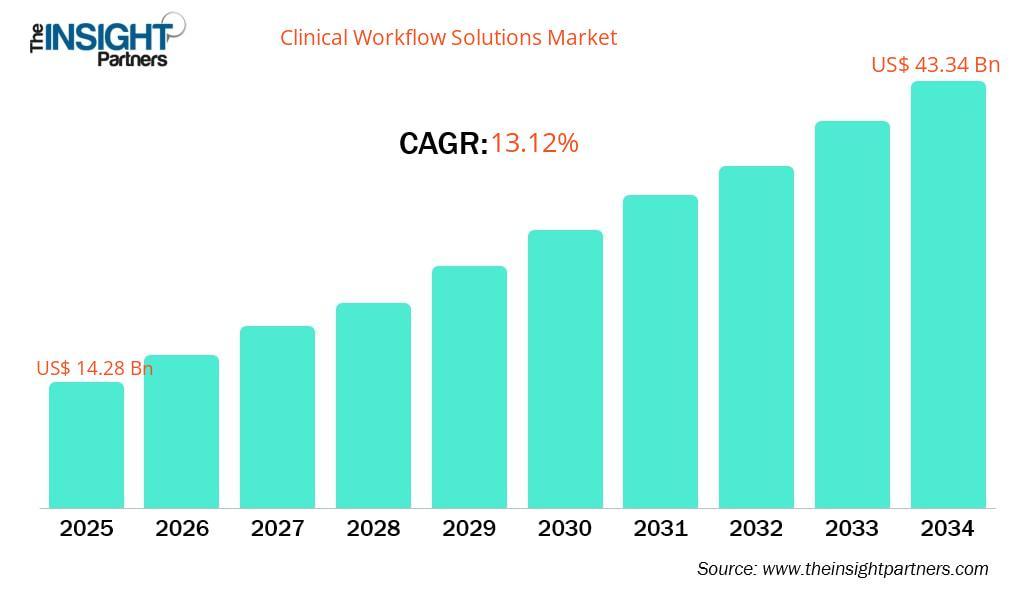
Global Clinical Workflow Solutions Market to Surpass US$ 43.34 Billion by 2034, Driven by a 13.12% CAGR

Clinical Workflow Solutions enhance communication among multidisciplinary care teams by providing real-time alerts, secure messaging, and centralized task management platforms.
The Clinical Workflow Solutions market is expected to register a CAGR of 13.12% from 2026 to 2034, with the market size expanding from US$ 14.28 Billion in 2025 to US$ 43.34 Billion by 2034.
What is driving the market?
Clinician staffing shortages, rising chronic disease burdens, and regulatory mandates for healthcare data interoperability are the principal growth drivers. Healthcare providers are increasingly required to reduce administrative friction, shorten patient length of stay, prevent medical errors, and coordinate care seamlessly across departments and care settings. Hospitals and ambulatory networks are seeking platforms that automate documentation, scheduling, and bed management without disrupting frontline clinical routines.
The transition is moving beyond basic electronic health record (EHR) digitization toward intelligent, automated workflow orchestration. Vendors are investing in AI-powered ambient scribing, real-time clinical communication, predictive patient-flow analytics, and cloud-native integration engines. High upfront implementation costs, legacy on-premise IT inertia, data privacy concerns, and cybersecurity risks remain important constraints.
Which region leads?
North America leads the market, accounting for an estimated 42.0%–44.0% share in 2025, supported by high EHR penetration, strict interoperability regulations, value-based reimbursement models, and rapid commercial adoption of AI clinical assistants.
Asia Pacific is the fastest-growing region, projected to expand at a CAGR of 15.0%–16.5% through 2033. Growth is fueled by hospital infrastructure expansion, rising healthcare expenditure, aging populations, and national digital health initiatives across China, India, Japan, and South Korea. Europe holds an estimated 23.0%–26.0% share, driven by national eHealth modernization programs, cross-border health data frameworks, and public-sector investments in hospital efficiency.
Download Sample Report@ https://www.theinsightpartners.com/sample/TIPRE00020019
Which segment leads?
By solution type, Data Integration Solutions is the largest segment, representing an estimated 25.0%–28.0% of market revenue in 2025, as seamless connectivity between EHRs, medical imaging, lab systems, and bedside devices forms the foundation of any clinical workflow. Workflow Automation Solutions is identified as the fastest-growing solution category, advancing at a 14.5%–15.5% CAGR, propelled by demand for automated patient flow, nursing scheduling, and documentation tools.
By end user, Hospitals dominate with an estimated 45.0%–58.0% share in 2025, reflecting acute-care complexity, high patient throughput, and enterprise-wide coordination needs. Long-Term Care Facilities represent the fastest-growing end-user segment (projected 10.8%–13.2% CAGR), driven by aging demographics, staffing regulations, and remote care coordination. By deployment mode, Cloud-Based delivery commands the largest share at approximately 46.8%, favored for lower upfront capital requirements and continuous software updates.
Which companies are prominent?
The competitive landscape features prominent market participants including Oracle Health, Epic Systems Corporation, Koninklijke Philips N.V., GE HealthCare, Siemens Healthineers, Stryker (Vocera), Baxter International (Hillrom), Veradigm LLC, NextGen Healthcare, athenahealth, InterSystems, and Microsoft Corporation.
These companies compete across EHR-embedded workflow suites, real-time clinical communication, alarm management, patient-flow command centers, and AI-enabled documentation. Strategic differentiation increasingly depends on deep EHR interoperability, measurable reductions in clinician documentation time, cybersecurity compliance, and the ability to deploy unified platforms across multi-hospital networks. The list reflects key industry competitors rather than a revenue-ranked market-share table.
What is changing in 2026?
In 2026, the market is shifting from standalone point tools toward unified, AI-embedded clinical orchestration platforms. Ambient AI documentation and conversational clinical assistants have moved from pilot programs into standard enterprise deployments, pulling adjacent spending in automated order entry, referral management, and coding. Simultaneously, regulatory enforcement around standardized APIs, prior-authorization automation, and cross-network data exchange is accelerating cloud migration and legacy system upgrades.
Healthcare CIOs and clinical leaders are increasingly linking procurement decisions to demonstrated return on investment such as hours saved per clinician, reduced after-hours charting, and faster emergency department discharge times rather than software feature counts alone.
What are the major investment opportunities?
The strongest opportunities lie in AI-driven workflow automation, cloud-based interoperability platforms, outpatient and home-care orchestration, and healthcare cybersecurity. Investment in generative AI agents that automate clinical notes, discharge summaries, and care-gap alerts offers high commercial appeal as health systems seek immediate relief from workforce shortages.
Additional opportunities include unified communication and alarm-management tools that consolidate pagers, secure messaging, and nurse-call systems onto single mobile devices, as well as predictive command-center analytics for bed capacity and surgical scheduling. Emerging healthcare markets across Asia Pacific particularly India, China, and Southeast Asia present strong expansion potential as private hospital groups and public health programs scale digital infrastructure. Investors should prioritize solutions with proven EHR integration, zero-trust security architecture, and quantifiable operational ROI.
Future Outlook
Over the next decade, clinical workflow solutions will evolve from passive task-tracking software into autonomous clinical operating systems. As multimodal AI models integrate real-time vital signs, diagnostic imaging, genomics, and EHR histories, platforms will increasingly anticipate clinical deterioration, auto-draft care pathways, and orchestrate cross-facility transitions with minimal human intervention. Furthermore, the expansion of hospital-at-home programs, virtual care wards, and remote patient monitoring will push clinical workflows well beyond hospital walls, making seamless, edge-to-cloud care coordination a foundational requirement for modern healthcare delivery.
Event Stream Processing Market Share, Growth & Demand by 2034
API Management Market Growth Opportunities and Forecast by 2031
Smart Advisor Market Key Companies Profile and SWOT Analysis by 2034
The Insight Partners is a leading market research and consulting firm delivering actionable insights through in-depth industry analysis and strategic intelligence. The firm supports clients across various industries in making informed decisions by providing comprehensive market forecasts, competitive assessments, and growth opportunities.
Contact Us:
If you have any queries about this report or if you would like further information, please contact us:
Contact Person: Ankit Mathur
E-mail: sales@theinsightpartners.com
Phone: +1-646-491-9876
Also Available in : Korean| German| Japanese| French| Chinese| Italian| Spanish


