

Back-End Web Development: Technologies, Architecture, and Best Practices

Back-End Web Development: A Complete Guide to Server-Side Programming
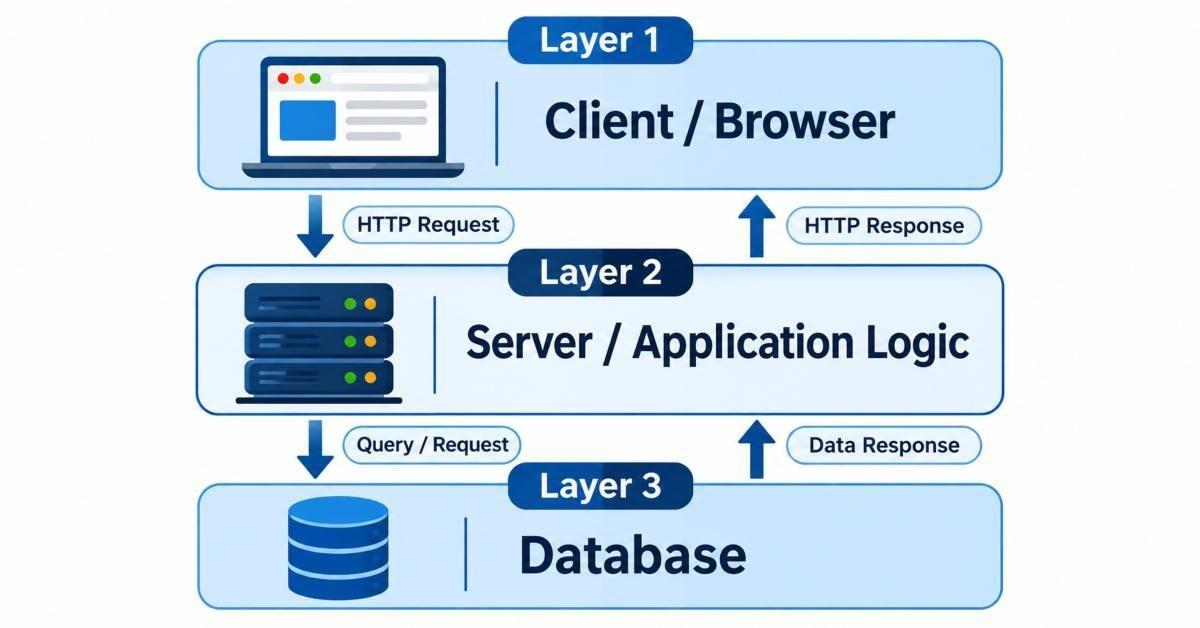
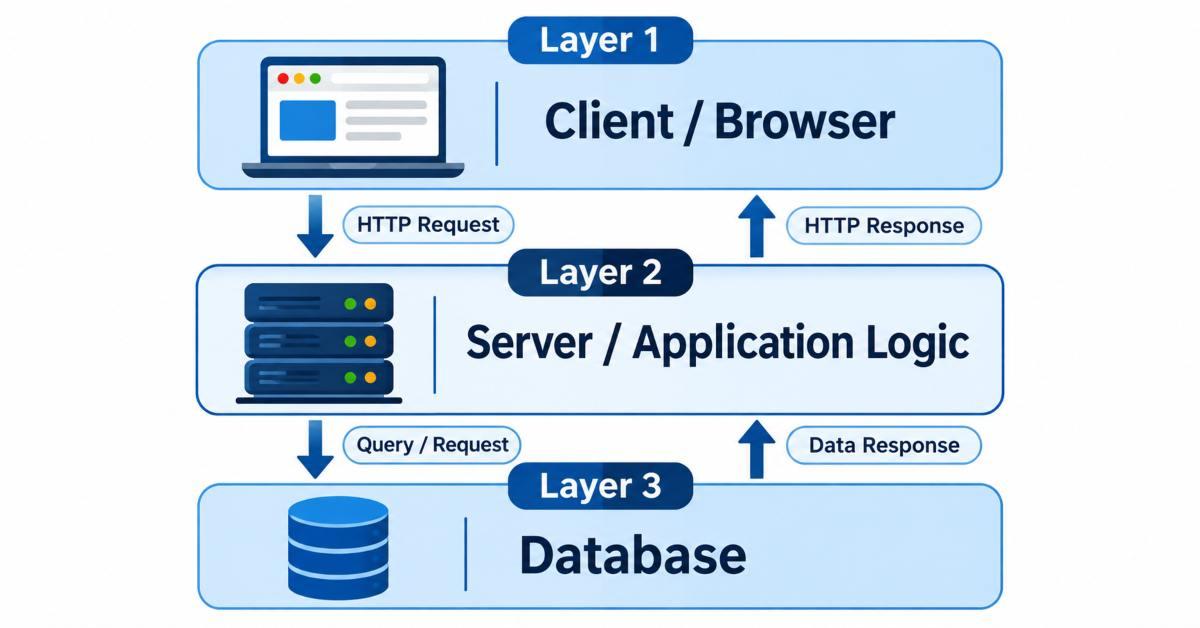
Back-end web development operates across three layers: the client browser, the server application logic, and the database.
Every time a user logs into an account, submits a form, processes a payment, or retrieves personalized content from a website, they are relying on back-end web development to make it happen. The back end is the invisible engine that powers everything users depend on — data processing, authentication, server communication, and application logic that runs entirely out of sight.
While front-end development handles what visitors see and interact with in the browser, back-end development handles everything that happens on the server side. These two disciplines work in constant communication: the front end sends requests, and the back end processes them, retrieves or stores data, applies business logic, and returns the appropriate response.
Modern website design and development relies on a well-architected back end to function reliably, securely, and at scale. Without robust server-side programming, even the most beautifully designed website cannot deliver the dynamic functionality that users now expect as standard.
The team at Apso Tech brings together front-end and back-end expertise to deliver complete web solutions that are fast, secure, and built to grow with your business.
This guide explains how back-end web development works, the technologies and languages it relies on, the security practices it demands, and the best practices that separate reliable applications from fragile ones.
What Is Back-End Web Development?
Back-end web development refers to the server-side layer of a web application — the code, databases, servers, and application logic that users never see directly but depend on entirely. It is responsible for receiving requests from the browser, processing them, interacting with databases, and returning the correct data or response.
The back end encompasses everything that happens after a user's browser sends a request and before the response arrives back on their screen. This includes authenticating login credentials, querying a product database, calculating a shipping cost, processing a payment, or generating a personalized dashboard — all of which require server-side logic running away from the user's device.
The key distinction between front-end and back-end development is where the code runs and what it controls. Front-end code runs in the user's browser and governs visual presentation and interface interactions. Back-end code runs on a server and governs data, logic, security, and the communication that makes a web application genuinely functional.
How Back-End Web Development Works
Understanding the mechanics of back-end web development begins with understanding the request-response cycle — the fundamental pattern through which browsers and servers communicate.
Browser Requests and Server Responses
When a user performs an action on a website — clicking a button, submitting a form, or navigating to a new page — the browser sends an HTTP request to the web server. The server receives this request, determines what action is needed, and returns an HTTP response containing the requested data, a redirect, or an error message.
Application Logic and Data Processing
Between receiving a request and sending a response, the server executes application logic written by back-end developers. This logic might validate user credentials, calculate a result, enforce business rules, trigger an email notification, or transform data into a format the front end can display.
Communication Between Servers and Databases
Most back-end applications interact with one or more databases to store, retrieve, update, or delete data. When a user searches for a product, the back end constructs a database query, retrieves the matching records, formats the results, and passes them to the front end for display — all within milliseconds.
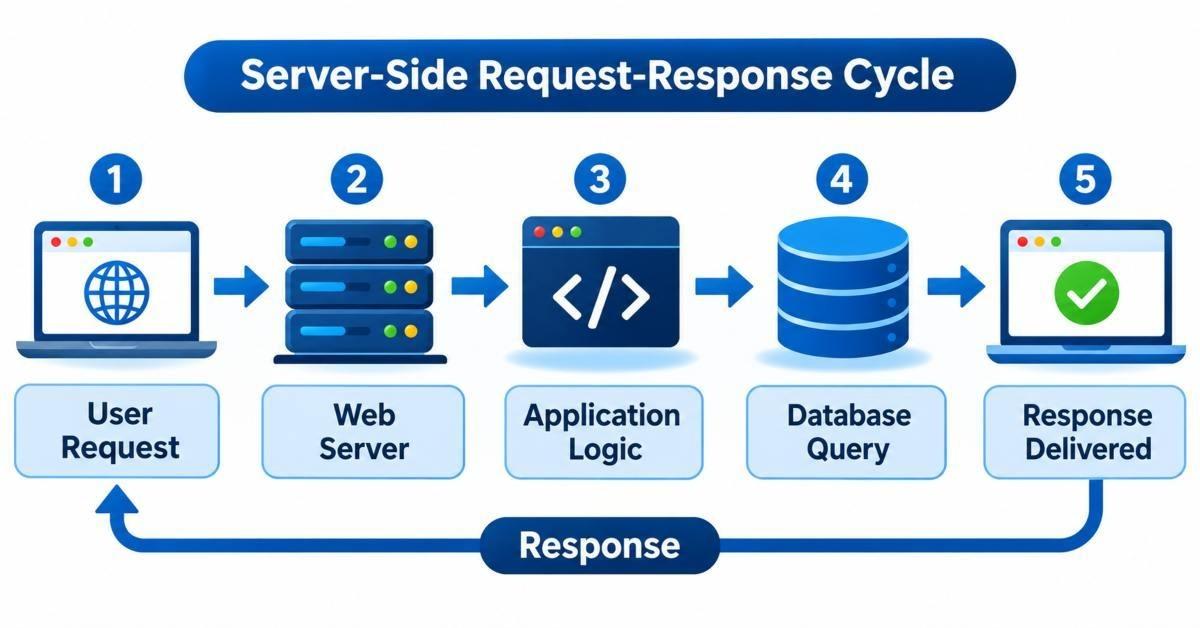
The server-side request-response cycle: from user request through web server, application logic, and database query to response delivered.
Core Components of Back-End Web Development
A complete back-end web development environment consists of several interdependent components that each play a specific role in handling requests, managing data, and delivering responses.
-
Web servers — Software such as Apache and Nginx receives incoming HTTP requests and routes them to the appropriate application code. The web server is the entry point through which all browser communication passes.
-
Server-side programming languages — The application logic is written in a server-side language such as PHP, Python, JavaScript (Node.js), Java, or Ruby. These languages process requests, run business logic, and interact with databases.
-
Databases and data storage — Databases store all persistent information — user accounts, product catalogues, orders, content, and settings. Back-end developers design database schemas, write queries, and manage data integrity.
-
APIs and application logic — Application Programming Interfaces (APIs) define how different parts of an application communicate with each other and with external services. Well-designed APIs are the backbone of modern, scalable back-end architecture.
Popular Back-End Web Development Languages
The choice of server-side programming language shapes the architecture, performance, and long-term maintainability of a web application. Each major language has distinct strengths suited to different types of projects.
PHP
PHP remains one of the most widely used server-side languages in the world, powering a significant portion of the web including WordPress, the dominant content management system. Its deep integration with MySQL, broad hosting support, and mature frameworks such as Laravel make it a reliable choice for content-driven websites and web applications.
Python
Python has become the preferred language for data-intensive web applications, machine learning integrations, and projects that prioritize readable, maintainable code. Frameworks such as Django and Flask provide structured environments for rapid back-end web development with strong security defaults.
JavaScript with Node.js
Node.js allows JavaScript — traditionally a front-end language — to run on the server, enabling full-stack JavaScript development. Its non-blocking, event-driven architecture makes it particularly well-suited to real-time applications, chat platforms, and high-concurrency APIs.
Java
Java is a strongly-typed, platform-independent language widely used in enterprise back-end web development. The Spring framework provides a comprehensive ecosystem for building large-scale, mission-critical applications that require high reliability and performance under heavy load.
C# and Other Server-Side Technologies
C# with the ASP.NET Core framework is the primary choice for back-end web development within Microsoft technology ecosystems. Ruby on Rails, Go, and Rust are also used in specific contexts — Rails for rapid application development, Go and Rust for applications requiring exceptional performance and concurrency.
Databases Used in Back-End Web Development
Databases are the persistent memory of a web application. Every user account, transaction record, piece of content, and configuration setting lives in a database — making the choice of database technology one of the most consequential back-end architecture decisions.
Relational Databases: MySQL and PostgreSQL
Relational databases organize data into structured tables with defined relationships between them. MySQL is the most widely deployed open-source relational database, particularly in combination with PHP. PostgreSQL offers advanced features including full-text search, JSON support, and complex query capabilities, making it the choice for applications with demanding data requirements.
NoSQL Databases: MongoDB
NoSQL databases store data in flexible document, key-value, or graph formats rather than structured tables. MongoDB, the leading document database, stores records as JSON-like documents, making it well-suited to applications where data structures change frequently or where large volumes of unstructured content must be stored efficiently.
Choosing a Suitable Database
The right database choice depends on the nature of the application's data, the complexity of relationships between records, expected query patterns, and scalability requirements. Many modern applications use multiple database technologies — a relational database for structured transactional data alongside a NoSQL store for session management, caching, or real-time features.
The Role of APIs in Back-End Web Development
Application Programming Interfaces are the communication protocols that allow different software components, applications, and services to exchange data in a structured, predictable way. In modern back-end web development, APIs are not an optional feature — they are the foundation of how web applications are built and how they connect with the broader digital ecosystem.
What Is an API?
An API defines a set of rules for how one piece of software can request information or actions from another. In web development, a back-end API accepts HTTP requests from the front end or from external clients, processes them according to defined logic, and returns structured data — typically formatted as JSON — in response.
REST APIs and JSON
REST (Representational State Transfer) is the most widely adopted architectural style for web APIs. RESTful APIs use standard HTTP methods — GET, POST, PUT, DELETE — to represent actions, and JSON (JavaScript Object Notation) as the data exchange format. JSON's lightweight, human-readable structure makes it the universal language of modern web API communication.
Connecting with Third-Party Services
APIs enable back-end systems to integrate with payment processors, mapping services, email delivery platforms, social media networks, shipping providers, and thousands of other third-party tools. Rather than building every capability from scratch, back-end developers compose applications from reliable external services connected through well-documented APIs.
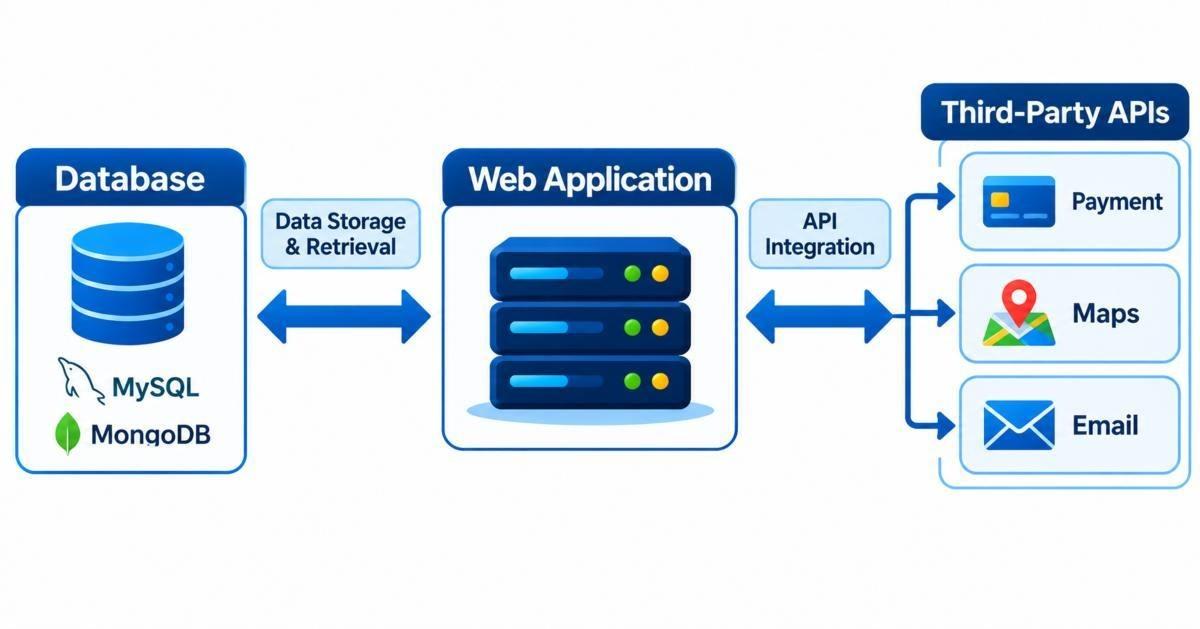
Back-end web development connects web applications to databases for data storage and to third-party APIs for extended functionality.
Back-End Web Development and Website Security
Security is not a feature added to a web application after development — it is a discipline woven into every layer of back-end web development. The server side controls access to sensitive data, processes financial transactions, and manages user identities, making it the primary target of malicious actors and the primary responsibility of back-end developers.
-
User authentication — Authentication verifies the identity of users attempting to access a system. Secure implementations use hashed and salted passwords, multi-factor authentication, secure session management, and industry-standard protocols such as OAuth 2.0 and JWT (JSON Web Tokens).
-
Authorization and access control — Once a user's identity is confirmed, authorization determines what they are permitted to do. Role-based access control (RBAC) ensures that users can only access the data and functionality appropriate to their permissions level.
-
Data encryption — Sensitive data must be encrypted both in transit (using HTTPS/TLS) and at rest (using database-level encryption). Encryption ensures that intercepted data is unreadable to unauthorized parties.
-
Input validation — Every piece of data received from a user or external source must be validated and sanitized on the server before processing. Failure to validate input is the root cause of SQL injection, cross-site scripting (XSS), and many other common attack vectors.
-
Secure database connections — Databases should be accessible only from the application server, with connections made over encrypted channels using least-privilege credentials. Prepared statements and parameterized queries must be used to prevent SQL injection attacks entirely.
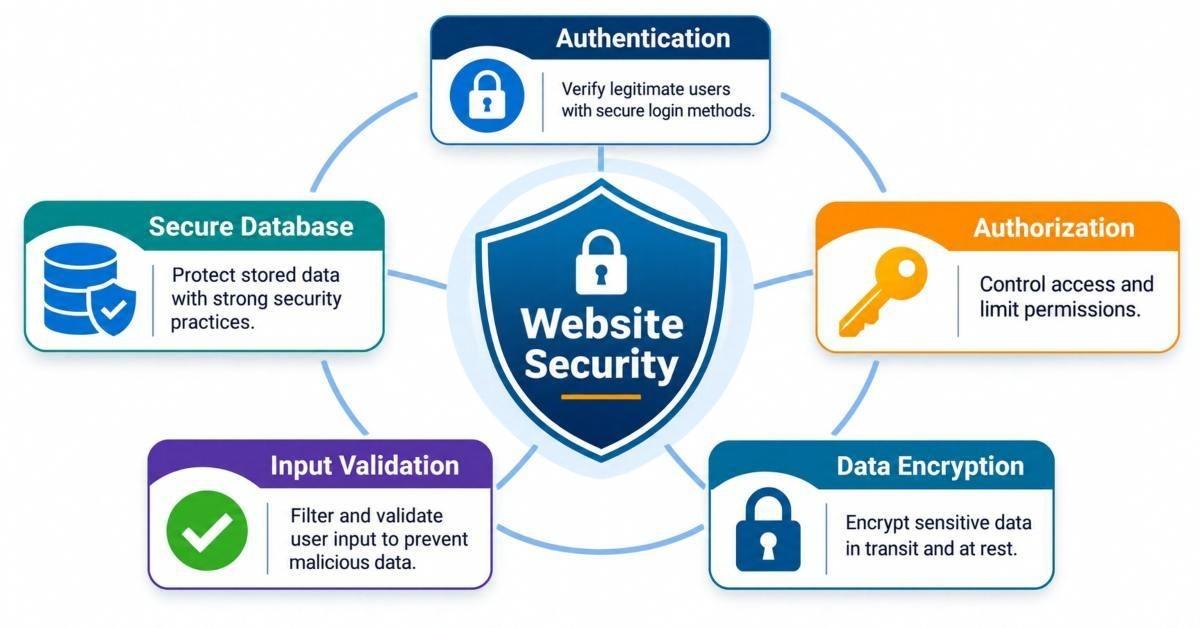
Back-end website security encompasses authentication, authorization, data encryption, input validation, and secure database protection.
Benefits of Professional Back-End Web Development
Investing in professional back-end web development delivers tangible, lasting advantages that directly affect how a web application performs, scales, and serves its users.
-
Better functionality — Custom back-end logic enables any feature a business requires — from dynamic pricing engines and recommendation algorithms to real-time notifications and complex multi-step workflows.
-
Reliable data management — Professional database design ensures data integrity, prevents duplication, and delivers fast, accurate query responses that keep the application responsive under real-world usage.
-
Improved security — A professionally built back end implements security at every layer, protecting user data, preventing unauthorized access, and reducing the risk of costly breaches or data loss.
-
Scalability — Well-architected back-end systems can handle growing traffic, expanding datasets, and new features without requiring a complete rebuild, protecting the initial development investment.
-
Integration with external services — Professional back-end web development enables seamless integration with payment gateways, CRM systems, analytics platforms, marketing tools, and any other service the business depends on.
Common Back-End Web Development Challenges
Even experienced development teams encounter consistent challenges in back-end web development. Anticipating these issues helps teams design more resilient systems and respond more effectively when problems arise.
-
Database performance — Poorly written queries, missing indexes, or unoptimized schema design can cause significant slowdowns as datasets grow, requiring ongoing database performance monitoring and optimization.
-
Server downtime — Hardware failures, software errors, and deployment issues can take applications offline. Redundant server configurations, automated health checks, and robust deployment pipelines minimize downtime risk.
-
Security vulnerabilities — New vulnerabilities are discovered constantly. Regular dependency updates, security audits, penetration testing, and adherence to OWASP security guidelines are essential ongoing responsibilities.
-
API errors and reliability — Back-end systems that depend on third-party APIs must handle failures, rate limits, and breaking changes gracefully, with appropriate error handling, retry logic, and fallback behaviors.
-
Managing increasing traffic — Applications that grow in popularity must scale their back-end infrastructure to handle concurrent requests without degraded performance, often requiring load balancing, caching layers, and horizontal scaling strategies.
Best Practices for Back-End Web Development
Following established best practices throughout the development process produces back-end systems that are secure, maintainable, and built to withstand the demands of real-world use.
-
Write maintainable code — use clear naming conventions, modular architecture, and thorough documentation so the codebase remains understandable and extensible over time
-
Validate all user input on the server side, regardless of any front-end validation already in place — never trust data from external sources
-
Protect sensitive information — store passwords using strong hashing algorithms (bcrypt, Argon2), never log sensitive data, and use environment variables for credentials and API keys
-
Optimize database queries — use indexes strategically, avoid N+1 query problems, profile slow queries regularly, and cache frequently accessed data where appropriate
-
Test all APIs and server functions — write unit tests for individual functions, integration tests for API endpoints, and conduct load testing to verify performance under peak traffic
-
Monitor application performance continuously — use logging, error tracking (such as Sentry), and performance monitoring tools to detect and respond to issues before users are affected
-
Apply the principle of least privilege throughout — users, services, and processes should have only the minimum permissions required to perform their function
How to Choose Back-End Web Development Services
The back-end development partner you choose has a direct and lasting impact on the security, reliability, and scalability of your web application. Evaluating providers carefully against the following criteria helps ensure you receive a solution built to perform.
-
Understand project requirements first — Before approaching any provider, clearly define the functionality your application needs, the volume of users it must support, the integrations it requires, and the data it will handle.
-
Evaluate technical expertise — Review the provider's experience with languages, frameworks, and databases relevant to your project. Ask for case studies or examples of comparable back-end systems they have built and maintained.
-
Review security practices — Ask directly how they handle authentication, data encryption, input validation, and dependency management. Security should be treated as a core competency, not an afterthought.
-
Consider scalability and architecture — Confirm that the solution will be designed with future growth in mind — not just the current requirements — and that the architecture can accommodate increasing traffic and new features without structural rework.
-
Discuss maintenance and long-term support — Back-end systems require ongoing maintenance, security patching, performance monitoring, and periodic updates. Ensure the provider offers a clear and reliable post-launch support structure.
Conclusion: Building Reliable Websites with Back-End Web Development
Back-end web development is the foundation on which reliable, secure, and scalable web applications are built. Every login that works, every payment that processes correctly, every piece of personalized content that loads at the right moment exists because a well-engineered server-side system made it possible.
The technologies — from PHP and Python to Node.js and PostgreSQL — are tools in service of a larger goal: delivering functionality that users can depend on, protecting the data they entrust to the system, and building infrastructure that grows alongside the business it serves.
Businesses that invest in professional back-end web development invest in the long-term performance, security, and credibility of their digital presence. The right back-end architecture is not just a technical decision — it is a strategic one that determines how well a website serves its users today and how effectively it can evolve to meet the demands of tomorrow.


