

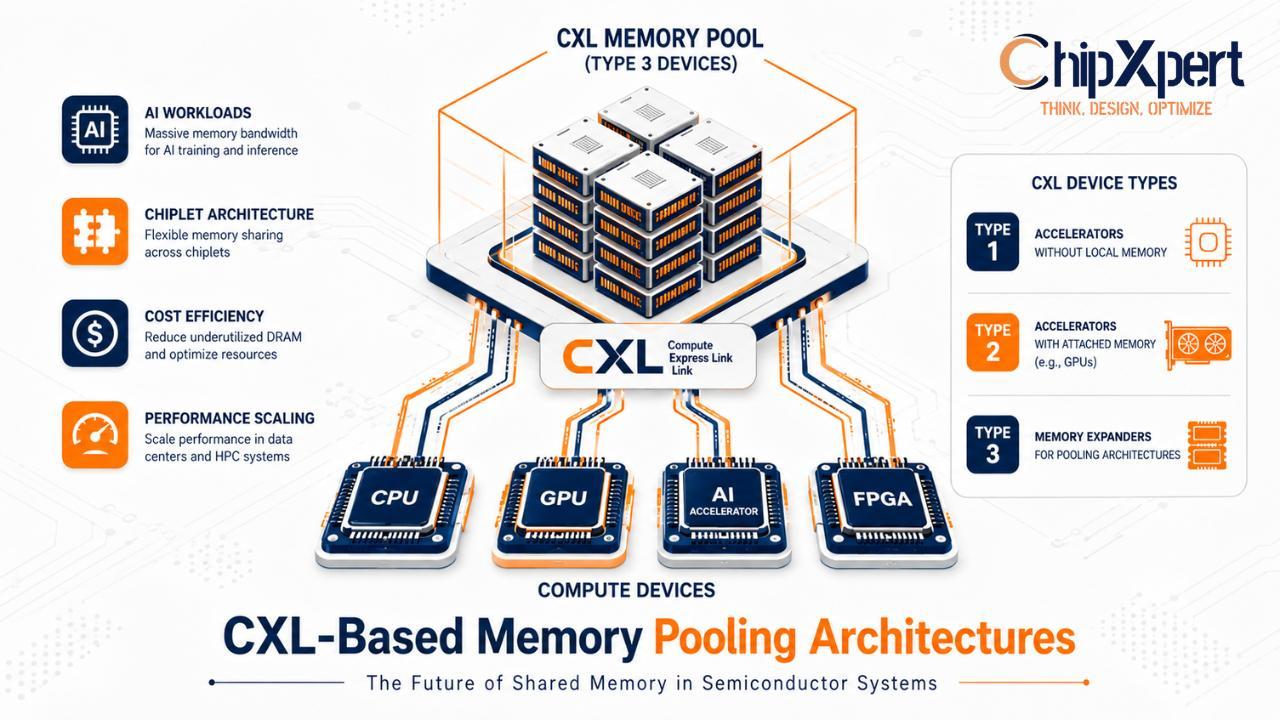
Compute Express Link (CXL) Attached Memory Module for AI Market to Reach USD 2,140.0 million by 2034 as Coherent Memory Architectures Expand

The rapid expansion of artificial intelligence workloads is increasing pressure on server memory capacity, particularly in systems supporting model training and inference. CXL-attached memory modules are gaining attention as a way to provide additional coherent memory beyond conventional CPU memory slots.
According to SemiconductorInsight, the global Compute Express Link (CXL) Attached Memory Module for AI Market reached USD 850.0 million in 2025 and is projected to attain USD 2,140.0 million by 2034, reflecting a CAGR of 10.8% between the headline market values over the 2026–2034 forecast period. These products are assembled memory devices that expose additional capacity to compatible servers over a coherent interconnect.
Explore the complete Compute Express Link (CXL) Attached Memory Module for AI Market analysis: https://semiconductorinsight.com/report/compute-express-link-cxl-attached-memory-module-for-ai-market/
Why Is CXL Attached Memory Module for AI Technology Becoming Important in Semiconductor Manufacturing?
CXL-attached memory modules provide additional memory capacity to compatible servers and accelerator platforms. A finished module generally contains DRAM memory chips, a protocol controller, power circuitry and board-level connectors that expose capacity over a coherent interconnect.
Unlike a controller chip sold as a standalone component, the value of an attached memory module resides in the assembled and testable memory product supplied to a server or accelerator operator.
The technology is relevant to AI systems that need greater usable memory for training data and inference context. It can help operators extend accessible DRAM without permanently overprovisioning local DIMMs in every compute node.
Commercial adoption depends on validated module configurations, host firmware, memory placement and reliable data handling. Capacity alone does not determine whether an attached module is suitable for a particular AI workload.
Market Growth Is Closely Linked to AI Memory Requirements
One of the major trends influencing the CXL Attached Memory Module for AI Market is the increasing memory demand associated with AI training and inference. These workloads can require large working sets and additional capacity beyond conventional server configurations.
Semiconductor Insight identifies DRAM-based attached modules as the dominant category, accounting for an estimated 84% of early module-market value. Persistent nonvolatile memory attachments represent approximately 16%.
The report identifies training accelerator environments as approximately 37% of application purchases, while inference accelerators contribute about 33%. Hybrid AI deployments account for another estimated 22%.
The opportunity is increasingly linked to the ability to keep attention-state data and other working information available to AI services while maintaining reliable throughput and error handling.
Receive your Free Sample Report today: https://semiconductorinsight.com/download-sample-report/?product_id=152847
DRAM-Based Attached Modules Lead the Technology Mix
DRAM-based attached modules represent an estimated 84% of early market value, supported by established DDR component supply chains and recognizable server form factors.
Persistent NVM attachments account for a smaller estimated 16% share and are associated with specialized retention requirements and software integration considerations.
The finished module can include memory chips, controller logic, voltage regulation, power-loss protection and telemetry. These components must operate together within the electrical, thermal and mechanical requirements of a target server. The report highlights the importance of system qualification. A module must be recognized by the server, placed correctly through NUMA or hardware-tier policies, and maintain data integrity when a device fails.
Training and Inference Accelerators Drive Application Demand
Training accelerator environments account for an estimated 37% of application purchases. These deployments can require additional memory capacity to support large model data and associated processing workloads.
Inference accelerators contribute approximately 33% of demand. The ability to retain attention-state data and other working information is an important consideration for inference services.
Hybrid AI workloads represent another estimated 22% of the market, reflecting systems that combine training and inference requirements within shared infrastructure.
Other applications also contribute to the market, with purchasing decisions influenced by throughput consistency, error handling, host firmware and the practical benefits of additional coherent memory.
Hyperscale AI Operators Influence Module Qualification
North America accounts for an estimated 42% of current module demand, supported by hyperscale AI operators evaluating ways to increase accessible DRAM beyond conventional CPU memory slots.
Asia-Pacific contributes approximately 33%, combining South Korean memory production with server ecosystems in China, Japan and Taiwan.
Europe represents about 17% of market demand, while South America accounts for approximately 5% and the Middle East and Africa around 3%.
The report notes that server-platform certification governs how quickly regional AI investment converts into installed CXL memory modules. Manufacturing location and final system-purchase location are not necessarily the same.
Additional Capacity Must Be Balanced Against Latency and Reliability
CXL-attached modules can provide greater accessible memory capacity for AI systems without requiring every compute node to be equipped with permanently overprovisioned local DIMMs.
The market opportunity is linked to the practical value of added coherent memory for training data, inference context and attention-state workloads. Module suppliers must demonstrate that the additional capacity supports real application requirements.
However, attached memory can introduce access latency and operating complexity. Buyers need to evaluate throughput consistency, error handling, host firmware and memory-placement policies rather than relying only on headline gigabyte capacity.
The report emphasizes that stable latency, data integrity and warranty support can influence purchasing decisions, particularly for AI operators running expensive accelerator fleets.
Access the Full Report for In-Depth Insights: https://semiconductorinsight.com/report/compute-express-link-cxl-attached-memory-module-for-ai-market/
Platform Qualification and Data Integrity Remain Key Challenges
Despite its advantages, CXL-attached memory module adoption faces integration and qualification challenges. A server must recognize the memory device and manage its placement correctly.
The system must isolate shared resources and retain data integrity when a device fails. These requirements make firmware, memory management and platform testing important parts of product readiness.
Manufacturing combines DRAM fabrication, controller or interface silicon, multilayer board assembly, electrical screening, firmware and certification. Finished modules must meet connector, voltage, thermal, mechanical and software requirements.
The report also highlights signal-integrity testing, burn-in and system-compatibility screening. High-speed interfaces and large numbers of modules in a rack increase the importance of reliable production testing.
The report also highlights signal-integrity testing, burn-in and system-compatibility screening. High-speed interfaces and large numbers of modules in a rack increase the importance of reliable production testing.
Where Are the Biggest Opportunities Emerging?
Several applications and technology developments could provide additional opportunities for companies participating in the CXL ecosystem.
AI training provides an important opportunity as large model workloads require additional memory capacity and reliable access to data across accelerator systems.
Inference acceleration is another growth area, particularly where services need to keep attention-state data available and manage large working sets.
Hybrid AI deployments could support demand for modules that operate across mixed training and inference environments. Their commercial value depends on validated throughput and memory placement.
Memory manufacturers and server OEMs can also benefit from collaboration across DRAM, controller, module assembly and platform certification, helping turn component capability into deployable products.
Compute Express Link (CXL) Attached Memory Module for AI Market Segmentation
The report evaluates the market by memory type, application, end user, architecture, performance tier and region, providing a detailed view of the modules and AI platforms shaping demand.
By type, the market is divided into:
DRAM-based attached modules
Persistent NVM attached modules
Other memory configurations
By application, the market covers:
Training accelerators
Inference accelerators
Hybrid AI workloads
Others
Others
Additional segmentation is provided by end user, architecture, deployment model or other report-specific dimensions.
The report evaluates these dimensions to distinguish the technical and commercial requirements of the different CXL product categories.
This segmentation distinguishes the underlying memory media and AI workload requirements. It also considers end-user categories, system architectures and performance tiers that influence the selection of attached memory modules.
View the complete Compute Express Link (CXL) Attached Memory Module for AI Market segmentation and forecast: https://semiconductorinsight.com/report/compute-express-link-cxl-attached-memory-module-for-ai-market/
Regional CXL Attached Memory Module for AI Market Outlook
North America represents approximately 42% of current demand, supported by hyperscale AI procurement programs and the ability of large operators to validate new server hardware.
Asia-Pacific accounts for around 33%, combining South Korean memory production with computing and server ecosystems in China, Japan and Taiwan. The region is an important part of the memory-module supply chain.
Europe represents approximately 17% of market demand, with Germany, France, Italy, the United Kingdom and Spain included in the report's regional coverage.
South America contributes about 5% and the Middle East and Africa around 3%. The report also covers country-level markets including Brazil, Mexico, Chile, Argentina, Colombia, the United Arab Emirates, Saudi Arabia, Qatar and South Africa.
Competitive Landscape and Key Companies
The CXL Attached Memory Module for AI Market includes memory manufacturers, semiconductor suppliers, controller and connectivity companies, and system vendors serving AI infrastructure.
Semiconductor Insight profiles Intel, Samsung Electronics, Micron Technology, SK hynix, NVIDIA, AMD, Google, Dell Technologies, Hewlett Packard Enterprise, Lenovo, Cisco Systems, Marvell Technology, Broadcom, Qualcomm and IBM.
Competition is influenced by memory-media capability, controller integration, module reliability, system compatibility and the ability to qualify products with server and AI platform providers. The report distinguishes physical module manufacturers from companies that influence demand through platform integration.
What Does the Compute Express Link (CXL) Attached Memory Module for AI Market Report Cover?
The Semiconductor Insight study provides analysis of market size, sales, revenue, competitive positioning, industry dynamics, segmentation and regional performance for CXL-attached memory modules used in AI systems.
The report examines DRAM and persistent NVM modules, manufacturing capacity, controller integration, module assembly, system qualification, firmware and reliability requirements. It also evaluates market drivers, restraints and technology developments.
The study provides segmentation by memory type, application, end user, architecture and performance tier, alongside regional analysis across North America, Asia-Pacific, Europe, South and Central America, and the Middle East and Africa.
Key Questions Answered by the Study
The report helps industry participants evaluate questions including:
What is the current CXL Attached Memory Module for AI Market size?
How large is the market projected to become by 2034?
What is the expected CAGR during 2026–2034?
Which memory types are included in the market?
What share is held by DRAM-based attached modules?
How are training and inference accelerators influencing demand?
What role does CXL-attached memory play in AI workloads?
Which region represents the largest market?
What qualification challenges affect module adoption?
Why are latency and data integrity important for AI memory modules?
Who are the key companies profiled in the study?
What factors influence the commercial deployment of CXL-attached memory?
Explore the full Compute Express Link (CXL) Attached Memory Module for AI Market forecast and competitive analysis: https://semiconductorinsight.com/report/compute-express-link-cxl-attached-memory-module-for-ai-market/
Get a Sample Report copy for free: https://semiconductorinsight.com/download-sample-report/?product_id=152847
About Semiconductor Insight
Semiconductor Insight provides market intelligence and industry research covering semiconductor technologies, electronic components, advanced manufacturing systems and related technology markets. Its research focuses on market sizing, forecasting, competitive landscapes, technology trends, segmentation and regional analysis to support strategic decision-making across the semiconductor ecosystem.
Contact Semiconductor Insight
Website: www.semiconductorinsight.com


