

Compute Express Link (CXL 3.0) Switch Chip for Memory Pooling Market to Reach USD 1,300.0 million by 2034 as Coherent Memory Architectures Expand

The need to allocate memory resources more efficiently across AI servers and high-performance computing environments is increasing interest in coherent memory fabrics. Against this backdrop, CXL 3.0 switch chips are emerging as important components for connecting multiple hosts and shared memory devices.
According to SemiconductorInsight, the global Compute Express Link (CXL 3.0) Switch Chip for Memory Pooling Market accounted for USD 420.0 million in 2025 and is expected to reach USD 1,300.0 million by 2034, representing 13.4% growth between the headline market values over the 2026–2034 outlook. These switch chips route coherent transactions among hosts and memory endpoints in shared-memory fabrics.
Explore the complete Compute Express Link (CXL 3.0) Switch Chip for Memory Pooling Market analysis: https://semiconductorinsight.com/report/compute-express-link-cxl-3-0-switch-chip-for-memory-pooling-market/
Why Is CXL 3.0 Switch Chip for Memory Pooling Technology Becoming Important in Semiconductor Manufacturing?
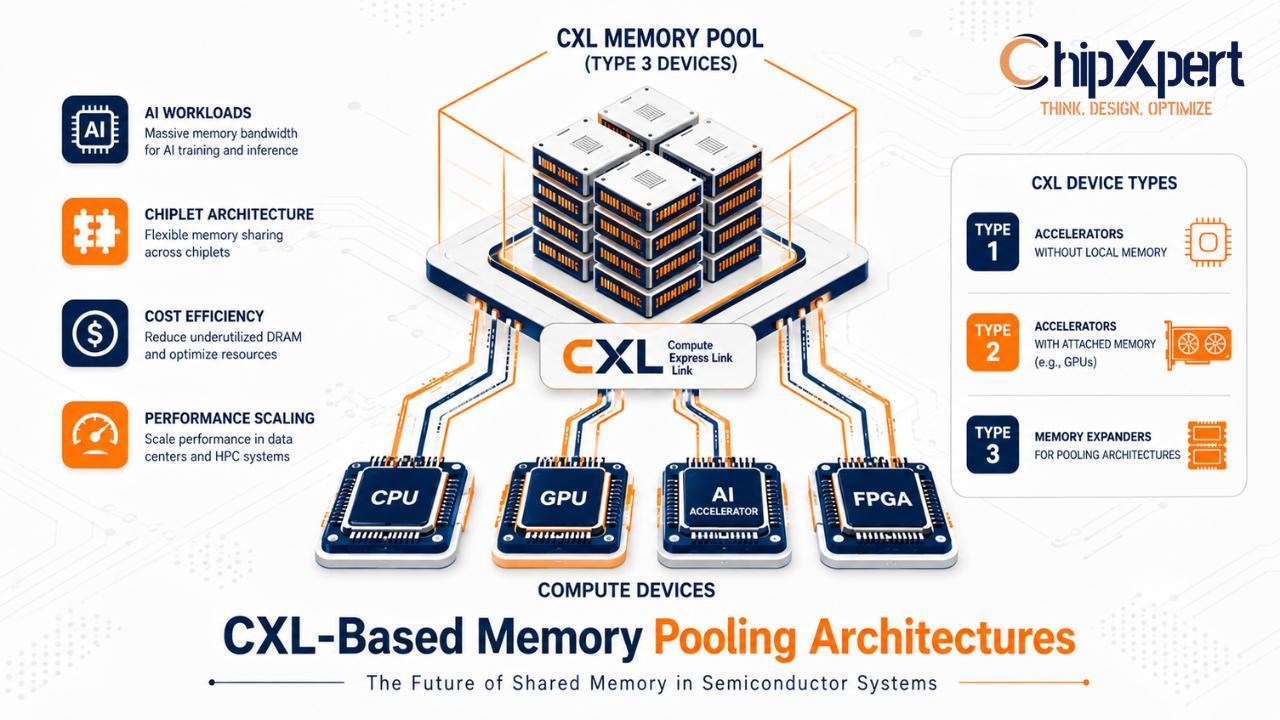
CXL 3.0 switch chips support memory pooling by connecting multiple coherent endpoints and hosts while maintaining the routing rules needed to access shared DRAM resources. This allows compute nodes to use memory capacity beyond their locally attached memory channels.
A fabric switch performs a different role from a Type 3 memory-controller chip or the DRAM module that contains physical memory capacity. It manages paths, transaction traffic and isolation so that multiple systems can access authorized resources.
The technology is relevant to cloud and server architectures where memory demand varies across workloads. Pooling can enable capacity to be allocated among nodes rather than permanently binding every memory card to a single processor.
CXL 3.x introduces multi-level fabric capabilities beyond earlier single-switch configurations. However, routing, resource ownership and tenant isolation remain important implementation considerations.
Market Growth Is Closely Linked to AI and Shared-Memory Architectures
One of the major trends influencing the CXL 3.0 switch-chip market is the growing requirement to move large working sets among systems with different memory needs. AI training and other data-intensive workloads can create variable demand across server nodes.
Semiconductor Insight identifies AI training as the largest application category, accounting for roughly 44% of demand. High-performance computing contributes approximately 31%, while virtual desktop infrastructure and other applications make up the balance.
Cloud service providers represent nearly 62% of purchasers, giving them substantial influence over switch security, fabric management, failover and firmware requirements.
The ability to share memory resources across hosts is therefore a key commercial driver, although deployment depends on the successful validation of complete multi-host topologies.
Receive your Free Sample Report today: https://semiconductorinsight.com/download-sample-report/?product_id=148513
CXL 3.x Fabric Capabilities Are Expanding the Technology Landscape
CXL 3.x introduces multi-level fabric features that can support larger memory pools and more complex connections between hosts and devices.
The report identifies CPU-centric switches as the leading type, representing an estimated 48% of initial market value. GPU-centric solutions contribute about 30%, while specialized accelerator-centric silicon accounts for approximately 22%.
The ecosystem includes switch-chip developers as well as processor manufacturers, infrastructure-chip vendors, memory suppliers, server OEMs and cloud customers. These participants can influence deployment through product development, integration or procurement. Semiconductor Insight notes that disclosed switching hardware and product sampling milestones indicate technology progress, but do not establish that every vendor has a verified standalone CXL 3.x switching product.
AI Training and High-Performance Computing Create Demand
AI and machine-learning training workloads account for roughly 44% of application demand. These workloads can involve large datasets and changing memory requirements across multiple computing nodes.
High-performance computing represents approximately 31% of demand. Scientific and technical systems can use shared-memory architectures to support specialized workloads and improve resource allocation.
Virtual desktop infrastructure is another application covered by the report. Shared memory resources can support infrastructure designs in which capacity is allocated according to changing user and workload requirements.
Other applications also contribute to the market, with demand influenced by the ability to manage coherent traffic, resource ownership and isolation across connected systems.
Cloud Providers Shape Switch Procurement and Validation
Cloud service providers represent nearly 62% of purchasers, making them a central influence on switch-chip requirements. Their deployment scale gives them a strong role in defining security, fabric management, failover and firmware expectations.
North America holds an estimated 41% share of initial revenue, reflecting early hyperscale procurement and U.S. switching-silicon engineering.
Asia-Pacific accounts for approximately 32%, with China, Taiwan, South Korea and Japan active in relevant computing infrastructure. Europe represents about 19%, while South America and the Middle East and Africa together contribute around 8%.
These regional positions describe demand-side market activity rather than the geographic distribution of all chip foundries or device-testing facilities.
Memory Pooling Offers Flexibility but Requires System-Level Control
Memory-pooling switch chips can help systems share memory resources across multiple hosts, potentially reducing the need to dedicate every memory card to a single processor.
The market includes switching functions used in multi-host memory fabrics, not the separate DRAM contents of pooled devices. This distinction is important when evaluating the economics of switch-chip deployments.
However, the value of pooling depends on effective routing, resource ownership and tenant isolation. System operators must ensure that hosts can access only authorized memory resources and that fabric reconfiguration does not expose stale or unauthorized data.
The report highlights that commercial deployments require more than link training. Independent verification of mixed-vendor performance, firmware and fabric management remains essential.
Access the Full Report for In-Depth Insights: https://semiconductorinsight.com/report/compute-express-link-cxl-3-0-switch-chip-for-memory-pooling-market/
Routing and Tenant Isolation Remain Key Challenges
Despite the opportunity, CXL 3.0 memory-pooling systems face technical challenges involving multi-host routing, resource allocation and operational isolation.
A switch ASIC must combine physical interfaces, coherent-transaction handling, routing tables, buffer management, error controls and a management plane. Firmware must support reconfiguration without compromising memory security.
Manufacturing requires ASIC architecture work, verification IP, advanced logic fabrication, packaging and board validation. High-speed interfaces also create thermal, electrical and yield-management challenges.
Engineers must test realistic multi-host topologies and rare failure cases. Reliable link training, protocol behavior, continuous-operation stability and interoperability are necessary before production pooling can be supported.
Engineers must test realistic multi-host topologies and rare failure cases. Reliable link training, protocol behavior, continuous-operation stability and interoperability are necessary before production pooling can be supported.
Where Are the Biggest Opportunities Emerging?
Several applications and technology developments could provide additional opportunities for companies participating in the CXL ecosystem.
AI training is a major opportunity because large working sets must be moved among machines with different memory requirements. Shared memory fabrics can support more flexible resource allocation.
High-performance computing provides another opportunity as scientific and technical systems evaluate coherent access to shared memory resources.
Cloud service providers can drive adoption through large procurement programs and detailed requirements for security, failover, fabric management and firmware support.
The development of multi-level CXL 3.x fabrics may create further opportunities for switch-chip suppliers able to demonstrate validated interoperability and reliable resource isolation.
Compute Express Link (CXL 3.0) Switch Chip for Memory Pooling Market Segmentation
The report evaluates the market by switch type, application, end user, architecture integration and business model, providing a detailed view of the products and deployments shaping demand.
By type, the market is divided into:
CPU-centric switches
GPU-centric switches
Accelerator-centric switches
By application, the market covers:
AI/ML training workloads
High-Performance Computing (HPC)
Virtual Desktop Infrastructure (VDI)
Others
Others
Additional segmentation is provided by end user, architecture, deployment model or other report-specific dimensions.
The report evaluates these dimensions to distinguish the technical and commercial requirements of the different CXL product categories.
This segmentation reflects the different host and workload requirements of memory-pooling fabrics. It also distinguishes switch architectures and commercial models used to deliver coherent connectivity across computing systems.
View the complete Compute Express Link (CXL 3.0) Switch Chip for Memory Pooling Market segmentation and forecast: https://semiconductorinsight.com/report/compute-express-link-cxl-3-0-switch-chip-for-memory-pooling-market/
Regional CXL 3.0 Switch Chip for Memory Pooling Market Outlook
North America represents an estimated 41% share of initial revenue, supported by early hyperscale procurement and U.S. switching-silicon engineering. Large cloud engineering teams have led trials of coherent, shareable memory at server and rack scale.
Asia-Pacific accounts for approximately 32% of demand, with China, Taiwan, South Korea and Japan active in relevant computing infrastructure and semiconductor supply chains.
Europe represents about 19% of the market, with Germany, France, the United Kingdom, Italy and Spain included in the report's regional coverage.
South America and the Middle East and Africa together account for around 8%. The report includes country-level analysis covering Brazil, Mexico, Chile, Colombia, Argentina, the United Arab Emirates, Saudi Arabia, Qatar and South Africa.
Competitive Landscape and Key Companies
The CXL 3.0 switch-chip market includes semiconductor suppliers, processor manufacturers, infrastructure-chip companies, memory vendors, server OEMs and cloud service providers.
Semiconductor Insight profiles Intel, Marvell Technology, Broadcom, Samsung Electronics, NXP Semiconductors, Qualcomm, AMD, Huawei, Alibaba Cloud, Google Cloud, Microsoft Azure, NVIDIA, Cisco Systems, Fujitsu and Dell Technologies.
Competition is influenced by switch architecture, protocol support, coherent routing, firmware maturity, multi-host validation and the ability to meet cloud-provider requirements. The report distinguishes companies developing switch silicon from organizations that purchase or integrate CXL technology.
What Does the Compute Express Link (CXL 3.0) Switch Chip for Memory Pooling Market Report Cover?
The Semiconductor Insight study provides analysis of market size, sales, revenue, competitive positioning, industry dynamics, segmentation and regional performance for CXL 3.0 switch chips used in memory pooling.
The report examines switch architectures, multi-host memory fabrics, ASIC design and production requirements, firmware, interoperability, routing and resource-isolation challenges. It also evaluates market drivers, restraints and technology developments.
The study provides segmentation by type, application, end user, architecture integration and business model, alongside regional analysis across North America, Asia-Pacific, Europe, South and Central America, and the Middle East and Africa.
Key Questions Answered by the Study
The report helps industry participants evaluate questions including:
What is the current CXL 3.0 switch-chip market size?
How large is the market projected to become by 2034?
What is the expected CAGR during the forecast period?
What is the role of a CXL switch chip in memory pooling?
How do CPU-centric, GPU-centric and accelerator-centric switches differ?
Which applications account for the largest demand?
Why are cloud service providers important purchasers?
What regional markets lead CXL 3.0 switch-chip demand?
What challenges affect multi-host routing and tenant isolation?
How do CXL 3.x fabric capabilities influence the market?
Who are the key companies profiled in the study?
What factors determine commercial qualification of memory-pooling switches?
Explore the full Compute Express Link (CXL 3.0) Switch Chip for Memory Pooling Market forecast and competitive analysis: https://semiconductorinsight.com/report/compute-express-link-cxl-3-0-switch-chip-for-memory-pooling-market/
Get a Sample Report copy for free: https://semiconductorinsight.com/download-sample-report/?product_id=148513
About Semiconductor Insight
Semiconductor Insight provides market intelligence and industry research covering semiconductor technologies, electronic components, advanced manufacturing systems and related technology markets. Its research focuses on market sizing, forecasting, competitive landscapes, technology trends, segmentation and regional analysis to support strategic decision-making across the semiconductor ecosystem.
Contact Semiconductor Insight
Website: www.semiconductorinsight.com


