

US Enterprise Client Virtualization Market Forecast to Witness Strong CAGR Through 2034

Client Virtualization reduces vulnerability to malware and ransomware attacks by containing potential threats within isolated virtual containers that can be easily wiped and restored.
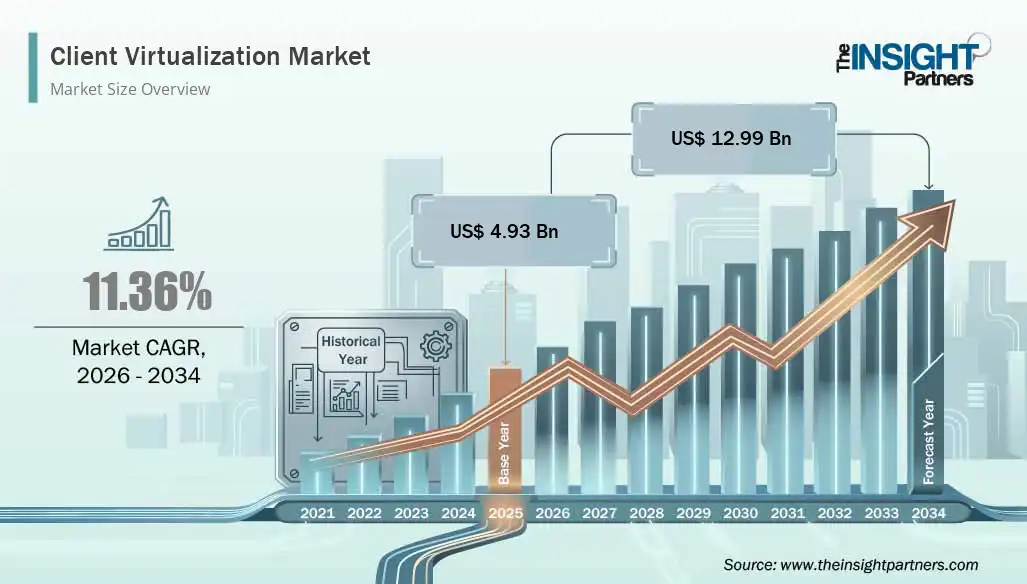
The Client Virtualization market size is expected to reach US$ 12.99 Billion by 2034 from US$ 4.93 Billion in 2025. The market is anticipated to register a CAGR of 11.36% during the forecast period 2026–2034.
What is driving the market?
Hybrid work permanence, stringent data-protection compliance, and the shift from capital-intensive hardware refreshes to cloud-based operational models are the principal growth drivers. Organizations are increasingly required to keep sensitive corporate and customer data off local endpoints while enabling seamless, low-latency access across personal and corporate devices. Financial institutions, healthcare providers, and government agencies are seeking virtualization architectures that centralize patching, audit logging, and access governance without degrading application responsiveness.
The transition is moving beyond traditional on-premises Virtual Desktop Infrastructure (VDI) toward cloud-native DaaS and hybrid multi-cloud deployments. Suppliers are investing in GPU-accelerated virtual workspaces, automated provisioning, thin-client endpoint ecosystems, and AI-assisted resource optimization. Bandwidth constraints in emerging markets, licensing complexity, and the cost of high-performance graphics workloads remain important constraints.
Download Sample Report@ https://www.theinsightpartners.com/sample/TIPRE00003387
Which region leads?
North America leads the market, accounting for an estimated 32%–36% share in 2025. Growth is supported by mature cloud infrastructure, widespread enterprise DaaS adoption, and strict regulatory frameworks such as HIPAA and FedRAMP across healthcare, financial services, and federal agencies.
Europe holds an estimated 26%–30% share, driven by data-sovereignty rules, GDPR compliance, and cybersecurity mandates such as the EU NIS2 Directive that encourage local data-center hosting. Asia Pacific accounts for approximately 22%–26% and is the fastest-growing region, with strong expansion across India, China, Japan, and ASEAN economies fueled by digital transformation, IT/BPO workforce scaling, and edge-supported VDI for manufacturing.
Which segment leads?
Desktop Virtualization (VDI & DaaS) is the leading solution segment, representing an estimated 50%–55% of market revenue in 2025. Its position is supported by the need to deliver complete, standardized Windows and Linux workspaces remotely while retaining centralized control over OS updates and security policies. Cloud-based DaaS is the fastest-growing deployment model, gaining share rapidly as organizations favor predictable subscription pricing and elastic scaling.
By end-use industry, BFSI (Banking, Financial Services, and Insurance) and IT & Telecom lead overall adoption due to strict compliance requirements and distributed engineering teams. Healthcare is identified as a high-growth vertical, as clinicians rely on virtual desktops to access electronic health records securely across shared terminals and remote devices without storing protected health information locally. By organization size, Large Enterprises dominate revenue share, while Small and Medium Enterprises (SMEs) represent the fastest-growing adopter group due to turnkey cloud subscriptions.
Which companies are prominent?
The competitive landscape features VMware (Broadcom), Microsoft, Citrix (Cloud Software Group), Amazon Web Services (AWS), Oracle, Red Hat, IBM, Cisco, Huawei, and Parallels as prominent market participants.
These companies compete across on-premises VDI platforms, cloud-native DaaS, application virtualization, hyperconverged infrastructure, and purpose-built thin clients. Strategic differentiation increasingly depends on multi-cloud interoperability, per-user subscription economics, latency optimization, zero-trust identity integration, and the ability to support graphics-intensive workloads at scale. The list reflects the market's competitive landscape rather than a revenue-ranked market-share table.
What is changing in 2026?
The market is shifting from basic remote-access enablement toward zero-trust, AI-ready, and cost-optimized digital workspaces. Enterprise IT specifications increasingly prioritize sovereign cloud hosting, automated session recording, conditional access controls, and predictable per-user monthly subscription models over perpetual software licenses. Regulatory enforcement under frameworks like the EU NIS2 Directive and regional data-localization mandates is accelerating the replacement of legacy VPN-and-laptop setups with pixel-streaming virtual desktops.
Vendors are accelerating lightweight thin-client hardware, integrated AI assistants for IT troubleshooting and dynamic resource scaling, and unified endpoint management. Procurement decisions are increasingly tied to total cost of ownership (TCO), license flexibility following recent vendor consolidation, and seamless integration with existing cloud ecosystems such as Microsoft Azure and AWS.
What are the major investment opportunities?
The strongest opportunities lie in cloud-native DaaS platforms, AI-driven workspace optimization, GPU-enabled virtual workstations, and sovereign cloud virtualization. Investment in automated capacity scaling, predictive latency management, and FinOps cost-governance tools can help enterprises control cloud compute expenses while maintaining native-like user experiences.
Additional opportunities include purpose-built thin-client devices for enterprise hot-desking, specialized virtual desktops for healthcare and engineering/CAD workflows, and managed DaaS offerings tailored for mid-market firms lacking dedicated VDI administrators. Asia Pacific and the Middle East offer attractive expansion potential as regional cloud data centers proliferate and SMEs bypass legacy on-premises infrastructure in favor of subscription-based virtual desktops. Investors should prioritize platforms that combine multi-cloud portability, strong zero-trust security posture, and transparent per-seat pricing.
Future Outlook
Through 2034, client virtualization is expected to evolve from a specialized remote-access tool into the default enterprise endpoint architecture. As edge computing, 5G connectivity, and cloud data-center footprints expand globally, latency barriers will continue to diminish, enabling real-time virtualized delivery of AI-heavy and 3D-rendered applications to low-cost endpoints. Over the next decade, widespread adoption of ephemeral, stateless virtual desktops provisioned dynamically per task and secured by continuous identity verification will reshape corporate hardware procurement, extend device lifecycles, and anchor enterprise cyber-resilience strategies.
Event Stream Processing Market Share, Growth & Demand by 2034
API Management Market Growth Opportunities and Forecast by 2031
Smart Advisor Market Key Companies Profile and SWOT Analysis by 2034
The Insight Partners is a leading market research and consulting firm delivering actionable insights through in-depth industry analysis and strategic intelligence. The firm supports clients across various industries in making informed decisions by providing comprehensive market forecasts, competitive assessments, and growth opportunities.
Contact Us:
If you have any queries about this report or if you would like further information, please contact us:
Contact Person: Ankit Mathur
E-mail: sales@theinsightpartners.com
Phone: +1-646-491-9876
Also Available in : Korean| German| Japanese| French| Chinese| Italian| Spanish


