

United States Challenger Bank Market Dynamics, Key Players, and Future Outlook up to 2034

Challenger Bank evolution continues to reshape global finance by blending cutting-edge fintech agility with the institutional trust and regulatory security of fully licensed banking. As digital adoption deepens worldwide, these institutions are firmly established as permanent pillars of modern everyday banking.
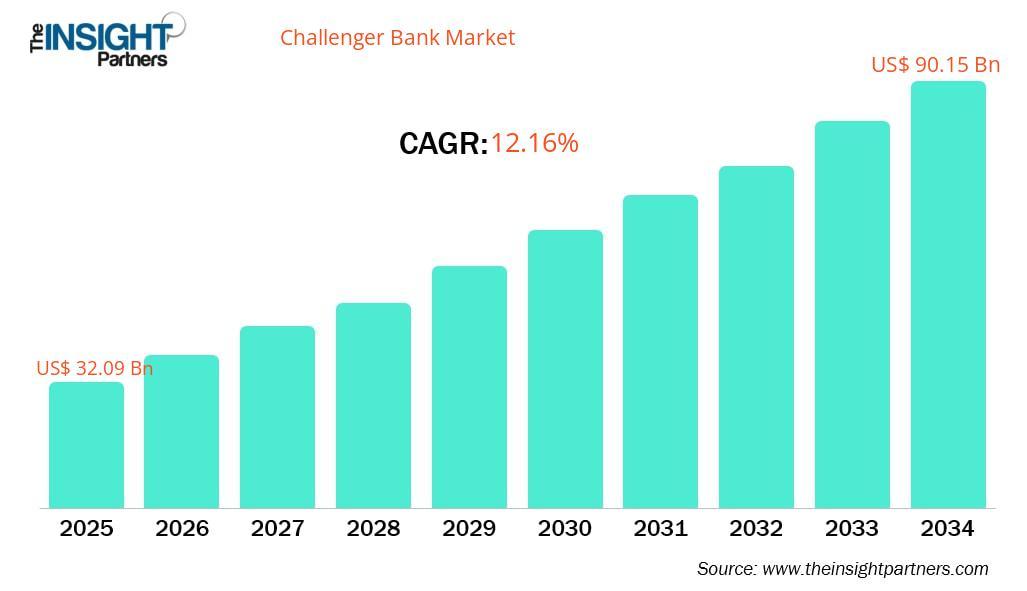
The Challenger Bank market is expected to register a CAGR of 12.16% from 2026 to 2034, with the market size expanding from US$ 32.09 Billion in 2025 to US$ 90.15 Billion by 2034.
What is driving the market?
Rising consumer preference for mobile-first banking, competitive zero- or low-fee pricing models, and supportive regulatory frameworks are the principal growth drivers. Challenger banks leverage lean, cloud-native infrastructures to deliver instant account opening, real-time KYC, automated budgeting, and 24/7 digital access without the overhead costs of physical branch networks. Retail consumers, digital natives, and small businesses are increasingly seeking seamless payments, cross-border transfers, and integrated credit tools that traditional institutions have been slower to modernize.
The transition is moving beyond basic digital checking accounts toward full-stack, profitable financial ecosystems. Providers are investing in full banking licenses, AI-driven personalization, automated underwriting, and embedded finance capabilities. However, stricter anti-money laundering (AML) and financial-crime compliance costs, rising customer acquisition expenses, cybersecurity threats, and pressure to achieve sustainable unit economics remain important constraints.
Download Sample Report@ https://www.theinsightpartners.com/sample/TIPRE00039139
Which region leads?
Europe leads the market in overall maturity and adoption, accounting for an estimated 30%–35% share in 2025, supported by progressive open banking mandates (such as PSD2 and its successors), high fintech penetration, and strong consumer trust in regulated digital banks across the U.K. and Germany. North America accounts for approximately 30%–35% of global share, driven by high smartphone adoption, demand for fee-free digital accounts, and partnerships between fintech brands and sponsor banks.
Asia Pacific holds an estimated 20%–22% share and represents the fastest-growing regional market. Growth is propelled by rapid smartphone penetration, government-backed digital payment rails, and large underbanked populations across India, China, Southeast Asia, and Australia.
Which segment leads?
Current and Checking Accounts represent the leading service segment, accounting for an estimated 28%–32% of market revenue in 2025. Its position is supported by everyday transaction volume, interchange fee revenue, salary direct deposits, and user-friendly mobile interfaces. Payments and Money Transfers follow closely at roughly 25% share, driven by peer-to-peer transfers, real-time payment rails, and multi-currency cards.
By end-user, the Personal/Retail Banking segment leads with over 50% share in 2025, reflecting broad adoption among Millennials and Gen Z consumers. Business and SME Banking is identified as the fastest-growing end-user segment, as startups, freelancers, and small enterprises adopt digital platforms for automated invoicing, expense management, and working-capital credit.
Which companies are prominent?
The competitive landscape includes Revolut Ltd., Monzo Bank Limited, Starling Bank Limited, N26 Bank SE, bunq B.V., Chime Financial, Varo Bank, Nu Holdings (Nubank), SoFi Technologies, and OakNorth Bank.
These companies compete across retail current accounts, high-yield savings, consumer and SME lending, cross-border FX, wealth management, and subscription tiers. Strategic differentiation increasingly depends on holding full domestic banking licenses, net interest margin expansion, low-cost deposit growth, and multi-product cross-selling rather than user growth alone. This list reflects key market participants rather than a revenue-ranked market-share table.
Straits Research
What is changing in 2026?
The market has shifted decisively from "growth at all costs" toward sustainable profitability, regulatory rigor, and full-service banking. In 2026, tighter supervisory scrutiny over Banking-as-a-Service (BaaS) sponsor-bank partnerships, enhanced fraud reimbursement rules, and stricter AML/KYC enforcement are pushing leading challengers to secure standalone banking charters and strengthen internal compliance infrastructure.
Providers are accelerating the rollout of AI-powered financial assistants, predictive cash-flow tools, and integrated wealth and credit products. Competition is no longer limited to user interface design; challenger banks are now competing directly with incumbent tier-one banks on deposit yields, mortgage and SME lending, and primary-account primacy.
What are the major investment opportunities?
The strongest opportunities lie in SME-focused digital banking, AI-driven credit underwriting, cross-border payment infrastructure, and embedded finance. Underserved small businesses represent a high-margin segment where integrated accounting, automated tax tools, and instant working-capital lines create strong customer retention and recurring subscription revenue.
Additional opportunities include localized digital banking expansion across high-growth emerging markets in Asia Pacific, Latin America, and the Middle East & Africa, where mobile-first platforms can onboard first-time formal banking customers at a fraction of legacy branch costs. Investors should prioritize platforms with proven unit profitability, proprietary technology stacks, diversified non-interchange revenue streams, and strong regulatory compliance readiness.
Future Outlook
Over the next decade, challenger banks are expected to evolve from standalone mobile apps into comprehensive, AI-orchestrated financial ecosystems. As open finance frameworks expand beyond basic payments into investments, insurance, and pensions, leading digital banks will act as centralized financial hubs for both retail and commercial users. Industry consolidation is also anticipated, with well-capitalized, profitable challengers acquiring niche fintechs to expand lending books and geographic footprints while forcing traditional banks to accelerate core modernization.
Event Stream Processing Market Share, Growth & Demand by 2034
API Management Market Growth Opportunities and Forecast by 2031
Smart Advisor Market Key Companies Profile and SWOT Analysis by 2034
The Insight Partners is a leading market research and consulting firm delivering actionable insights through in-depth industry analysis and strategic intelligence. The firm supports clients across various industries in making informed decisions by providing comprehensive market forecasts, competitive assessments, and growth opportunities.
Contact Us:
If you have any queries about this report or if you would like further information, please contact us:
Contact Person: Ankit Mathur
E-mail: sales@theinsightpartners.com
Phone: +1-646-491-9876


