

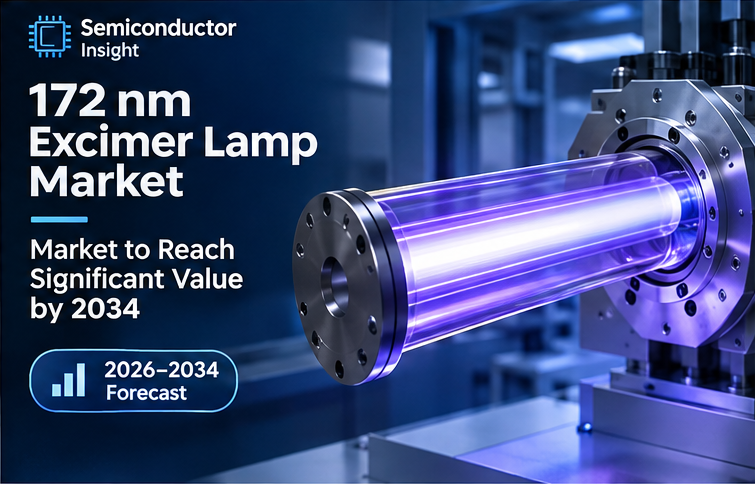
172 nm Excimer Lamp Market to Reach USD 538.3 Million by 2034 as Precision Surface Processing Expands

Industrial manufacturers are increasingly evaluating precision surface-treatment technologies that can clean and activate materials without direct contact or conventional wet-chemical processes. Within this environment, 172 nm excimer lamps are gaining attention for vacuum-ultraviolet applications involving electronic substrates, display materials, polymers and specialized manufacturing processes.
According to Semiconductor Insight, the 172 nm Excimer Lamp Market was valued at USD 260.2 million in 2025 and is projected to reach USD 538.3 million by 2034, growing at a CAGR of 8.4% over the 2026–2034 forecast period. The market is estimated at USD 282.1 million in 2026. Asia-Pacific held the largest regional share at approximately 44%, supported by electronic-substrate and display-manufacturing activity.
Explore the complete market analysis: https://semiconductorinsight.com/report/172-nm-excimer-lamp-market/
Why Is This Market Becoming Important?
A xenon excimer lamp produces vacuum-ultraviolet radiation concentrated around 172nm. The high-energy photons can cleave selected organic bonds and change surface wettability, supporting cleaning and activation of glass, silicon, polymers and other materials before coating, lamination or bonding.
Unlike broad-spectrum ultraviolet sources, 172nm lamps are used in controlled process environments where exposure distance, oxygen concentration and surface geometry influence treatment performance. Their applications include precision cleaning, surface activation and selected photochemical processes.
The technology is particularly relevant to production lines that require repeatable surface preparation. Its commercial value depends on lamp output, illumination uniformity, equipment integration, operating life and the ability to demonstrate improvements in downstream coating or bonding processes.
Industrial Power Configurations Are Expanding Adoption
The 20–100W category represents the largest type segment, accounting for an estimated 63% of lamp value. Products below 20W contribute approximately 25%, particularly in compact laboratory and focused exposure systems, while higher-power and specialist configurations account for the remaining 12%.
Industrial users select lamp configurations according to substrate dimensions, required irradiance, duty cycle and treatment uniformity. Larger or continuous production lines may require customized lamp geometry and more demanding thermal and maintenance planning.
Semiconductor and Display Manufacturing Create Demand
Semiconductor applications account for an estimated 42% of market revenue, while display applications contribute approximately 29%. Medical uses represent around 10%, with other applications accounting for approximately 19%.
Semiconductor and display manufacturers use controlled surface treatment in selected cleaning, bonding and coating preparation steps. Medical and research applications remain specialized and require validation of exposure conditions, materials compatibility and relevant safety requirements.
Oxygen Absorption and Lamp Maintenance Remain Challenges
172nm vacuum-ultraviolet radiation is strongly attenuated by oxygen in air, making chamber design, gas management and exposure distance important process considerations. Ozone removal, shielding and ventilation also contribute to system integration requirements.
Lamp ageing and quartz-window contamination can affect output over time. The report references a Hamamatsu flat lamp rated at 172nm, 180W and a design life of approximately 2,000 hours, illustrating the maintenance considerations associated with industrial deployment.
Receive your Free Sample Report today: https://semiconductorinsight.com/download-sample-report/
Where Are the Biggest Opportunities Emerging?
Surface treatment accounts for an estimated 51% of process-technology demand. UV curing contributes approximately 22%, other photochemical uses 17%, and sterilisation around 10%. Applications in electronics manufacturing, industrial processing and research laboratories provide opportunities for specialist lamp suppliers.
Asia-Pacific leads with approximately 44% of market value, followed by North America at 26%, Europe at 19%, the Middle East and Africa at 6%, and South and Central America at 5%. Regional adoption is linked to specialist processing lines rather than general-purpose ultraviolet lighting.
Access the Full Report for In-Depth Insights: https://semiconductorinsight.com/report/172-nm-excimer-lamp-market/
172 nm Excimer Lamp Market Market Segmentation
The report evaluates the market by product or technology type and application, providing a detailed view of where products and services are deployed.
By type, the market is divided into:
Below 20W
20–100W
Others
By application, the market covers:
Semiconductor
Display
Medical
Others
This segmentation helps industry participants compare technology configurations and end-use requirements while identifying the product categories that shape market demand.
View the complete market segmentation and forecast: https://semiconductorinsight.com/report/172-nm-excimer-lamp-market/
Regional Market Outlook
Asia-Pacific leads with an estimated 44% of 2025 revenue, supported by display, semiconductor and electronic-substrate manufacturing in Japan, China, Taiwan and South Korea. North America contributes approximately 26%, Europe 19%, the Middle East and Africa 6%, and South and Central America 5%. Regional demand depends on specialist process equipment, technical support and maintenance access.
Competitive Landscape and Key Companies
The market includes specialized technology providers, manufacturers and companies serving the relevant semiconductor and advanced manufacturing ecosystem.
Semiconductor Insight identifies USHIO Inc., Hamamatsu Photonics, ORC Manufacturing, WONIK QnC, Excelitas Technologies, Ziegler Electronic Devices, First UVC, JK Lighting, GMY Lighting Technology and Quark Technology. The report notes that supplier roles differ and product-specific 172nm specifications should be verified. among the companies and organizations covered in the competitive landscape.
Competition is influenced by product performance, manufacturing capability, process qualification, reliability, customer support and the ability to meet specialized application requirements. The report also examines manufacturer positioning, product portfolios, market performance and competitive developments.
What Does the Market Report Cover?
The Semiconductor Insight study examines market size, sales, revenue, competitive positioning, industry dynamics, segmentation and regional performance. It covers lamp power categories, applications, process technologies, end-user industries and country-level markets, alongside production capability, operating constraints and supplier positioning.
The study also evaluates market drivers, challenges, restraints, industry developments, new product developments, mergers and acquisitions, expansions and collaboration or supply arrangements where covered by the report.
Key Questions Answered by the Study
The report helps industry participants evaluate questions including:
What is the size of the 172 nm excimer lamp market?
What is a 172 nm excimer lamp used for?
Which lamp power category leads the market?
Which applications account for the largest demand?
Which region dominates the market?
Explore the full market forecast and competitive analysis: https://semiconductorinsight.com/report/172-nm-excimer-lamp-market/
Get a Sample Report copy for free: https://semiconductorinsight.com/download-sample-report/
About Semiconductor Insight
Semiconductor Insight provides market intelligence and industry research covering semiconductor technologies, electronic components, advanced manufacturing systems and related technology markets. Its research focuses on market sizing, forecasting, competitive landscapes, technology trends, segmentation and regional analysis to support strategic decision-making across the semiconductor ecosystem.
Contact Semiconductor Insight
Website: www.semiconductorinsight.com


