

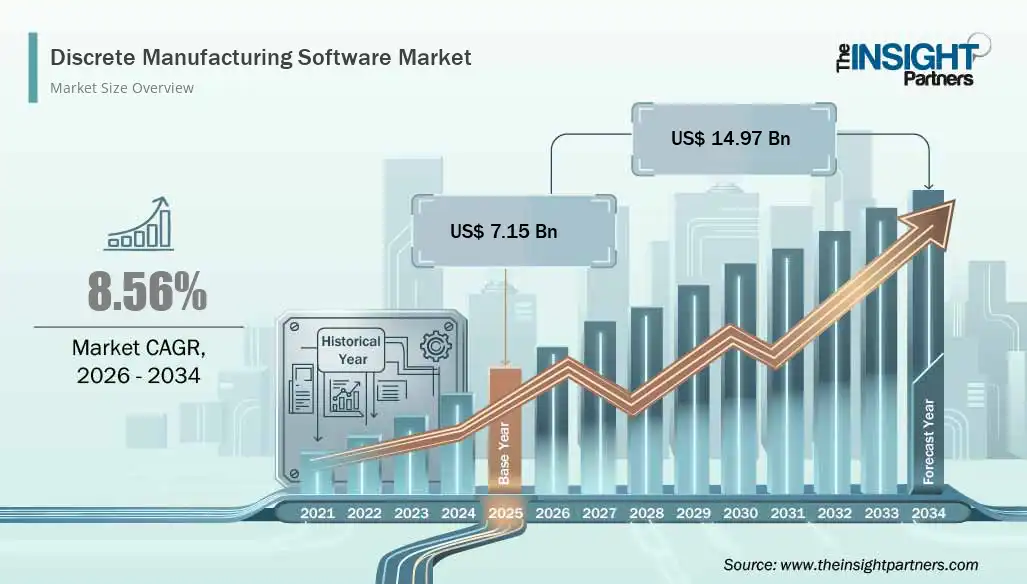
Global Discrete Manufacturing Software Market Analysis: US$ 14.97 Billion by 2034 at 8.56% CAGR

Discrete Manufacturing Software facilitates compliance with environmental, health, and safety regulations by documenting material safety data, tracking hazardous waste disposal, and maintaining audit-ready records for regulatory inspections.
The global Discrete Manufacturing Software market was valued at US$ 7.15 billion in 2025 and is expected to reach US$ 14.97 billion by 2034; it is estimated to record a CAGR of 8.56% during 2026-2034.
What is driving the market?
Accelerating Industry 4.0 adoption, cloud migration, and the need for real-time supply chain and production visibility are the principal growth drivers. Discrete manufacturers who produce distinct, countable items via assembly lines and complex bills of materials (BOM) are increasingly required to synchronize engineering, procurement, shop-floor scheduling, and quality control. Automotive, aerospace, and electronics producers are seeking integrated software suites that reduce unplanned downtime, improve Overall Equipment Effectiveness (OEE), and shorten time-to-market without compromising product quality or regulatory compliance.
The transition is moving beyond standalone departmental tools toward unified digital threads. Vendors are investing in cloud-native SaaS architectures, native Industrial IoT (IIoT) connectivity, digital twins, and AI-driven predictive maintenance. However, high upfront implementation costs, complex integration with legacy on-premises systems, data silos across global plants, and digital workforce skill shortages remain important constraints.
Which region leads?
North America leads the market, accounting for an estimated 35%–37% share in 2025, supported by early cloud ERP adoption, advanced aerospace and defense manufacturing, and federal reshoring and digitalization initiatives such as the U.S. CHIPS and Science Act.
Asia Pacific is the fastest-growing region, with a projected CAGR of 9.2%–10.0% through 2034, holding roughly 25%–28% share. Growth is fueled by rapid industrial automation, electronics and EV manufacturing expansion, and government smart-factory programs across China, India, Japan, and South Korea. Europe holds an estimated 26%–28% share, driven by strict sustainability reporting mandates, automotive electrification, and established Industry 4.0 frameworks.
Download Sample Report@ https://www.theinsightpartners.com/sample/TIPRE00012453
Which segment leads?
By software type, Enterprise Resource Planning (ERP) is the leading segment, representing an estimated 38%–42% of market revenue, anchored by its role as the core financial, inventory, and production-planning backbone for discrete operations. Manufacturing Execution Systems (MES) and Product Lifecycle Management (PLM) follow closely, with MES projected to grow rapidly at a CAGR of 8.8%–9.5% as factories digitize shop-floor execution. By deployment mode, Cloud-Based solutions lead in both market share (over 58%) and growth rate due to lower total cost of ownership and faster multi-site scalability.
By end-use industry, Automotive leads with an estimated 27%–30% share, reflecting complex multi-tier supplier networks, just-in-time (JIT) assembly, and the shift toward electric vehicles. Electronics & Electrical is a high-growth vertical, forecast to expand at a CAGR of 9.1%–9.8% due to shortened product lifecycles and semiconductor manufacturing investments.
Which companies are prominent?
Prominent market participants include SAP SE, Siemens AG, Oracle Corporation (including NetSuite), Epicor Software Corporation, Infor, IFS AB, Rockwell Automation, Dassault Systèmes, PTC Inc., and Microsoft Corporation.
These vendors compete across enterprise ERP suites, shop-floor MES, CAD/PLM engineering tools, and industrial automation platforms. Strategic differentiation increasingly depends on cloud-native architecture, low-code configurability, pre-built industry templates (for make-to-order and engineer-to-order workflows), and embedded AI capabilities. This list reflects the competitive landscape rather than a revenue-ranked market-share table.
What is changing in 2026?
In 2026, the market is shifting from basic digitization toward AI-augmented, autonomous manufacturing execution. Rather than using software solely for retrospective reporting, discrete manufacturers are deploying embedded generative AI copilots and machine-learning algorithms for dynamic production scheduling, real-time quality defect detection, and automated supply-chain risk mitigation.
Manufacturers are also accelerating legacy-to-cloud ERP migrations as aging on-premises systems fail to support edge computing, 5G shop-floor telemetry, and granular carbon-footprint tracking required under evolving global trade and environmental regulations. Procurement decisions increasingly prioritize composable, API-first platforms that unify IT (enterprise business systems) and OT (operational shop-floor machinery) without costly custom middleware.
What are the major investment opportunities?
The strongest opportunities lie in cloud-native ERP migration tools, AI-driven predictive maintenance, digital twin simulation, and SME-focused SaaS platforms. Mid-sized discrete manufacturers represent a major underserved segment seeking modular, subscription-based software that delivers rapid ROI without heavy IT overhead.
Additional opportunities include specialized vertical solutions for EV battery assembly, semiconductor fabrication, and medical device traceability, where strict regulatory serialization and audit trails are mandatory. Vendors and investors focusing on low-code integration connectors that bridge legacy CNC machinery with modern cloud analytics are particularly well-positioned to capture market share.
Future Outlook (2026–2034)
Through 2034, the Discrete Manufacturing Software Market will evolve toward self-optimizing, software-defined factories. As regionalization, nearshoring, and reshoring reshape global supply chains, manufacturers will rely on unified digital threads linking product design (PLM), enterprise planning (ERP), and shop-floor robotics (MES) to spin up new production lines rapidly. Over the long term, sustainability compliance and circular manufacturing such as tracking component genealogy for remanufacturing, repair, and recycling will become standard modules within core discrete manufacturing platforms, cementing software as the primary driver of industrial competitiveness.
Event Stream Processing Market Share, Growth & Demand by 2034
API Management Market Growth Opportunities and Forecast by 2031
Smart Advisor Market Key Companies Profile and SWOT Analysis by 2034
The Insight Partners is a leading market research and consulting firm delivering actionable insights through in-depth industry analysis and strategic intelligence. The firm supports clients across various industries in making informed decisions by providing comprehensive market forecasts, competitive assessments, and growth opportunities.
Contact Us:
If you have any queries about this report or if you would like further information, please contact us:
Contact Person: Ankit Mathur
E-mail: sales@theinsightpartners.com
Phone: +1-646-491-9876
Also Available in : Korean| German| Japanese| French| Chinese| Italian| Spanish


