

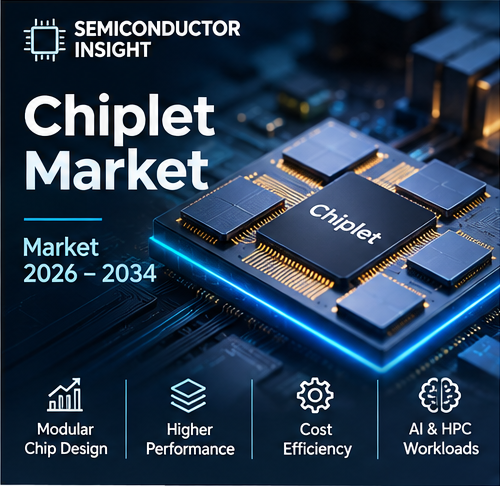
Chiplet Market to Reach USD 8 Billion by 2034 as Modular Semiconductor Architectures Accelerate

The semiconductor industry is increasingly adopting modular silicon architectures to address rising performance requirements, manufacturing complexity and the economics of advanced process nodes. Chiplets divide a complex system into smaller functional dies that can be combined within a system-in-package, enabling designers to integrate CPUs, GPUs, memory, high-speed I/O and analog components on a common substrate.
According to Semiconductor Insight, the Chiplet Market was valued at USD 1.85 billion in 2025. The market is projected to grow from USD 2.05 billion in 2026 to USD 8 billion by 2034, exhibiting a CAGR of 16.5% during the forecast period. Chiplet adoption is supported by demand for higher performance per watt, reduced fabrication costs and advances in high-density interconnect technologies.
Explore the complete Chiplet Market analysis: https://semiconductorinsight.com/report/chiplet-market/
Why Are Chiplets Reshaping Semiconductor Design?
Chiplet architectures allow designers to partition a complex processor or system-on-chip into smaller functional building blocks. These dies can be manufactured using different process technologies and integrated within a common package, allowing each function to use a suitable design and manufacturing approach.
The modular model can improve design reuse and reduce the need to redesign an entire monolithic die when performance or functionality changes. It can also improve manufacturing economics by reducing the size and yield exposure of individual dies.
Demand is particularly relevant to AI accelerators, high-performance computing, data-centre networking and advanced consumer electronics, where system performance depends on efficient communication among compute, memory and I/O components.
Interconnect Innovation Is Enabling Heterogeneous Integration
High-density electrical and advanced interconnect technologies are central to chiplet deployment. Silicon bridges, interposers and proprietary die-to-die links can reduce communication distance and support higher bandwidth between separate dies.
Technologies such as Intel EMIB and advanced system-in-package approaches demonstrate how multiple silicon components can be integrated into a unified system. The design must nevertheless balance link performance, power consumption, package routing and manufacturing yield.
As chiplet ecosystems mature, interface standardization and reusable IP are expected to support interoperability and reduce integration effort for semiconductor designers.
AI Accelerators and High-Performance Computing Drive Adoption
AI workloads require substantial compute capacity and fast movement of data between processors and memory. Chiplet-based architectures allow designers to combine compute tiles, memory components and I/O dies to match the requirements of specific workloads.
Data-centre operators and system integrators are also seeking scalable platforms that can be customized across product tiers. Modular silicon can support product differentiation while allowing manufacturers to reuse validated building blocks.
The market opportunity extends to networking, communications and consumer devices as manufacturers seek greater integration density and power efficiency.
Design Complexity and Packaging Constraints Remain Challenges
Chiplet systems require careful co-design across silicon, package, thermal and software layers. Die-to-die interfaces must meet signal-integrity, latency and power targets while operating reliably across temperature and manufacturing variations.
Advanced packaging capacity, substrate availability and test complexity can affect production schedules and cost. Multi-die systems also require effective known-good-die screening and package-level validation to manage yield.
Interoperability and ecosystem maturity remain important considerations as suppliers develop compatible chiplets, design tools and package architectures.
Where Are the Main Market Opportunities Emerging?
Opportunities are developing across CPU, GPU, memory, analog and I/O chiplets, together with advanced substrates, interposers, hybrid bonding and die-to-die interface technologies.
Companies able to provide reusable chiplet IP, reliable packaging integration and validated high-bandwidth links can benefit as AI and high-performance computing systems adopt modular architectures.
Chiplet Market Segmentation
The report evaluates the market across the following product, technology, application and end-user categories:
By type: CPU Chiplets; GPU Chiplets; Memory Chiplets; Analog/Digital Chiplets
By application: AI Accelerators; High-Performance Computing; Data-Center Networking; Consumer Electronics; Others
By end user: Semiconductor OEMs; System Integrators; Cloud Service Providers
By integration approach: 2.5D Interposers; 3D Stacking; Hybrid Bonding; Advanced Organic Packaging
This segmentation helps stakeholders compare product requirements, identify application-specific demand and understand the commercial structure of the market.
Access the full report: https://semiconductorinsight.com/report/chiplet-market/
Regional Chiplet Market Outlook
North America held the largest share of 2025 market value at an estimated 35%, supported by chip design activity and advanced packaging development.
Asia-Pacific accounted for an estimated 34% share, reflecting its concentration of outsourced advanced packaging, memory manufacturing and semiconductor production.
Europe and other regions participate through semiconductor R&D, industrial electronics and growing investment in advanced computing architectures.
Competitive Landscape and Key Companies
The Chiplet Market market includes established semiconductor suppliers, technology developers and specialized solution providers serving the requirements of advanced electronic systems.
Companies identified in the report include: Intel; AMD; TSMC; Qualcomm.
Competition is influenced by product performance, engineering expertise, manufacturing capability, customer relationships, intellectual property and the ability to support evolving system requirements.
What Does the Chiplet Market Market Report Cover?
The Semiconductor Insight study provides analysis of market size, revenue, competitive positioning, industry dynamics, segmentation and regional performance.
The report examines market drivers, restraints, opportunities, technology developments, supply-chain considerations and competitive strategies.
The study provides detailed segmentation by relevant product, technology and application categories and examines market performance across the regions identified in the report.
Key Questions Answered by the Study
What is the projected size of the Chiplet Market?
What is the expected CAGR during 2026–2034?
What are the primary factors driving market growth?
Which technologies and product categories are shaping the market?
Which applications are generating demand?
What are the major market segments?
Which regions represent important markets?
Who are the leading companies operating in the market?
What challenges could restrict adoption?
How are technology developments influencing the market?
What opportunities are emerging for suppliers?
What factors are shaping the competitive landscape?
Explore the full market forecast and competitive analysis: https://semiconductorinsight.com/report/chiplet-market/
Get a Sample Report copy for free: Download Sample Report PDF
About Semiconductor Insight
Semiconductor Insight provides market intelligence and industry research covering semiconductor technologies, electronic components, advanced manufacturing systems and related technology markets.
Contact Semiconductor Insight
Website: www.semiconductorinsight.com


