

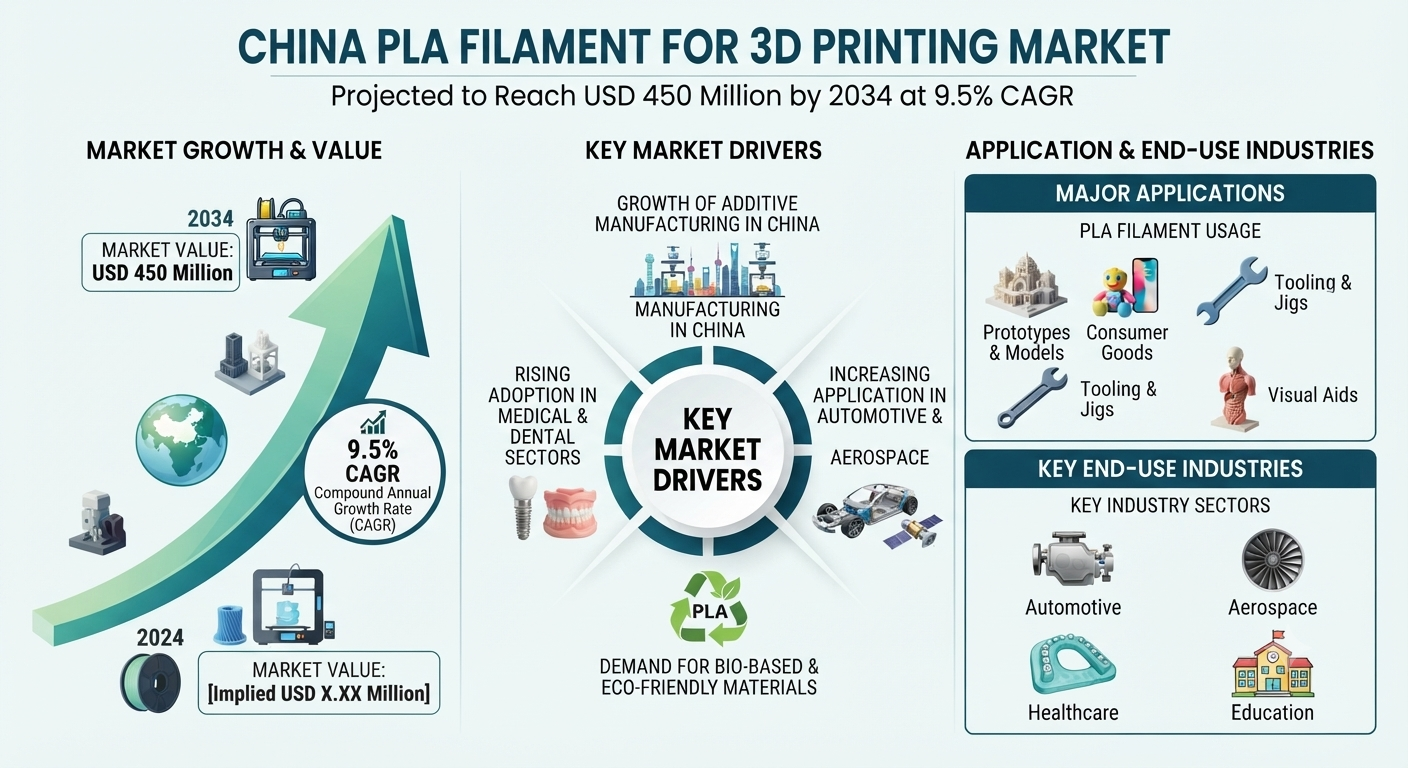
China PLA Filament for 3D Printing Market to Reach USD 450 Million by 2034 at 9.5% CAGR

The China PLA filament for 3D printing market is benefiting from wider adoption of additive manufacturing across education, prototyping, product development and selected industrial applications. Polylactic acid (PLA) filament is widely used in fused-filament fabrication because it is comparatively easy to print and is associated with bio-based feedstock and biodegradability messaging. Its accessibility has helped make PLA familiar among hobbyists, schools, makerspaces and professional users.
According to 24ChemicalResearch, the China PLA filament for 3D printing market was valued at USD 180 million in 2025 and is projected to grow to USD 200 million in 2026 and USD 450 million by 2034, exhibiting a CAGR of 9.5%. The report links expansion to green-manufacturing priorities, educational and hobbyist printing, industrial prototyping and a broadening range of specialized applications.
Read the complete market report: https://www.24chemicalresearch.com/reports/280384/china-pla-filament-for-d-printing-market
Download the free sample: https://www.24chemicalresearch.com/download-sample/280384/china-pla-filament-for-d-printing-market
PLA Filament: A Widely Used Material for Fused-Filament Printing
PLA is a thermoplastic polyester commonly produced from renewable carbohydrate feedstocks such as corn starch. In filament form, it is fed through a heated nozzle and deposited layer by layer. Its printability makes it suitable for learning, visual models, prototypes and many non-load-bearing parts. Material formulation, filament diameter, moisture control, color and additives influence print quality.
What Is Driving Market Growth?
Educational and hobbyist printing is an important demand driver. The report notes that universities and makerspaces have integrated PLA filament into curricula and that more than 45% of new 3D printers sold in 2023 were bundled with PLA cartridges. Green-manufacturing priorities and interest in biodegradable materials also contribute to demand.
Filament Manufacturing and Quality
Commercial filament production requires control of polymer quality, extrusion conditions, diameter, roundness, moisture and winding consistency. Variations in dimensions or absorbed moisture can affect feeding, extrusion stability and finished-part quality. Suppliers compete through consistent specifications, color options, packaging and compatibility with desktop and professional printers.
Market Opportunities Beyond Hobbyist Printing
Industrial prototyping creates opportunities for suppliers able to deliver consistent material quality at scale. Medical and dental models, educational tools and composite PLA products broaden the application base. Specialty formulations can serve users seeking particular appearance, stiffness or functional characteristics.
Market Segmentation
The report's visible segmentation identifies filament diameter and applications. The 1.75 mm format dominates because it matches the majority of domestic FDM printers; 3 mm filament serves niche industrial machines.
· By type: 1.75 mm filament; 3 mm filament.
· By application: Industrial prototyping; medical and dental models; educational tools.
Regional and Domestic Outlook
This study focuses on China. The report links growth to green-manufacturing initiatives, educational and hobbyist printing, industrial prototyping and specialized applications. The domestic competitive landscape includes established filament brands and manufacturers developing composite and recycled-PLA products.
Competitive Landscape
The report identifies eSUN and Polymaker as leading domestic players, with Flashforge, Anhui Esaan and Guangdong Silver Age also holding strong positions. Hangzhou Hawk, Dongguan Zhehan, Fujian Hengtuo and Shanghai Doule Leaf are described as emerging participants. Competition centers on extrusion scale, material certification, specialty composites, quality assurance and distribution.
Challenges Facing PLA Filament Suppliers
The report identifies corn-starch supply-chain volatility, stricter labeling of biodegradability and competition from wood-filled PLA as constraints. Producers must also maintain consistent filament quality and ensure environmental claims accurately reflect product properties and applicable disposal conditions.
What Does the Report Cover?
The 205+ page study covers the China PLA filament for 3D printing market for 2026–2034. Its market overview states a 2025 value of USD 180 million, a 2026 estimate of USD 200 million and a 2034 forecast of USD 450 million. It discusses demand drivers, applications, material development, market constraints and competitive conditions.
Read the Full Report
https://www.24chemicalresearch.com/reports/280384/china-pla-filament-for-d-printing-market
Key Questions Answered by the Study
· What was the China PLA filament market value in 2025?
· What are the 2026 estimate and 2034 forecast?
· What CAGR is projected through 2034?
· How does education and hobbyist printing contribute to demand?
· Which applications are expanding beyond hobbyist printing?
· What manufacturing factors influence filament quality?
· Which filament diameters are covered?
· Which manufacturers are profiled?
About 24 Chemical Research
24 Chemical Research specializes in chemical and materials market intelligence, covering specialty chemicals, polymers, surfactants, advanced materials and related industrial markets. Its research combines market sizing and forecasting with analysis of production, capacity, pricing, trade flows, applications, suppliers, regional demand and competitive positioning.
Contact 24 Chemical Research | Phone: +91 9169162030 | Email: help@24chemicalresearch.com | Website: www.24chemicalresearch.com
Contact 24 Chemical Research
Phone: +91 9169162030
Email: help@24chemicalresearch.com
Website: www.24chemicalresearch.com


