

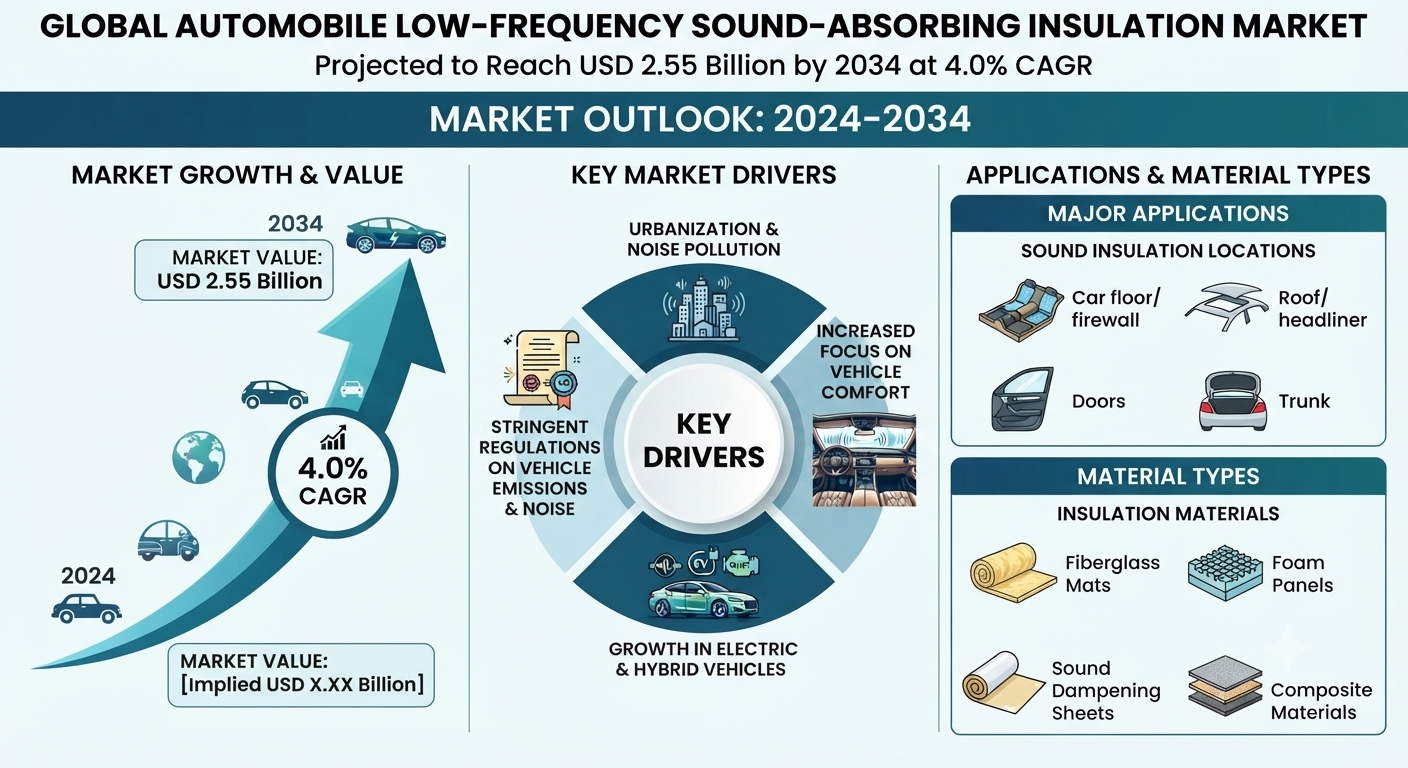
Automobile Low-Frequency Sound-Absorbing Insulation Market to Reach USD 2.55 Billion by 2034 at 4.0% CAGR

The global automobile low-frequency sound-absorbing insulation market is gaining importance as vehicle manufacturers focus on cabin quietness, noise, vibration and harshness (NVH) performance. These materials include closed-cell foams, multilayer composites and hybrid foams engineered to attenuate acoustic energy in the 20–500 Hz range. Their role is becoming more significant as electrified platforms change the noise profile inside passenger and commercial vehicles.
According to 24ChemicalResearch, the global automobile low-frequency sound-absorbing insulation market reached USD 1.85 billion in 2025 and is projected to reach USD 2.55 billion by 2034, exhibiting a CAGR of 4.0% during 2026–2034. The report identifies North America as the leading region in its market summary and Asia-Pacific as an emerging region; its regional analysis separately describes Asia-Pacific as the dominant deployment hub.
Read the complete market report: https://www.24chemicalresearch.com/reports/288354/automobile-low-frequency-sound-absorbing-insulation-market
Download the free sample: https://www.24chemicalresearch.com/download-sample/288354/automobile-low-frequency-sound-absorbing-insulation-market
Low-Frequency Acoustic Insulation in Automotive Applications
Low-frequency insulation is designed to reduce cabin noise and improve NVH performance. Product solutions include closed-cell foams, open-cell foams, hybrid foams and multilayer composites. Applications include under-the-bonnet structures, interiors, wheel arches and other vehicle areas where noise transmission and vibration need to be controlled.
What Is Driving Market Growth?
Growing consumer demand for quieter cabins is a major driver, particularly in mid-to-high-end vehicles. Electrification is changing the acoustic environment: with less engine noise, road, tire and wind disturbances can become more noticeable. This increases the need for materials that attenuate low-frequency noise without adding excessive weight.
Material Innovation and Vehicle Integration
Nanoporous polymers, bio-based elastomers and nanocellulose-reinforced composites are among the technologies discussed in the report. Multilayer designs combine foam and other functional layers to improve absorption while preserving structural integrity. Material selection must account for thickness, density, weight, durability, moisture resistance, temperature exposure and integration into constrained vehicle spaces.
Market Opportunities in Electric Vehicles and Sustainable Materials
Electric vehicle platforms provide an important opportunity because battery, road and structural vibration can create new acoustic-treatment requirements. The report also highlights circular-economy requirements and interest in recyclable cores, bio-based polyols and recycled materials. Aftermarket replacement panels and upgrade kits represent an additional channel.
Market Segmentation
The report evaluates the market by material type, application, end user, material technology and vehicle type.
· By type: Closed-cell foams; open-cell foams; hybrid foams.
· By application: Under the bonnet; interior; wheel arch; others.
· By end user: OEMs; aftermarket; Tier-2 suppliers.
· By material technology: Multilayer composites; single-layer materials; recycled and sustainable materials.
· By vehicle type: Passenger vehicles; commercial vehicles; electric vehicles.
Regional Outlook
The report's regional discussion identifies Asia-Pacific as a major deployment hub, supported by OEMs, Tier suppliers, research institutes and automotive manufacturing. The market summary lists North America as the leading region and Asia-Pacific as emerging. Regional demand is also influenced by vehicle electrification, regulatory approaches and the expansion of automotive supply chains.
Competitive Landscape
The report profiles Saint-Gobain, Autoneum, 3M, BASF SE, DuPont de Nemours, Freudenberg Group, Huntsman Corporation, Trelleborg AB, Daechang, Rogers Corporation, Rockwool International and Global Arena Technologies. Saint-Gobain is described as a leading supplier, while specialist companies are developing bio-based and recyclable foam technologies.
Challenges Facing Suppliers
Advanced composite foams can cost 30–40% more than mineral wool for production runs below 5,000 units, according to the report. Petrochemical price volatility can also lengthen component lead times. Structural integration constraints create further engineering challenges, as acoustic treatments must fit limited spaces without compromising rigidity or adding excess weight.
What Does the Report Cover?
The 129+ page study covers the global and regional market for 2026–2034, with 2025 as the base year and historical data from 2020–2025. It includes market sizing, type and application segmentation, company profiles, product specifications, capacity, sales, pricing, gross margins, regional consumption and trade analysis.
Read the Full Report
Key Questions Answered by the Study
· What was the market size in 2025 and what is the 2034 forecast?
· What CAGR is projected during 2026–2034?
· Which material types are included?
· Which vehicle applications use low-frequency insulation?
· How does electrification affect cabin acoustic requirements?
· Which sustainable material technologies are emerging?
· Which regions are leading or emerging?
· Which suppliers are profiled?
About 24 Chemical Research
24 Chemical Research specializes in chemical and materials market intelligence, covering specialty chemicals, polymers, surfactants, advanced materials and related industrial markets. Its research combines market sizing and forecasting with analysis of production, capacity, pricing, trade flows, applications, suppliers, regional demand and competitive positioning.
Contact 24 Chemical Research | Phone: +91 9169162030 | Email: help@24chemicalresearch.com | Website: www.24chemicalresearch.com
Contact 24 Chemical Research
Phone: +91 9169162030
Email: help@24chemicalresearch.com
Website: www.24chemicalresearch.com


