

US Credit Risk Assessment Market Size, Competitive Landscape, and Predictions for 2034

Credit Risk Assessment utilizes early warning systems driven by real-time transaction monitoring to detect behavioral shifts in borrower accounts. Sudden changes in spending habits, maxing out revolving credit lines, or frequent overdrafts trigger automated alerts for risk management teams. Prompt detection allows lenders to adjust credit lines dynamically and intervene before defaults materialize.
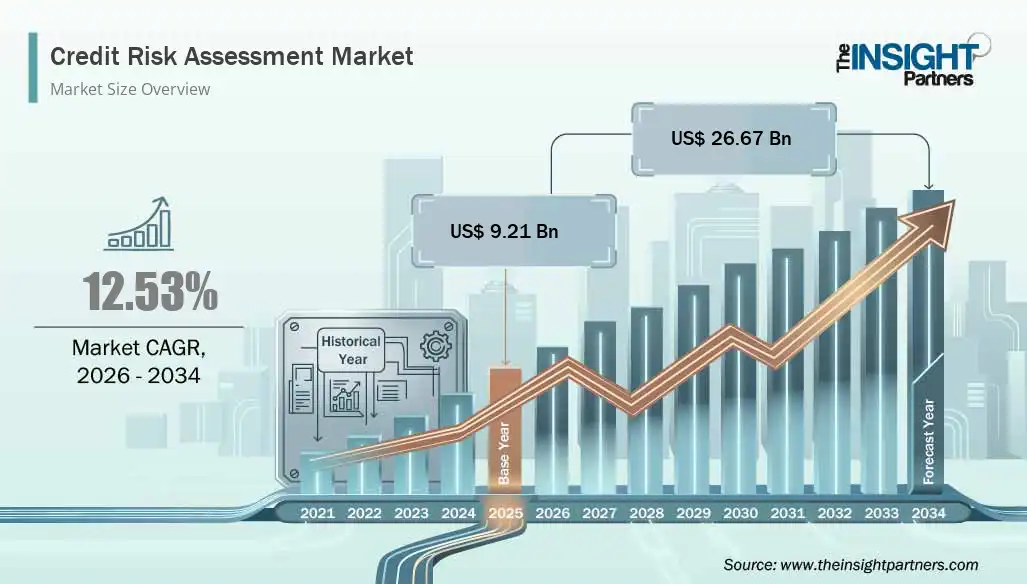
The Credit Risk Assessment Market size is expected to reach US$ 26.67 Billion by 2034 from US$ 9.21 Billion in 2025. The market is estimated to record a CAGR of 12.53% from 2026 to 2034.
What is driving the market?
Regulatory compliance, escalating default volumes, and the rapid adoption of AI-driven alternative data scoring are the principal growth drivers. Financial institutions are increasingly required to adhere to strict capital adequacy ratios (such as Basel III/IV mandates), IFRS 9/CECL expected loss standards, and anti-fraud protocols. Banks, microfinance platforms, and enterprise credit providers are seeking automated credit scoring solutions that improve decisioning accuracy without increasing manual review time or underwriting friction.
The transition is moving beyond traditional rule-based scoring models toward continuous, predictive credit evaluation. Solution providers are investing in AI/ML-driven decision engines, open banking API integrations, real-time fraud detection, and explainable AI models designed to comply with fair-lending regulations. Legacy IT infrastructure, data privacy and security risks in cloud environments, and the shortage of specialized risk data scientists remain important constraints.
Which region leads?
North America leads the market, accounting for an estimated 38%–42% share in 2025, supported by sophisticated banking infrastructure, high credit penetration, early adoption of machine learning models, and mature regulatory oversight.
Asia Pacific accounts for an estimated 22%–26% share in 2025 and is identified as the fastest-growing region, with a projected CAGR of 17.1%–18.5%. Growth is driven by rapid digital lending expansion, rising household loan demand, government financial-inclusion initiatives, and expanding fintech activity. China and India present significant opportunities as surging retail and SME lending coincides with national investments in digital credit infrastructure and automated underwriting platforms.
Download Sample Report@ https://www.theinsightpartners.com/sample/TIPRE00039187
Which segment leads?
Software (including analytics platforms and automated decisioning tools) is the leading component segment, representing an estimated 62%–66% of market revenue in 2025. Its dominance is underpinned by cloud migration, the demand for scalable AI scoring models, and software integration across core banking systems. The software segment is forecast to grow at a CAGR of 14.5%–15.2% through 2033.
By end-use industry, Banking, Financial Services, and Insurance (BFSI) leads with an estimated 52%–56% share in 2025, reflecting massive transaction volumes and complex compliance requirements across retail, commercial, and mortgage lending. Small & Medium Enterprise (SME) Lending is identified as a high-growth segment, with an estimated 15.8%–16.9% CAGR, as alternative data scoring models enable automated loan approvals for thin-file borrowers.
Which companies are prominent?
The report identifies Experian plc, Equifax Inc., TransUnion, FICO (Fair Isaac Corporation), Moody's Analytics, S&P Global Inc., IBM Corporation, SAS Institute, Oracle Corporation, and SAP SE as prominent market participants.
These companies compete across credit scoring, decision analytics, data verification, cloud-native risk engines, and enterprise risk management solutions. Strategic differentiation increasingly depends on alternative data integration, model explainability, real-time risk scoring, regulatory reporting automation, and the ability to deploy enterprise-grade platforms securely at scale. The list reflects the report's competitive landscape rather than a revenue-ranked market-share table.
What is changing in 2026?
The market is shifting from static, periodic risk reviews toward dynamic, continuous credit assessment systems. Scoring specifications increasingly incorporate real-time cash flow monitoring, utility payment records, open-banking financial data, and social/behavioral telemetry to assess creditworthiness accurately.
Financial institutions are accelerating the deployment of cloud-native decision engines, natural language processing for unstructured financial document analysis, and synthetic data testing models. Procurement decisions are increasingly tied to model transparency, data governance certification, and explainability compliance, creating strong demand for model risk management (MRM) tools, bias auditing, and collaboration between credit bureaus, fintech developers, and bank risk officers.
What are the major investment opportunities?
The strongest opportunities lie in AI-powered credit scoring engines, open-banking data aggregation tools, automated loan originations, and cloud-based risk analytics platforms. Investment in alternative data integration, continuous monitoring infrastructure, real-time fraud mitigation, and explainable AI architectures can improve underwriting speed while reducing default exposure. Strategic partnerships between legacy credit bureaus and alternative-data aggregators can help vendors widen their market coverage.
Additional opportunities include specialized risk assessment platforms for Buy-Now-Pay-Later (BNPL) providers, cross-border trade credit insurance tools, and tailored scoring modules for underbanked SMEs. SaaS-based credit assessment tools and decisioning-as-a-service models are creating recurring revenue streams where cloud connectivity, compliance tracking, and automated reporting operate economically for mid-tier lenders and credit unions.
What is the future outlook?
Through 2034, the market will witness a structural shift from retrospective credit evaluation to predictive and real-time risk orchestration. Autonomous underwriting algorithms, generative AI for financial audit synthesis, and privacy-preserving federated learning will reshape institutional risk strategies. Providers that pair strong analytical precision with verifiable algorithmic fairness and regulatory adaptability will be best positioned to capture enterprise market share.
Event Stream Processing Market Share, Growth & Demand by 2034
API Management Market Growth Opportunities and Forecast by 2031
Smart Advisor Market Key Companies Profile and SWOT Analysis by 2034
The Insight Partners is a leading market research and consulting firm delivering actionable insights through in-depth industry analysis and strategic intelligence. The firm supports clients across various industries in making informed decisions by providing comprehensive market forecasts, competitive assessments, and growth opportunities.
Contact Us:
If you have any queries about this report or if you would like further information, please contact us:
Contact Person: Ankit Mathur
E-mail: sales@theinsightpartners.com
Phone: +1-646-491-9876


