

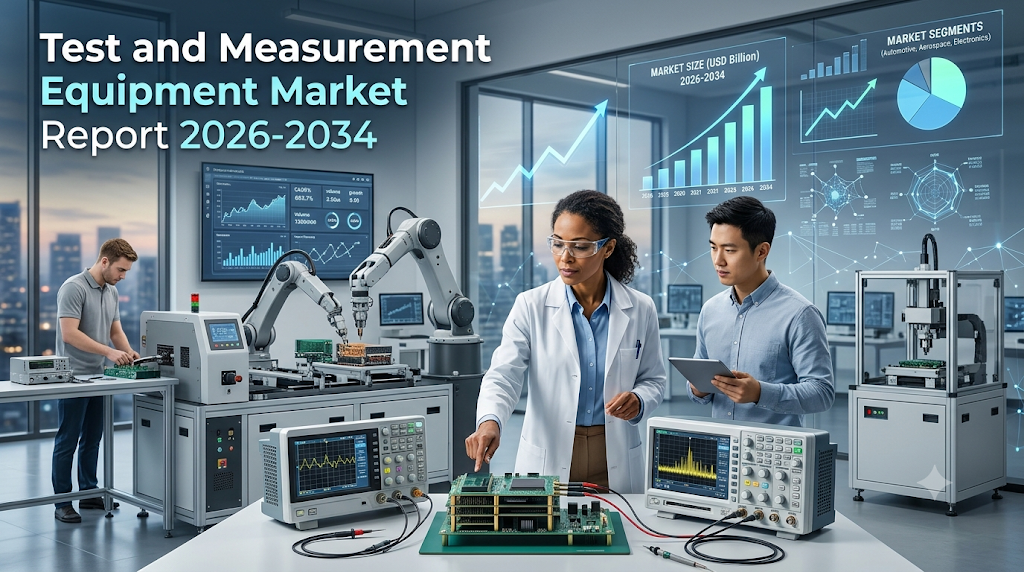
Test and Measurement Equipment Market Growth: Key Trends, Demand & Forecast 2026-2034

Market Overview:
According to IMARC Group’s latest research publication, “Test and Measurement Equipment Market: Global Industry Trends, Share, Size, Growth, Opportunity and Forecast 2026-2034”, The global test and measurement equipment market size was valued at USD 27.94 Billion in 2025 and is projected to reach USD 39.17 Billion by 2034, exhibiting a CAGR of 3.71% during the forecast period 2026-2034.
This detailed analysis primarily encompasses industry size, business trends, market share, key growth factors, and regional forecasts. The report offers a comprehensive overview and integrates research findings, market assessments, and data from different sources. It also includes pivotal market dynamics like drivers and challenges, while also highlighting growth opportunities, financial insights, technological improvements, emerging trends, and innovations. Besides this, the report provides regional market evaluation, along with a competitive landscape analysis.
How AI is Reshaping the Future of the Test and Measurement Equipment Market
- Approximately 75% of organisations are projected to adopt AI-augmented test automation by 2026, enabling predictive maintenance, anomaly detection on automated test equipment, and natural-language generative instrumentation platforms.
- Liquid Instruments raised a funding round totaling USD 12 million in June 2024 and subsequently launched its Generative Instrumentation platform, which allows engineers to create custom instruments using natural language prompts, marking the mainstream arrival of AI in test workflows.
- AI-driven cloud portals for rental fleet optimisation, such as the platform launched by Electro Rent in October 2025, are transforming service-layer monetisation beyond traditional hardware sales and enabling dynamic instrument allocation across distributed test environments.
- Emerson’s July 2025 integration of its Nigel AI Advisor into test workflows illustrates how AI-based decision support is being embedded directly into instrument operating environments to accelerate fault diagnosis and test cycle optimisation.
- In November 2025, Nokia and Rohde & Schwarz jointly created and validated a 6G radio receiver using AI technologies, with Nokia Bell Labs confirming the receiver’s performance using 6G test equipment and methodologies developed by Rohde & Schwarz, underlining AI’s role in next-generation wireless test development.
Download a sample PDF of this report: https://www.imarcgroup.com/test-measurement-equipment-market/requestsample
Key Trends in the Test and Measurement Equipment Market
- 5G, 6G, and mmWave Infrastructure Expansion: Over 2.25 billion 5G connections existed globally in 2024, and China alone had deployed more than 4.8 million 5G base stations by the end of 2025, exceeding its national planning targets. This large-scale rollout is driving sustained demand for vector network analyzers and spectrum test instruments operating up to 110 GHz, with South Korea and Japan also contributing as early global 5G leaders.
- EV and ADAS Validation Requirements Intensifying: Global electric vehicle sales crossed 17 million units in 2024 according to the International Energy Agency, with each EV platform requiring bidirectional power supply testing, battery cell cycling, and radar and lidar validation. The migration from traditional engine dynamometers to electric-drive test cells is opening opportunities for modular, reconfigurable instrumentation, as exemplified by Axiometrix’s CANSASflex HISO-T-2L module launched in 2025 for high-voltage e-mobility measurement.
- Software-Defined and Modular Instrumentation Gaining Adoption: The industry is steadily transitioning from fixed-function hardware boxes to software-defined platforms where a single chassis performs multiple measurement functions via firmware updates. Reference architectures from NI’s PXI platform and Rohde & Schwarz’s R&S ZNA are driving this shift, extending instrument lifecycles and enabling subscription-based feature monetisation across R&D and production test environments.
- Calibration-as-a-Service and Cloud-Connected Instruments: Cloud-based calibration platforms, remote instrument access, and digital twin integration are transforming calibration from on-site service delivery to distributed, predictive service models. Market consolidation in this segment is accelerating, led by calibration service providers such as Transcat through ongoing acquisitions, as compliance requirements under ISO/IEC 17025 and NIST traceability standards drive recurring demand across aerospace, pharmaceutical, and automotive sectors.
- Aerospace and Defence Modernisation Budgets Supporting Demand: Global defence spending crossed USD 2.4 Trillion in 2024 according to SIPRI data, funding radar, avionics, and electronic warfare programmes that depend on high-frequency mmWave and satellite communication test systems. This sustained spending creates structural demand for precision test instruments in both domestic and export-oriented defence supply chains.
We explore the factors propelling the test and measurement equipment market growth, including technological advancements, consumer behaviors, and regulatory changes.
Growth Factors in the Test and Measurement Equipment Market
- Semiconductor Capital Expenditure Driving Instrument Demand: Semiconductor revenues exceeded USD 600 Billion globally, with capex exceeding USD 185 Billion in 2024, funding fab expansions that require automated test equipment for wafer and device-level validation. The CHIPS Act in the United States has further accelerated this investment, with major chipmakers committing to re-shore and expand domestic manufacturing capacity, directly sustaining demand for high-end ATE and metrology platforms.
- Industrial Automation and IoT Device Proliferation: Smart factory deployments and the rollout of over 39 billion connected IoT devices projected by 2030 are creating continuous demand for electrical, RF, and protocol test instruments, particularly for predictive maintenance and real-time quality assurance applications across discrete and process manufacturing industries.
- Asia Pacific’s Semiconductor Self-Sufficiency and IT Expansion: Asia Pacific accounted for 30.7% of global test and measurement equipment revenue in 2025 and is the fastest-growing region. China’s semiconductor localisation drive, India’s IT-services sector growth at approximately 6.3% CAGR, Japan’s automated test equipment leadership, and South Korea’s 5G advancement are collectively powering the region’s demand for advanced test and calibration solutions.
- Repair, After-Sales Services, and Long Instrument Lifecycles: Repair and After-Sales Services dominate the service segment with a 54.6% share in 2025, reflecting the extended operational lives of high-value instruments. Many flagship spectrum analyzers remain in active service for 10 to 15 years, creating a structural recurring revenue base for OEMs including Keysight, Fluke, and Rohde & Schwarz through global service depot networks.
- Saudi Vision 2030 and Gulf Infrastructure Modernisation: Middle East and Africa accounts for 5.7% of global market revenue in 2025, with Saudi Arabia’s Vision 2030 smart infrastructure programmes and the UAE’s telecom and defence build-out creating incremental demand for calibration services, rental instrument pools, and modular instrumentation solutions across the region.
Leading Companies Operating in the Global Test and Measurement Equipment Industry:
- Keysight Technologies
- Rohde & Schwarz
- TEKTRONIX, INC.
- NATIONAL INSTRUMENTS CORP
- Anritsu
- Advantest Corporation
- Fluke Corporation
- Yokogawa Electric Corporation
- Teledyne Technologies Incorporated
- VIAVI Solutions Inc.
Test and Measurement Equipment Market Report Segmentation:
Breakup By Product:
- General Purpose Test Equipment (GPTE)
- Mechanical Test Equipment (MTE)
General Purpose Test Equipment accounts for the majority of shares at 62.8% in 2025, driven by broad deployment of oscilloscopes, spectrum analyzers, signal generators, and multimeters across R&D, manufacturing, and field service applications in electronics, telecom, and industrial sectors.
Breakup By Service Type:
- Repair Services / After-Sales Services
- Calibration Services
Repair and After-Sales Services dominate with a 54.6% share in 2025, reflecting the high-value installed base of legacy instruments with long operational lifecycles and the critical role of OEM-authorised service networks globally.
Breakup By End Use Industry:
- Automotive and Transportation
- Aerospace and Defense
- IT and Telecommunications
- Education and Government
- Semiconductor and Electronics
- Healthcare
- Others
Automotive and Transportation leads the end use industry segment, driven by accelerating EV platform validation requirements, ADAS radar and lidar testing, and bidirectional power supply test demands across global automotive manufacturing hubs.
Breakup By Region:
- North America (United States, Canada)
- Asia Pacific (China, Japan, India, South Korea, Australia, Indonesia, Others)
- Europe (Germany, France, United Kingdom, Italy, Spain, Russia, Others)
- Latin America (Brazil, Mexico, Others)
- Middle East and Africa
North America holds the leading position with a 34.9% revenue share in 2025, anchored by CHIPS Act-funded semiconductor investment, robust defence and aerospace R&D budgets, and the presence of global leaders including Keysight Technologies, Tektronix, National Instruments, Fluke, and Teledyne.
Recent News and Developments in the Test and Measurement Equipment Market
- January 2025: Teradyne completed its acquisition of Infineon’s automated test equipment operations in Regensburg, Germany, expanding its semiconductor ATE portfolio and strengthening its position in European semiconductor manufacturing test infrastructure.
- September 2025: Tektronix launched the 7 Series DPO oscilloscope, its first new high-performance benchtop oscilloscope platform in nearly two decades, featuring 25 GHz bandwidth and industry-leading low noise performance, targeting high-speed communications, AI infrastructure validation, and quantum computing test applications.
- November 2025: Nokia and Rohde & Schwarz jointly created and successfully tested a 6G radio receiver using AI technologies, with Nokia Bell Labs validating its performance using 6G test equipment and methodologies developed by Rohde & Schwarz, marking a significant milestone in next-generation wireless network test development.
Note: If you require specific details, data, or insights that are not currently included in the scope of this report, we are happy to accommodate your request. As part of our customization service, we will gather and provide the additional information you need, tailored to your specific requirements. Please let us know your exact needs, and we will ensure the report is updated accordingly to meet your expectations.
About Us:
IMARC Group is a global management consulting firm that helps the world’s most ambitious changemakers to create a lasting impact. The company provides a comprehensive suite of market entry and expansion services. IMARC offerings include thorough market assessment, feasibility studies, company incorporation assistance, factory setup support, regulatory approvals and licensing navigation, branding, marketing and sales strategies, competitive landscape and benchmarking analyses, pricing and cost research, and procurement research.
Contact Us:
IMARC Group
134 N 4th St. Brooklyn, NY 11249, USA
Email: sales@imarcgroup.com
Tel No: (D) +91 120 433 0800
United States: +1-201-971-6302


