

Petrochemicals Market Expansion: Key Drivers & Competitive Landscape Analysis 2026-2034

Market Overview:
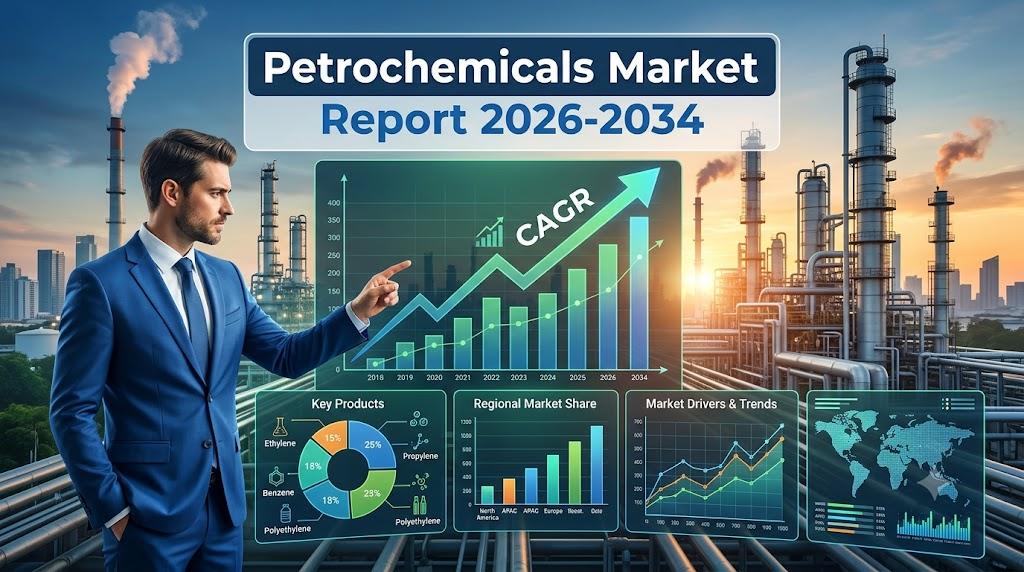
According to IMARC Group’s latest research publication, “Petrochemicals Market: Global Industry Trends, Share, Size, Growth, Opportunity and Forecast 2026-2034”, The global petrochemicals market grew from USD 675.7 Billion in 2025 to USD 705.5 Billion in 2026. Looking forward, IMARC Group expects the market to reach USD 996.1 Billion by 2034, exhibiting a growth rate (CAGR) of 4.40% during 2026-2034.
This detailed analysis primarily encompasses industry size, business trends, market share, key growth factors, and regional forecasts. The report offers a comprehensive overview and integrates research findings, market assessments, and data from different sources. It also includes pivotal market dynamics like drivers and challenges, while also highlighting growth opportunities, financial insights, technological improvements, emerging trends, and innovations. Besides this, the report provides regional market evaluation, along with a competitive landscape analysis.
How Technology and Sustainability Are Reshaping the Global Petrochemicals Industry
- The Asia Pacific region dominates the global petrochemicals market, accounting for more than 52% of the total market share, driven by rapid urbanization, expanding industrial bases, and a growing middle class expected to comprise two-thirds of the global middle class by 2030 according to the UNDP.
- Ethylene leads the type segment, with global production capacity reaching 223.86 million metric tons, shaped by downstream demand from plastics, chemicals, and packaging industries.
- Polymers represent the largest application segment, with global plastic polymer production having reached 460 million tons per year and projected to nearly triple from 2019 levels by 2050 as per the OECD Global Plastics Outlook.
- Plastic packaging alone accounts for more than 17% of global petrochemical production, according to the Rocky Mountain Institute, underscoring the critical role of packaging as a demand anchor.
- In December 2025, Saudi Aramco, ExxonMobil, and Samref signed a venture framework agreement to study upgrading the Yanbu refinery and expanding it into a world-class integrated petrochemical complex, signaling major upstream-downstream integration strategies.
Download a sample PDF of this report: https://www.imarcgroup.com/petrochemicals-market/requestsample
Key Trends in the Petrochemicals Market
- Crude Oil Price Volatility Reshaping Cost Structures: The price of crude oil, the primary feedstock for petrochemicals, has a direct and measurable effect on production economics. In 2012, crude oil was priced at approximately USD 702 per cubic meter, declining to around USD 637 per cubic meter by 2022. Companies are increasingly adopting hedging strategies and diversifying feedstock sourcing to manage pricing risk, particularly as OPEC members, who controlled 72% of proved crude oil reserves and 37% of global crude oil production in 2021, continue to influence supply dynamics.
- Surging Demand from Packaging and Automotive Sectors: The packaging industry is a critical end-user, with plastics derived from petrochemicals enabling lightweight, durable, and cost-effective solutions. Advanced economies such as the United States and Europe use up to 20 times as much plastic as developing economies like India and Indonesia, creating a sustained demand differential. The US market for advanced construction petrochemicals was also identified to potentially grow by 32%, reflecting sectoral expansion in downstream industries.
- Shift Toward Sustainable and Eco-Friendly Petrochemical Alternatives: Environmental regulations at both government and corporate levels are accelerating the transition toward greener petrochemical production. Bioplastic production, which stood at an estimated 2.2 million tons globally, is projected to reach 7.4 million tons by 2028 per European Bioplastics e.V., demonstrating the pace of sustainable material adoption within the broader petrochemical ecosystem.
- Asia Pacific Consolidating Its Manufacturing Dominance: China’s demand for petrochemical feedstocks in 2023 significantly exceeded 2019 levels according to the International Energy Agency, indicating sustained post-pandemic recovery momentum. India is simultaneously expanding its refining capacity to meet rising fuel and petrochemical demand driven by rapid economic growth, with projects such as the Barmer refinery in Rajasthan targeting a 9 million ton-per-year output.
- Innovation in Ethylene Production via Carbon Conversion Technologies: Researchers led by a University of Cincinnati professor developed an improved method to convert carbon dioxide into ethylene using a specialized copper catalyst, improving conversion efficiency. This aligns with broader industry efforts to decarbonize production chains while maintaining output volumes, particularly critical as ethylene remains the highest-volume petrochemical globally.
The petrochemicals market report provides a comprehensive overview of the industry. This analysis is essential for stakeholders aiming to navigate the complexities of the biochar market and capitalize on emerging opportunities.
Growth Factors in the Petrochemicals Market
- Industrial Demand Across Automotive, Construction, and Healthcare: Petrochemicals are embedded across multiple high-value industries. In automotive, they form the basis of plastics, rubber, and synthetic fibers used in vehicle interiors, under-the-hood components, and exteriors. In construction, PVC pipes, insulation, and sealants derived from petrochemicals are standard materials. In healthcare, specialized polymer applications in device manufacturing and drug delivery packaging represent a growing demand segment, particularly in Asia Pacific where healthcare infrastructure investment is accelerating.
- Population Growth and Urbanization Driving Infrastructure Demand: The Asia Pacific middle class is projected to comprise two-thirds of the global total by 2030, according to UNDP estimates. This demographic surge is generating mass demand for consumer durables, packaged goods, infrastructure, and transportation, all of which depend heavily on petrochemical-derived materials across their supply chains.
- QatarEnergy and Chevron Phillips Chemical USD 6 Billion Ras Laffan Complex: A formal agreement was signed between QatarEnergy and Chevron Phillips Chemical Company LLC, a joint venture between Chevron Corporation and Phillips 66, to construct the Ras Laffan Petrochemicals Complex at a cost of USD 6 billion. This scale of investment illustrates how Gulf region governments are channeling hydrocarbon revenues into downstream petrochemical value chains to diversify national economies.
- Sustainability Investments Driving R&D Expenditures: Sumitomo Chemical, a major Japanese chemical company, established a new environmentally friendly method to produce propylene directly from ethanol and built a pilot plant under Japan’s Green Innovation Fund Project, with commercialization targeted for 2025. Such investments reflect the broader industry pivot toward lower-carbon intensity production pathways that can satisfy both regulatory mandates and investor ESG expectations.
- University Research Collaborations Accelerating Green Ethylene Production: The development of a copper catalyst-based CO2-to-ethylene conversion pathway by University of Cincinnati researchers represents the kind of academic-industry collaboration increasingly central to advancing sustainable petrochemical feedstocks. As ethylene accounts for the largest share of petrochemical type output globally, any efficiency breakthrough in its production carries outsized commercial impact.
Leading Companies Operating in the Global Petrochemicals Industry:
- BASF SE
- Chevron Corporation
- China National Petroleum Corporation
- China Petrochemical Corporation
- DuPont de Nemours Inc.
- Exxon Mobil Corporation
- Formosa Plastics Corporation
- Indian Oil Corporation Limited
- INEOS Group Ltd.
- LyondellBasell Industries N.V.
- Reliance Industries Limited
- Saudi Basic Industries Corporation (Saudi Arabian Oil Co.)
- Shell plc
- Sumitomo Chemical Co. Ltd.
- TotalEnergies SE
Petrochemicals Market Report Segmentation:
Breakup By Type:
- Ethylene
- Propylene
- Butadiene
- Benzene
- Toluene
- Xylene
- Methanol
- Others
Ethylene accounts for the largest share on account of widespread downstream applications across plastics, packaging, and chemical manufacturing, with global production capacity reaching 223.86 million metric tons.
Breakup By Application:
- Polymers
- Paints and Coatings
- Solvents
- Rubber
- Adhesives and Sealants
- Surfactants and Dyes
- Others
Polymers dominate the application segment due to the increasing demand for lightweight and durable materials across the automotive, packaging, and construction industries, with global plastic polymer output having doubled from 2000 to 2019.
Breakup By End Use Industry:
- Packaging
- Automotive and Transportation
- Construction
- Electrical and Electronics
- Healthcare
- Others
Breakup By Region:
- North America (United States, Canada)
- Asia Pacific (China, Japan, India, South Korea, Australia, Indonesia, Others)
- Europe (Germany, France, United Kingdom, Italy, Spain, Russia, Others)
- Latin America (Brazil, Mexico, Others)
- Middle East and Africa
Asia Pacific holds the leading position owing to rapid urbanization, industrialization, a growing middle class, and expanding petrochemical feedstock demand, particularly in China and India.
Recent News and Developments in the Petrochemicals Market
- December 2025: Saudi Aramco, ExxonMobil, and Samref signed a venture framework agreement to study upgrading the Yanbu refinery and expanding it into a world-class integrated petrochemical complex. The companies stated that the plans remain subject to market conditions, regulatory approvals, and final investment decisions.
- October 2025: BASF achieved mechanical completion of its steam cracker at the Zhanjiang Verbund site in China, with commissioning and full operational start-up targeted by the end of 2025. The world-scale site is expected to significantly expand BASF’s integrated petrochemical production footprint in Asia Pacific.
- May 2026: Saudi Aramco transferred full control of Malaysia’s Pengerang Integrated Petroleum Complex to PETRONAS in a major downstream exit, marking a significant strategic realignment of Aramco’s overseas petrochemical and refining asset portfolio.
Note: If you require specific details, data, or insights that are not currently included in the scope of this report, we are happy to accommodate your request. As part of our customization service, we will gather and provide the additional information you need, tailored to your specific requirements. Please let us know your exact needs, and we will ensure the report is updated accordingly to meet your expectations.
About Us:
IMARC Group is a global management consulting firm that helps the world’s most ambitious changemakers to create a lasting impact. The company provides a comprehensive suite of market entry and expansion services. IMARC offerings include thorough market assessment, feasibility studies, company incorporation assistance, factory setup support, regulatory approvals and licensing navigation, branding, marketing and sales strategies, competitive landscape and benchmarking analyses, pricing and cost research, and procurement research.
Contact Us:
IMARC Group
134 N 4th St. Brooklyn, NY 11249, USA
Email: sales@imarcgroup.com
Tel No: (D) +91 120 433 0800
United States: +1-201-971-6302


