


Global MO (Metal Organic) Source Market to Reach USD 565.94 Million by 2034 as Compound Semiconductor and LED Manufacturing Expand
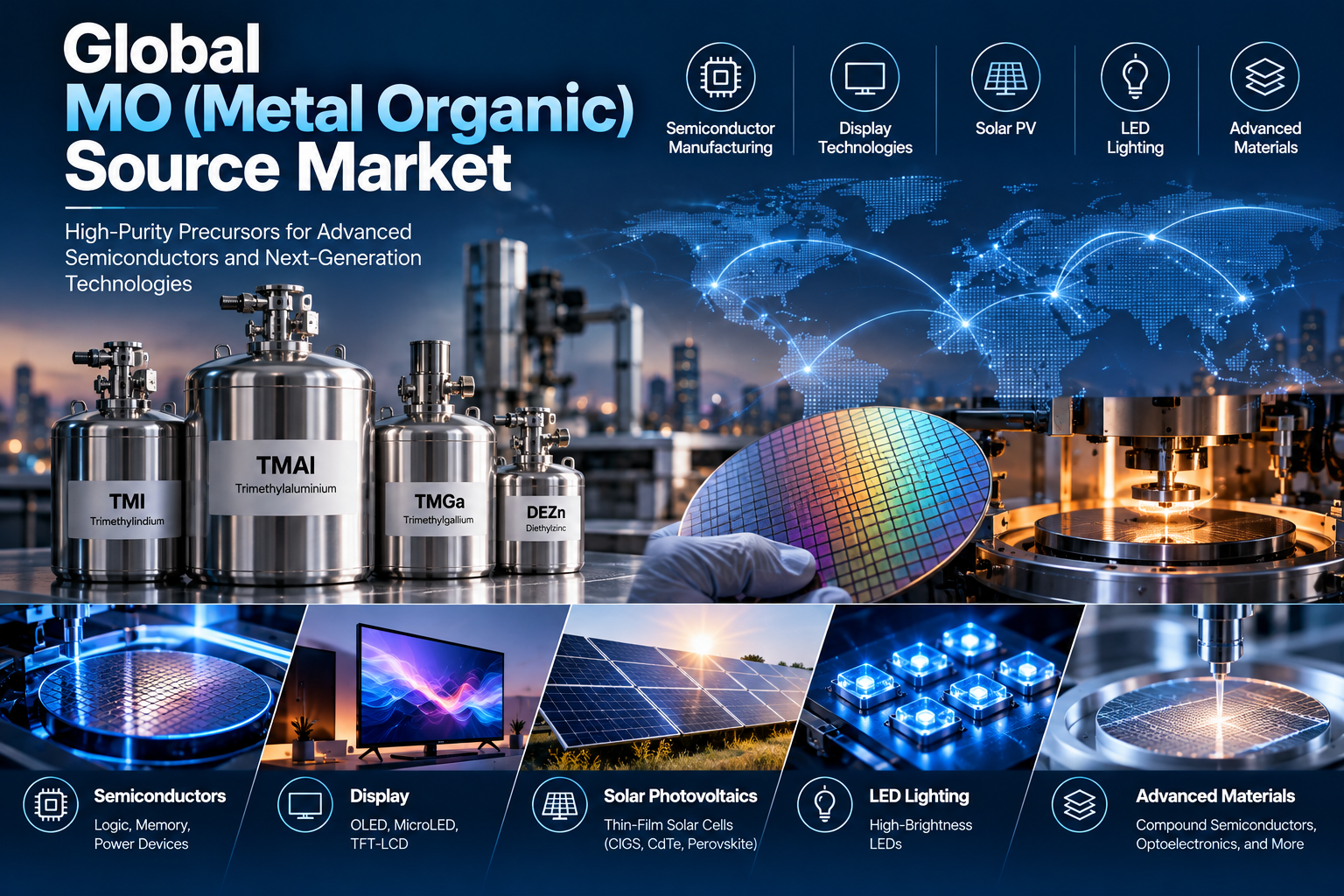
The semiconductor and optoelectronics industries depend on high-purity precursor materials to manufacture advanced compound-semiconductor structures. Against this backdrop, metal organic (MO) sources are gaining importance as essential chemical inputs for epitaxial deposition processes used in LEDs, semiconductor lasers and selected compound-semiconductor applications.
According to Semiconductor Insight, the Global MO (Metal Organic) Source Market was valued at USD 183.95 million in 2025 and is projected to reach USD 565.94 million by 2034, growing at a CAGR of 13.3% during 2026–2034. These high-purity metalorganic compounds deliver gallium, indium, aluminum and related elements into semiconductor deposition reactors, where material purity, stable vapor delivery and repeatable process performance are important.
Explore the complete market analysis: https://semiconductorinsight.com/report/global-mo-metal-organic-source-market/
Why Are Metal Organic Sources Becoming Important in Semiconductor Manufacturing?
Metal organic sources are specialized precursor chemicals used to deliver selected metallic elements into semiconductor deposition reactors. Their controlled chemical composition and vapor-delivery characteristics make them important inputs for producing compound-semiconductor materials.
These compounds are used in metalorganic chemical vapor deposition (MOCVD) and related epitaxial fabrication processes. Principal materials include trimethylgallium, triethylgallium, trimethylindium and trimethylaluminium.
The materials are consumed during epitaxial growth rather than being installed in finished electronic products. Manufacturers require consistent purity, repeatable vapor delivery and stable source-container performance to maintain the quality of semiconductor layers.
The role of MO sources in producing LEDs, compound-semiconductor lasers and specialized electronic structures is therefore a major reason why demand is linked to the expansion of advanced epitaxy manufacturing.
Market Growth Is Closely Linked to LED Manufacturing
One of the major trends influencing the MO Source Market is demand from LED manufacturing. Gallium nitride and indium gallium nitride epitaxy use metalorganic precursor materials during wafer growth, creating recurring chemical requirements as production reactors operate.
Semiconductor Insight identifies the LED Industry as the largest application segment, accounting for an estimated 44% of 2025 market demand. The volume of precursor consumption depends on wafer diameter, epitaxial layer complexity, reactor uptime and material utilization.
As LED manufacturers expand or upgrade production capacity, qualified chemical suppliers can benefit from recurring demand for gallium, indium and aluminum source materials. However, chemical purchases depend on actual reactor operation rather than downstream LED packaging volumes alone.
This makes qualified precursor availability, purity consistency and reliable delivery important considerations for compound-semiconductor manufacturers.
Receive your Free Sample Report today: https://semiconductorinsight.com/download-sample-report/?product_id=62171
Trimethylgallium Is Leading the Technology Landscape
Trimethylgallium (TMGa) represents the largest named precursor category within the MO Source Market. The compound is used in GaN, GaAs and related III-V semiconductor deposition recipes.
Semiconductor Insight estimates that TMGa accounted for approximately 35% of 2025 market value. Its commercial importance is linked to LED manufacturing and other compound-semiconductor structures that require controlled gallium delivery during epitaxial growth.
Trimethylindium is another important source material, supporting InGaN active layers and selected indium phosphide structures used in optical emitters. Trimethylaluminium supports AlGaN and related epitaxial layers, while triethylgallium serves selected deposition recipes.
The different precursor families have distinct chemical and handling requirements. They are not interchangeable, and supplier selection depends on reactor compatibility, impurity specifications and process qualification.
Semiconductor Laser Manufacturing Creates Additional Demand
The MO Source Market extends beyond LED production into semiconductor laser manufacturing. Indium phosphide and related compound-semiconductor structures require controlled metalorganic feedstocks during epitaxial deposition.
Semiconductor Insight identifies Semiconductor Laser as the second-largest application, representing an estimated 26% of 2025 demand. The segment is supported by optical-device manufacturing and the need for carefully controlled epitaxial layers.
Laser-device production places particular importance on material composition, source stability and repeatable wafer quality. A change in precursor supplier can require reactor trials and verification of device performance before production approval.
These requirements broaden the market for specialist chemical suppliers serving optical communications, photonics and other advanced semiconductor applications.
High-Purity Chemistry and Delivery Systems Are Shaping Market Development
Another important development in the market is the increasing importance of precursor purity and delivery consistency. Semiconductor buyers evaluate source chemicals according to trace-metal contamination, vapor delivery, canister performance and technical support.
Trimethylgallium is delivered as a liquid, while trimethylindium is a crystalline material that requires controlled vapor transport. These differences influence source-container design, handling procedures and reactor delivery conditions.
Specialized cylinders, valves and documented delivery systems form part of the qualification process. A new supplier must demonstrate repeatable material performance and compatibility with the customer's deposition equipment.
Consequently, supplier relationships are shaped not only by chemical price but also by technical documentation, reliable logistics and the ability to maintain consistent quality across production cycles.
Compound Semiconductor Epitaxy Is an Important Market Driver
The expansion of compound-semiconductor manufacturing provides an important demand driver for metalorganic precursor chemicals. GaN and InGaN deposition uses gallium and aluminum sources, while indium phosphide and related structures require indium-based chemistry.
Demand is also influenced by the utilization of installed MOCVD reactors, epitaxial layer thickness, wafer starts and device yields. Additional manufacturing capacity can create recurring chemical demand once equipment is installed and production recipes are qualified.
However, improvements in precursor utilization can reduce the amount of chemical consumed per saleable wafer. The relationship between semiconductor output and precursor revenue therefore depends on process efficiency as well as production volume.
This distinction is central to understanding the market: MO source demand is linked to qualified epitaxial production and material consumption rather than the total sales of finished LEDs, lasers or electronic devices.
Chemical Handling and Procurement Volatility Remain Key Challenges
Despite the importance of these materials, the MO Source Market faces several technical and commercial constraints. High-purity precursor chemicals require specialized handling, storage and transportation procedures.
Moisture-sensitive and reactive compounds require controlled filling, source containers and process-gas connections. Supplier qualification involves demonstrating chemical purity, safe handling and reliable delivery rather than simply providing a nominally equivalent material.
Reactor utilization and production scheduling can also create uneven ordering patterns. Installed MOCVD capacity does not automatically translate into chemical purchases if chambers are idle or production qualification is delayed.
The report also identifies improved precursor-use efficiency, substitution and delayed qualification as factors that can restrain market growth. These issues make supply reliability and technical support important competitive differentiators.
Where Are the Biggest Opportunities Emerging?
Several applications could provide additional opportunities for MO source manufacturers. LED production remains a major demand area because GaN and InGaN epitaxy require high-purity metalorganic feedstocks.
Semiconductor laser manufacturing represents another opportunity, particularly for optical-device structures based on indium phosphide and related compound-semiconductor materials.
Selected III-V solar-cell and concentrated photovoltaic processes also use metalorganic precursors. This opportunity is narrower than conventional silicon photovoltaic manufacturing and depends on the use of relevant compound-semiconductor deposition processes.
Further opportunities may emerge from the diversification of GaN epitaxy into selected RF, power and sensing applications, alongside the development of additional qualified reactor capacity.
Access the Full Report for In-Depth Insights: https://semiconductorinsight.com/report/global-mo-metal-organic-source-market/
MO (Metal Organic) Source Market Segmentation
The report evaluates the market by precursor type and application, providing a detailed view of the chemical families and manufacturing processes driving demand.
By type, the market is divided into:
Trimethylgallium (TMGa)
Triethylgallium (TEGa)
Trimethylindium (TMIn)
Trimethylaluminium (TMAl)
Other MO Sources
By application, the market covers:
LED Industry
Semiconductor Laser
Solar Cell
Phase Change Memory
Others
Regional MO (Metal Organic) Source Market Outlook
Asia-Pacific represents the largest regional market, accounting for an estimated 48% of 2025 precursor revenue. The region benefits from concentrated compound-semiconductor manufacturing and LED epitaxy capacity across China, South Korea, Japan and Taiwan. Its modeled growth outlook is supported by reactor utilization and the expansion of photonics manufacturing.
North America accounts for approximately 32% of 2025 demand, with activity supported by specialty optical-component production, compound-semiconductor development and research reactors. The United States is the principal regional buyer, while Canada contributes through research and optoelectronic development.
Europe represents an estimated 15% of the market, supported by photonics, specialized compound-semiconductor devices and advanced epitaxy research. Germany and the United Kingdom are among the markets where process engineering, research and technical qualification support demand.
South America accounts for approximately 3% of the market, while the Middle East and Africa represent around 2%. Demand in these regions is more selective and depends on the presence of qualified compound-semiconductor processing facilities and specialist chemical logistics.
Competitive Landscape and Key Companies
The MO (Metal Organic) Source Market includes specialty chemical manufacturers and suppliers serving compound-semiconductor epitaxy and optoelectronics applications.
Semiconductor Insight identifies Nata Opto-electronic, SAFC Hitech, AkzoNobel Specialty Chemicals (now Nouryon), Jiang Xi Jia Yin Opt-Electronic, Albemarle, Chemtura (acquired by LANXESS), Sumitomo Chemical, UBE Corporation, Lake Materials, ARGOSUN MO, Suzhou Pure Opto-Electronic, Entegris, Nouryon and Merck Electronic Materials among the companies covered in the competitive landscape.
Competition within the market is influenced by chemical purity, source-container technology, delivery reliability, process compatibility, safety documentation and the ability to support customer qualification. The report also examines company positioning, market performance, product portfolios and competitive developments.
What Does the MO (Metal Organic) Source Market Report Cover?
The Semiconductor Insight study provides analysis of market size, sales, revenue, competitive positioning, industry dynamics, segmentation and regional performance.
The report examines the industry chain, precursor materials, production and supply conditions, downstream epitaxy customers and chemical procurement requirements. It also evaluates market drivers, challenges, restraints, industry developments, new product developments, mergers and acquisitions, expansions and collaboration or supply contracts.
The study provides detailed segmentation by precursor type and application and examines market performance across North America, Europe, Asia-Pacific, South America, and the Middle East and Africa. Country-level coverage includes the United States, Canada, Mexico, Germany, France, the United Kingdom, Italy, China, Japan, South Korea, India, Brazil, Argentina, Saudi Arabia, the UAE, Egypt, Nigeria and South Africa.
Key Questions Answered by the Study
The report helps industry participants evaluate questions including:
What is the current Global MO (Metal Organic) Source Market size?
How large is the market projected to become by 2034?
What is the expected CAGR during 2026–2034?
What are metal organic source chemicals used for?
Which precursor type holds the largest market share?
How does trimethylgallium support LED manufacturing?
What role do metalorganic sources play in semiconductor laser production?
Which applications are included in the market?
What challenges affect the storage and handling of MO source chemicals?
Which region represents the largest market?
Who are the leading MO source manufacturers?
What factors influence supplier qualification and procurement?
Explore the full market forecast and competitive analysis: https://semiconductorinsight.com/report/global-mo-metal-organic-source-market/
Get a Sample Report copy for free: https://semiconductorinsight.com/download-sample-report/?product_id=62171
About Semiconductor Insight
Semiconductor Insight provides market intelligence and industry research covering semiconductor technologies, electronic components, advanced manufacturing systems and related technology markets. Its research focuses on market sizing, forecasting, competitive landscapes, technology trends, segmentation and regional analysis to support strategic decision-making across the semiconductor ecosystem.
Contact Semiconductor Insight
Website: www.semiconductorinsight.com
 Deutsch
 English
 Arabic
 French
 Spanish
 Portuguese
 Turkish
 Dutch
 Italiano
 Russian
 Romaian
 Portuguese (Brazil)
 Greek