


Automotive Grade Silicon Carbide Components Market to Reach USD 2,752.09 Million by 2034 as Electric Vehicle Powertrain Electrification Accelerates
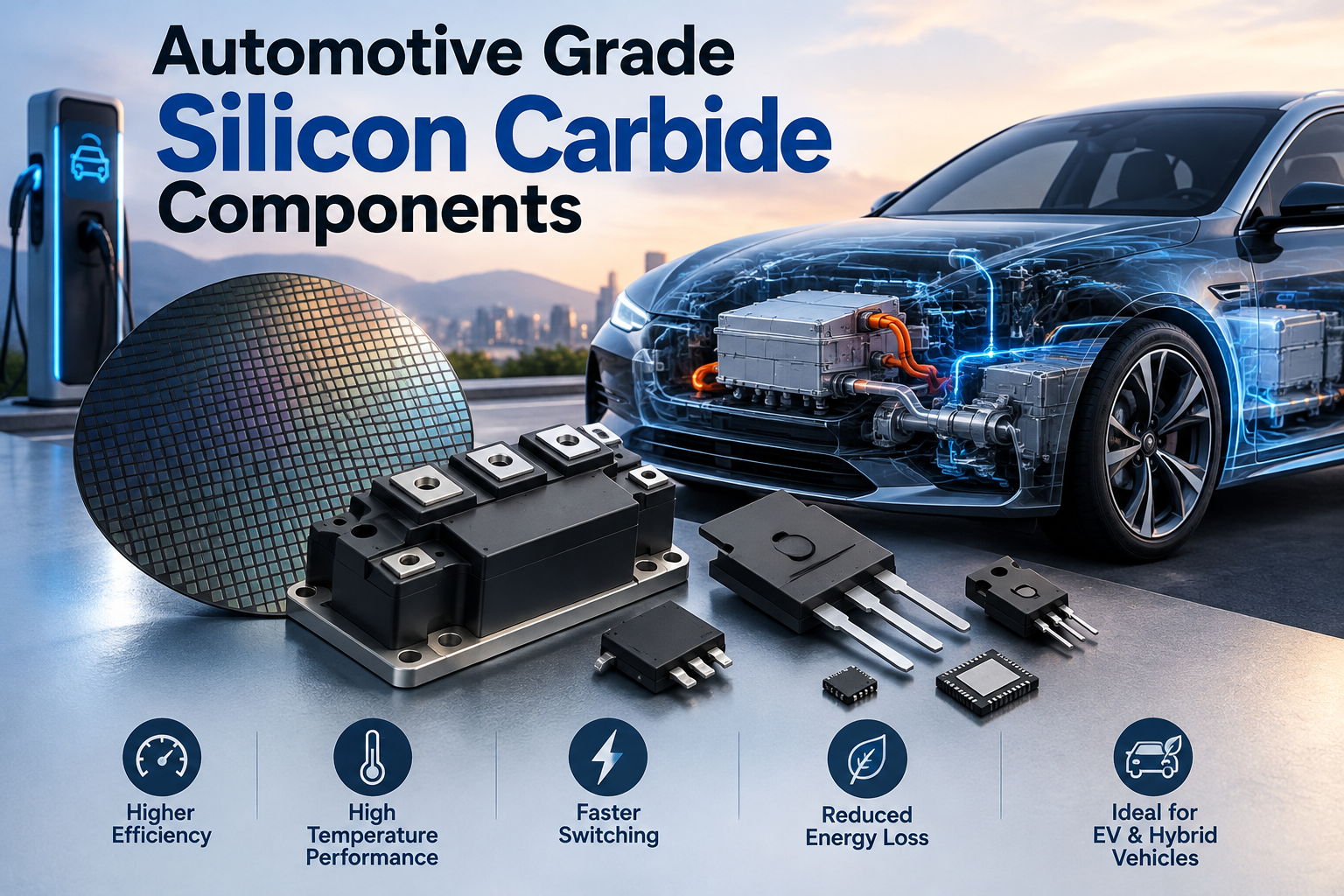
The automotive industry is undergoing a major transition toward electrified powertrains, higher-voltage vehicle architectures and more efficient energy-conversion systems. Against this backdrop, automotive-grade silicon carbide (SiC) components are gaining importance because of their ability to operate at higher voltages and temperatures while reducing switching losses compared with many conventional silicon-based semiconductor devices.
According to Semiconductor Insight, the Automotive Grade Silicon Carbide Components Market was valued at USD 894.40 million in 2025 and is estimated at USD 1,013.38 million in 2026. The market is projected to reach USD 2,752.09 million by 2034, advancing at a CAGR of 13.3% from 2025 to 2034. These components are used in automotive power-conversion applications, particularly main traction inverters, vehicle chargers and auxiliary electrical systems.
Explore the complete market analysis
https://semiconductorinsight.com/report/automotive-grade-silicon-carbide-components-market/
Why Are Silicon Carbide Components Becoming Important in Automotive Electronics?
Power semiconductors are essential to electric and hybrid vehicles because they control the conversion and distribution of electrical energy across the powertrain. As vehicle manufacturers adopt higher-voltage architectures and seek improved energy efficiency, semiconductor components must meet demanding switching, thermal and reliability requirements.
Silicon carbide is a wide-bandgap material that enables power devices to operate at higher voltages and temperatures than many traditional silicon components. Its switching characteristics can help reduce energy losses and support higher switching frequencies in selected automotive power systems.
These properties make SiC components particularly relevant to traction inverters, onboard chargers and other vehicle power-conversion applications. Their commercial value depends on the device design, package, operating voltage and qualification requirements of each vehicle platform.
The combination of lower switching losses, high-temperature capability and power density is therefore a major reason why automotive-grade SiC components are gaining attention across electric and hybrid vehicle supply chains.
Market Growth Is Closely Linked to Electric Vehicle Powertrain Development
One of the major trends influencing the Automotive Grade Silicon Carbide Components Market is the continued development of electric vehicle powertrains. Traction inverters require semiconductor devices capable of converting battery power into controlled electrical output for vehicle motors.
Semiconductor Insight identifies Main Inverter as the largest application segment, accounting for an estimated 59% of 2025 market revenue. SiC FET devices and integrated power assemblies can reduce switching losses in these systems, although the final benefit depends on battery voltage, cooling architecture and system design.
Vehicle manufacturers evaluate semiconductor content according to platform requirements rather than electric vehicle production volumes alone. Battery voltage, inverter topology, hybridization, semiconductor content per vehicle and component packaging all influence market demand.
For automotive suppliers, this creates opportunities to provide qualified SiC devices and power assemblies that meet the performance and reliability requirements of next-generation vehicle platforms.
Receive your Free Sample Report today
https://semiconductorinsight.com/download-sample-report/
Main Inverters Are Expanding the Technology Landscape
Main traction inverters represent the most significant application area within the automotive SiC components market. These systems convert battery direct current into controlled alternating current required by the electric motor.
SiC FETs are used as switching devices in high-efficiency inverter architectures, where switching energy, thermal performance and voltage handling are important design considerations. The report estimates that main inverters accounted for approximately 59% of 2025 application revenue.
Automotive customers qualify power devices over extended development cycles. Components must withstand thermal cycling, vibration, humidity and changing electrical loads before they can be approved for long-term vehicle production.
This qualification process creates opportunities for manufacturers with established automotive quality systems, proven package designs and the ability to provide long-term component supply.
Vehicle Chargers Create Additional Demand
The market extends beyond traction inverters into onboard vehicle charging systems. These systems combine rectification, power-factor correction and isolated conversion, creating opportunities for SiC diodes and transistor-based components.
Semiconductor Insight estimates that Vehicle Charger represented approximately 29% of 2025 market revenue. Component selection depends on vehicle architecture, charging standards, package availability and the electromagnetic performance of the complete power stage.
SiC Schottky diodes can support fast recovery and lower switching losses in selected rectifier and converter stages. Their adoption depends on factors such as surge current, junction temperature, reverse voltage and automotive qualification.
These applications broaden the addressable market for automotive-grade SiC components by creating demand from both traction power systems and vehicle charging electronics.
SiC FET Technology Is Leading Product Development
Another important development in the market is the use of different SiC component types to meet automotive power-conversion requirements. Semiconductor Insight segments the market into SiC Diodes, Silicon Carbide Triode, SiC FET and Other products.
SiC FET devices represent the leading type, with an estimated 55% share of 2025 revenue. Their role in controlled switching stages supports applications such as traction inverters, onboard chargers and DC/DC converters.
SiC diodes account for an estimated 23% of the market, while Silicon Carbide Triode represents approximately 14%. The report retains the triode category as a separate publisher-defined segment rather than merging it with other transistor families.
The product mix reflects different device functions and automotive qualification requirements. Package insulation, junction temperature, gate-drive behavior and thermal interface design influence which component is selected for a vehicle platform.
Efficiency and High-Temperature Operation Are Important Market Drivers
Lower switching losses and the ability to operate at elevated temperatures provide an important performance advantage for silicon carbide components in automotive power electronics.
These properties can help vehicle manufacturers improve power-conversion efficiency and manage cooling requirements in traction inverters and onboard chargers. The benefits are particularly relevant to high-voltage platforms where power density and thermal performance influence system design.
However, the practical advantage depends on gate-drive tuning, electromagnetic compatibility, package parasitics and operating voltage. A semiconductor device must be evaluated as part of the complete power stage rather than through an isolated data-sheet efficiency figure.
This distinction is central to understanding the market: automotive SiC components compete through switching performance, reliability and system-level efficiency rather than simply replacing every silicon device in every vehicle.
Automotive Qualification and Packaging Remain Key Challenges
Despite their advantages, automotive-grade SiC components face several technical and commercial constraints. Automotive customers require extended qualification because power devices must withstand thermal cycling, humidity, vibration and years of changing electrical loads.
Long qualification cycles can delay the transition from prototype development to recurring component shipments. A design win does not necessarily translate into immediate volume revenue because production timing depends on vehicle-platform schedules and purchasing agreements.
Packaging and thermal integration are additional considerations. Power modules must provide suitable insulation, heat transfer and electrical performance under the operating conditions of the vehicle.
The report also highlights the importance of long-term supply agreements, qualification documentation, source assurance and the ability to maintain consistent component quality across production programs.
Where Are the Biggest Opportunities Emerging?
Several applications could provide additional opportunities for automotive SiC component manufacturers. The expansion of electric vehicle platforms creates demand for efficient traction-inverter devices and integrated power assemblies.
Vehicle charging systems represent another opportunity as automakers develop onboard chargers with different voltage and power requirements. SiC diodes and switching devices can serve selected rectification and conversion stages.
High-voltage powertrain architectures could further support adoption where lower switching losses and thermal performance are important. Manufacturers that can provide qualified devices alongside reliable packaging and technical support may benefit from platform nominations.
Asia-Pacific vehicle production, North American automotive engineering programs and European powertrain development provide additional opportunities for suppliers serving global automotive electronics supply chains.
Access the Full Report for In-Depth Insights
https://semiconductorinsight.com/report/automotive-grade-silicon-carbide-components-market/
Automotive Grade Silicon Carbide Components Market Segmentation
The report evaluates the market by component type and application, providing a detailed view of where automotive-grade SiC devices are deployed.
By type, the market is divided into:
· SiC Diodes
· Silicon Carbide Triode
· SiC FET
· Other
By application, the market covers:
· Main Inverter
· Vehicle Charger
· Other
Regional Automotive Grade Silicon Carbide Components Market Outlook
Asia-Pacific represents the largest regional market, accounting for an estimated 48% of 2025 revenue. The region benefits from vehicle assembly clusters, semiconductor manufacturing capacity and established automotive electronics supply networks. China, Japan, South Korea and India are important markets covered by the report.
North America accounts for approximately 24% of the market, supported by automotive engineering centers, traction-inverter programs and high-voltage power-system qualification. The United States is an important center for vehicle platform development and supplier sourcing, while Canada and Mexico participate through integrated automotive supply chains.
Europe represents an estimated 20% share, with demand supported by automotive engineering, powertrain development and semiconductor manufacturing. Germany, France, Italy, the United Kingdom and Spain contribute through vehicle production, power-electronics design and component integration.
South America accounts for approximately 5% of the market, while the Middle East and Africa represent around 3%. These markets are developing through vehicle assembly, charging infrastructure and imported automotive power-electronics systems.
Competitive Landscape and Key Companies
The Automotive Grade Silicon Carbide Components Market includes semiconductor manufacturers and automotive power-module suppliers serving electric and hybrid vehicle applications.
Semiconductor Insight identifies Wolfspeed, STMicroelectronics, WeEn Semiconductors, ROHM, Infineon Technologies, Shenzhen BASiC Semiconductor, Sanan Optoelectronics, StarPower Semiconductor, Wingtech Technology, Shanghai Hestia Power and Semikron Danfoss among the companies covered in the competitive landscape.
Competition within the market is influenced by switching efficiency, voltage capability, thermal performance, automotive qualification, package integration and long-term supply assurance. The report also examines manufacturer positioning, product portfolios, market performance and competitive developments.
What Does the Automotive Grade Silicon Carbide Components Market Report Cover?
The Semiconductor Insight study provides analysis of market size, sales, revenue, competitive positioning, industry dynamics, segmentation and regional performance.
The report examines the industry chain, upstream materials, midstream component manufacturing and downstream automotive customers. It also evaluates market drivers, challenges, restraints, industry developments, new product developments, mergers and acquisitions, expansions and collaboration or supply contracts.
The study provides detailed segmentation by component type and application and examines market performance across North America, Europe, Asia-Pacific, South America, and the Middle East and Africa. Country-level coverage includes the United States, Canada, Mexico, Germany, France, the United Kingdom, Italy, China, Japan, South Korea, India, Brazil, Argentina, Saudi Arabia, the UAE and South Africa.
Key Questions Answered by the Study
The report helps industry participants evaluate questions including:
· What is the current Automotive Grade Silicon Carbide Components Market size?
· How large is the market projected to become by 2034?
· What is the expected CAGR through the forecast period?
· Which SiC component type holds the largest market share?
· How are electric vehicle powertrains influencing demand?
· Why are SiC components used in main traction inverters?
· What role do vehicle chargers play in market growth?
· What are the main advantages of silicon carbide over conventional silicon devices?
· What challenges affect automotive SiC component qualification?
· Which region represents the largest market?
· Who are the leading automotive-grade SiC component manufacturers?
· What factors influence competition among automotive semiconductor suppliers?
Explore the full market forecast and competitive analysis
https://semiconductorinsight.com/report/automotive-grade-silicon-carbide-components-market/
Get a Sample Report copy for free
https://semiconductorinsight.com/download-sample-report/
About Semiconductor Insight
Semiconductor Insight provides market intelligence and industry research covering semiconductor technologies, electronic components, advanced manufacturing systems and related technology markets. Its research focuses on market sizing, forecasting, competitive landscapes, technology trends, segmentation and regional analysis to support strategic decision-making across the semiconductor ecosystem.
Contact Semiconductor Insight
Website: www.semiconductorinsight.com
 Greek
 English
 Arabic
 French
 Spanish
 Portuguese
 Deutsch
 Turkish
 Dutch
 Italiano
 Russian
 Romaian
 Portuguese (Brazil)