


Enzymatic Depolymerization Recycling Market to Reach USD 249.2 Million by 2034 at 16.5% CAGR
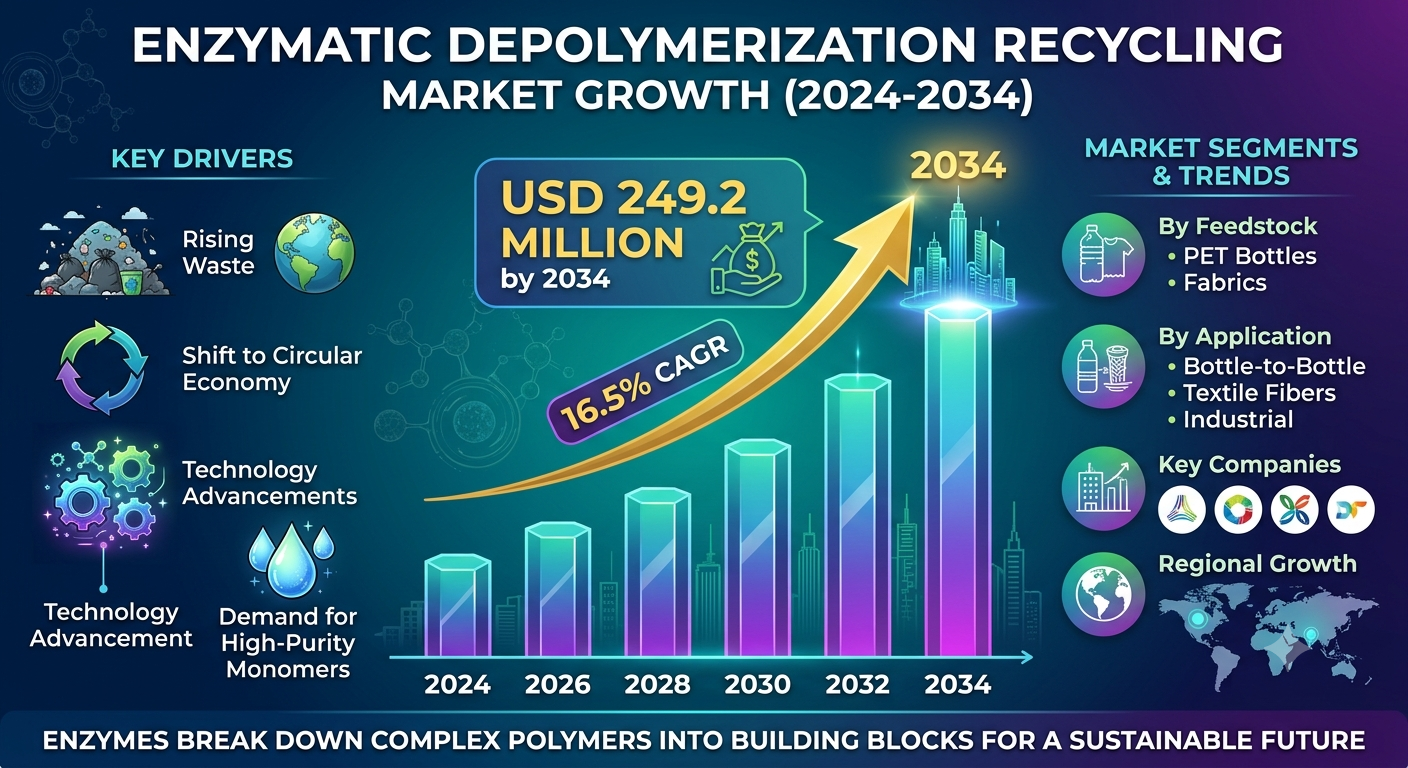
Global Enzymatic Depolymerization Recycling Market to Reach USD 249.2 Million by 2034 at 16.5% CAGR as Enzyme-Enabled Circularity Gains Ground
The global enzymatic depolymerization and recycling market is gaining attention across the chemical and waste management industry as manufacturers look for recycling systems that combine high-quality monomer recovery with bio-based technology positioning. Enzymatic depolymerization uses tailored biocatalysts to break selected synthetic polymers into recoverable molecular building blocks. PET hydrolases and cutinase-related enzymes can release monomers from polyester, while engineered enzyme systems for nylon address a more challenging set of chemical bonds. Their ability to recover high-quality building blocks from difficult waste streams allows them to serve a broad range of requirements across food and beverages, clothing and textiles, packaging, and other applications.
According to 24ChemicalResearch, the global enzymatic depolymerization and recycling market was valued at USD 62.8 million in 2025 and is projected to increase from USD 73.2 million in 2026 to USD 249.2 million by 2034, registering a CAGR of 16.5% during the forecast period. The market is being shaped by plastic waste pressure, textile offtake, monomer quality requirements, engineered enzymes and recycling policy.
Read the complete Global Enzymatic Depolymerization Recycling Market report:
https://www.24chemicalresearch.com/reports/282258/global-enzymatic-depolymerization-recycling-forecast-market
What Is Driving Enzymatic Depolymerization Recycling Market Growth?
The strongest demand driver identified by the report is the shift toward circular polyester and nylon procurement. Brands are increasingly examining recycled materials to meet sustainability commitments, creating opportunities for enzymatic recycling in textile-to-textile and bottle-to-bottle applications. Their ability to support monomer quality, contamination tolerance and closed-loop commitments makes them commercially relevant where brands are attempting to balance circularity with performance.
Textile brand partnerships provide another growth avenue. Samsara Eco and lululemon announced a ten-year collaboration in June 2025 covering recycled nylon and polyester, expanding the market beyond traditional mechanical recycling and bringing brand qualification, monomer purity and contracted offtake into the competitive landscape.
Production Chemistry and Technology Remain Important
The manufacturing economics of enzymatic depolymerization are closely connected to production technology. The report identifies engineered enzymes and process integration as an area of development, with process improvements aimed at increasing yield while maintaining monomer purity. Production remains more complex than simply treating waste with enzymes. Enzyme dose, reaction time, feedstock sorting, pretreatment and downstream purification influence the quality and economics of the recovered material. This makes production technology an important competitive factor, with developers able to improve conversion efficiency and control monomer purity strengthening their position in higher-value applications.
Request the complimentary Enzymatic Depolymerization Recycling Market sample:
https://www.24chemicalresearch.com/download-sample/282258/global-enzymatic-depolymerization-recycling-forecast-market
Feedstock Economics and Scale-Up Challenges
Like many advanced recycling markets, enzymatic depolymerization economics are influenced by feedstock availability and quality. The report highlights feedstock sorting, contamination and process cost as an important challenge for technology developers. Because mixed textiles contain dyes, finishes and several polymer types, feedstock composition can influence processing costs. Sorting and pretreatment increase operating costs but can unlock streams with poor mechanical-recycling outcomes.
Where Are the Chemical Industry Opportunities?
North America currently represents the largest regional market at approximately 32% of 2025 revenue, followed by Europe at 30%, Asia-Pacific at 25%, Oceania at 10% and Rest of World at 3%. Another opportunity is the expansion of enzymatic recycling into textile-to-textile circularity. Nylon recycling is a further high-value opportunity, with Samsara Eco announcing a nylon 6 enzyme advance in December 2024 and Epoch Biodesign emphasizing integrated nylon 6,6 recycling.
Enzymatic Depolymerization Recycling Market Segmentation
The report evaluates the market across type, application, end user and distribution channel. By type, PET leads at 66% share in 2025. By application, clothing and textiles lead at 41%. By end user, industrial manufacturers represent 61% share, while direct technology contracts remain the principal channel at 55%.
Competitive Landscape: Technology Developers and Recycling Specialists
The global enzymatic depolymerization and recycling market remains competitive and development-stage. The report profiles Carbios, Samsara Eco and Epoch Biodesign among the key companies operating in the market. Carbios is highlighted for its enzymatic PET depolymerization, Samsara Eco for its Jerrabomberra scale-up plant and EosEco enzyme systems, and Epoch Biodesign for its nylon 6,6 demonstration capacity.
Challenges Facing Enzymatic Depolymerization Manufacturers
Cost remains one of the principal barriers to wider adoption, with enzyme consumption, sorting, pretreatment and purification costs constraining growth. Scale-up risk is another consideration, as announced facilities are development milestones rather than existing production capacity. Technical performance also limits some applications, as polyethylene cannot be treated like PET by ordinary ester-cleaving enzymes.
Read the Full Report for Key Data:
https://www.24chemicalresearch.com/reports/282258/global-enzymatic-depolymerization-recycling-forecast-market
About 24 Chemical Research
24 Chemical Research specializes in chemical and materials market intelligence, covering specialty chemicals, polymers, surfactants, advanced materials and related industrial markets. Its research combines market sizing and forecasting with analysis of production, capacity, pricing, trade flows, applications, suppliers, regional demand and competitive positioning.
Contact 24 Chemical Research
Phone: +91 9169162030
Email: help@24chemicalresearch.com
Website: www.24chemicalresearch.com
 Portuguese (Brazil)
 English
 Arabic
 French
 Spanish
 Portuguese
 Deutsch
 Turkish
 Dutch
 Italiano
 Russian
 Romaian
 Greek