


Automobile Clutch Material Market to Reach USD 5.34 Billion by 2034 at 5.1% CAGR
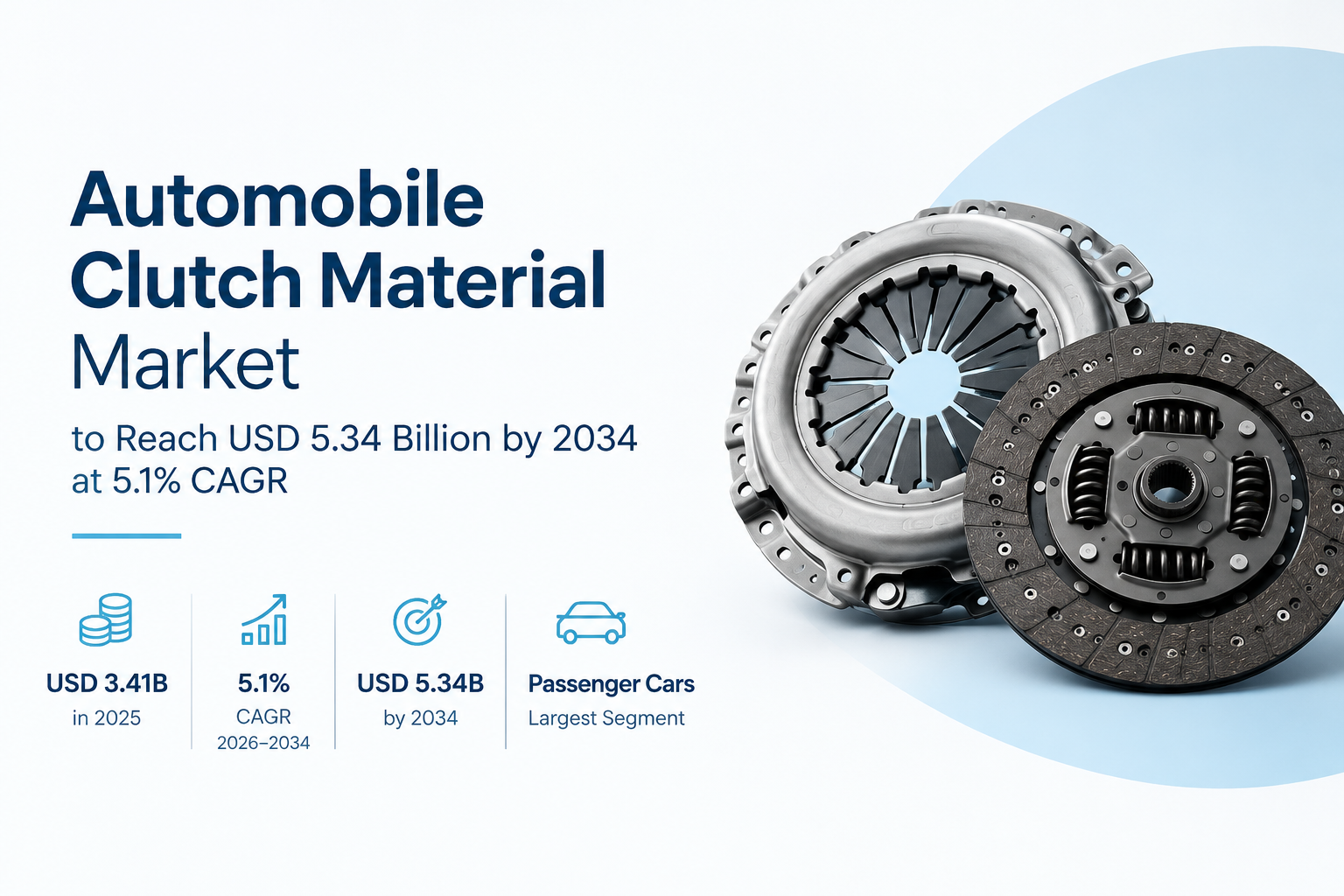
According to 24ChemicalResearch, the global automobile clutch material market was valued at USD 3.41 billion in 2025 and is estimated to reach USD 3.58 billion in 2026. The market is projected to reach USD 5.34 billion by 2034, growing at a compound annual growth rate (CAGR) of 5.1% during the 2026–2034 forecast period. Rising vehicle production, replacement demand, advancements in friction materials, and increasing requirements for thermal stability and higher torque capacity are supporting market growth. Hybrid transmissions, dual-clutch systems, and specialized friction technologies are creating additional opportunities.
https://www.24chemicalresearch.com/reports/280227/global-automobile-clutch-material-market
Automobile Clutch Material Market Overview
Automobile clutch materials are friction materials and friction-lined components used in dry and wet clutch systems across passenger cars, commercial vehicles, and off-highway vehicles. They provide controlled friction, smooth engagement, wear resistance, thermal stability, and reliable performance.
Organic clutch facings remain the principal material category because of their favorable cost, smooth engagement, and suitability for conventional manual and automated-manual applications. Ceramic, carbon-carbon composite, and sintered metallic materials serve applications requiring greater heat resistance, torque density, and specialized wet-clutch performance.
The market is evolving alongside changing powertrain architectures. Although battery-electric vehicles reduce the need for certain conventional clutch components, hybrid transmissions, disconnect clutches, dual-clutch transmissions, all-wheel-drive couplings, wet-clutch systems, and replacement components continue to support demand.
Suppliers compete on friction stability, fade resistance, wear behavior, noise, vibration and harshness (NVH), thermal performance, and compatibility with transmission oils.
What Is Driving the Automobile Clutch Material Market?
1. Global Vehicle Production and Automotive Manufacturing
Vehicle manufacturing remains an important source of original equipment demand. The report cites International Organization of Motor Vehicle Manufacturers (OICA) data indicating global vehicle production of 96.4 million units in 2025, an increase of 3.9% compared with 2024.
This production base supports demand for clutch and transmission components in vehicles that use friction interfaces. Manufacturers are adapting to requirements for higher torque density, stop-start cycling, and compact drivetrain packaging. Suppliers offering consistent friction performance, application-specific formulations, and reliable manufacturing are positioned to serve these requirements.
2. Replacement Demand from the Existing Vehicle Fleet
The established fleet of combustion-engine and hybrid vehicles supports recurring aftermarket demand as clutch facings and replacement kits wear during operation.
The report cites 256 million passenger cars on European Union roads in 2024, alongside 31.1 million vans and 6.2 million trucks. This installed base illustrates the continuing requirement for maintenance and replacement components.
Older commercial vehicles and manual-transmission fleets contribute to replacement demand. Product availability, application coverage, durability, and operating cost remain important purchasing considerations.
3. Advanced Friction Materials and Thermal Performance
Commercial vehicles, performance cars, off-highway machinery, and advanced transmissions expose friction interfaces to substantial thermal loads, pressure, and repeated engagement cycles.
Organic materials remain widely used because of their cost-effectiveness and smooth engagement. Ceramic, carbon-composite, and sintered metallic materials serve applications requiring greater heat resistance, torque capacity, and reduced thermal fade.
Suppliers are developing formulations to improve friction stability, thermal performance, durability, and vibration control. Testing and validation remain important before materials can be adopted in demanding applications.
4. Hybrid Powertrains and Advanced Clutch Architectures
Hybrid transmissions, dual-clutch transmissions (DCTs), and wet-clutch systems are changing technical requirements. Wet-clutch applications require materials that maintain controlled friction in oil while addressing drag losses and repeated-cycle durability.
The report notes that BorgWarner produces more than 800,000 DualTronic units annually, demonstrating the scale of advanced clutch architectures. These applications create opportunities for specialized friction plates, composite materials, clutch packs, and system-level engineering.
5. Electrification and Changing Powertrain Demand
Battery-electric vehicles present a structural challenge because many electric drivetrains do not require conventional engine-clutch functions.
The report states that battery-electric cars represented 17.4% of European Union registrations in 2025, while hybrids accounted for 34.5%.
Consequently, suppliers are increasingly focusing on hybrid transmissions, dual-clutch systems, wet-clutch packs, commercial vehicles, off-highway machinery, and replacement components. Market development will depend on powertrain composition, material upgrades, and the durability requirements of the existing fleet.
Automobile Clutch Material Market Segmentation Insights
By Type
-
Organic Clutch Facings: Represent approximately 70% of market value in 2025. They offer smooth engagement, acceptable thermal capability, low noise, and favorable cost, making them suitable for high-volume passenger cars and commercial vehicles.
-
Ceramic Clutch Materials: Account for approximately 15% of market value. They serve applications involving higher thermal stress and repeated high-energy engagement, including severe-duty and heavy-duty vehicles. Higher costs and potentially more aggressive engagement can limit adoption.
-
Carbon-Carbon Composites: Represent approximately 6% of market value. Used in premium applications, motorsport, high-performance vehicles, and selected wet-clutch systems, they offer specialized friction performance but involve higher costs and application-specific processing.
-
Sintered Metallic Materials: Account for approximately 9% of market value. They support heavy-duty, off-highway, and compact high-load systems requiring robustness under demanding temperatures and pressures.
By Application
-
Passenger Cars: Represent approximately 60% of market consumption. Demand includes manual, automated-manual, hybrid, and dual-clutch architectures, alongside replacement requirements. Cost, pedal feel, NVH performance, and durability remain important considerations.
-
Light Commercial Vehicles: Account for approximately 18% of consumption. Higher load factors and frequent stop-start cycles increase thermal cycling and wear requirements. Fleet operators prioritize service life, availability, and operating cost.
-
Heavy Commercial Vehicles: Represent approximately 17% of consumption. High torque, thermal loads, and intensive utilization support demand for durable organic and ceramic friction materials.
-
Off-Highway Vehicles: Account for approximately 5% of consumption. Agricultural, construction, and mining machinery require materials suited to high torque, dusty conditions, low-speed maneuvering, and repeated cycling.
By End User
-
Original Equipment Manufacturers (OEMs): Account for approximately 62% of market value. OEMs require validated friction performance, NVH characteristics, durability, and manufacturing consistency.
-
Aftermarket: Represents approximately 38% of market value. Demand is supported by the existing combustion-engine and hybrid vehicle fleet, with availability, durability, brand recognition, and application coverage influencing purchases.
By Material Technology
-
Conventional Friction Materials: Account for approximately 67% of the market. Resin-bonded organic materials remain widely used because of their cost, comfort, and durability.
-
Advanced Composite Materials: Represent approximately 28%. Engineered fiber, carbon, ceramic, and hybrid systems address applications requiring improved thermal stability, reduced wear, or higher power density.
-
Nano-Enhanced / Engineered Surface Materials: Account for approximately 5%. These technologies seek to improve friction stability, wear behavior, and thermal response. Adoption remains constrained by cost, production scale-up, and validation requirements.
Regional Market Analysis
Asia-Pacific
Asia-Pacific is the largest market, accounting for an estimated 61% of global market value in 2025. Automotive manufacturing in China, Japan, India, South Korea, and Southeast Asia supports demand for organic clutch facings, hybrid transmissions, dual-clutch systems, and advanced friction materials. Localized supplier operations support vehicle manufacturers and engineering programs.
Europe
Europe accounts for approximately 18% of market value. Its established vehicle fleet and automotive manufacturing base support conventional and advanced clutch applications. Electrification affects conventional clutch demand, while hybrid transmissions, dual-clutch systems, specialized friction applications, and replacement requirements continue to create opportunities.
North America
North America represents approximately 13% of global market value. Heavy commercial vehicles, performance applications, and replacement demand support the market. Organic and ceramic materials serve different commercial-vehicle requirements, while specialized driveline applications support engineered friction materials.
Latin America
Latin America accounts for approximately 5% of market value. Demand is associated with the existing vehicle fleet, commercial transportation, regional assembly, and price-sensitive replacement markets. Organic facings remain important, while premium materials serve specialized heavy-duty and performance applications.
Middle East & Africa
The Middle East and Africa represent approximately 3% of global market value. Commercial fleets, off-highway equipment, and replacement requirements support demand. High ambient temperatures and severe operating conditions can increase thermal loading, making durable friction systems important for trucks, construction equipment, and mining machinery.
Competitive Landscape
The automobile clutch material market includes integrated clutch-system manufacturers, transmission specialists, commercial-vehicle suppliers, and specialized friction-material producers.
Key market participants include:
-
EXEDY Corporation
-
Schaeffler AG (LuK)
-
ZF Friedrichshafen AG (SACHS)
-
BorgWarner Inc.
-
Valeo
-
Eaton Corporation plc
-
Miba AG
-
F.C.C. Co., Ltd.
-
Aisin Corporation
-
ASK Automotive Limited
Integrated suppliers compete through original equipment relationships, system engineering, and replacement portfolios. Transmission specialists focus on friction plates, clutch packs, oil compatibility, and high-cycle durability. Commercial-vehicle suppliers emphasize torque capacity, vibration control, durability, and long service intervals.
Formulation expertise, quality consistency, application-specific engineering, and validation capabilities remain important competitive factors.
Report Summary
The global automobile clutch material market is projected to grow from USD 3.41 billion in 2025 to USD 5.34 billion by 2034, at a CAGR of 5.1% during 2026–2034. Vehicle production, replacement demand, advanced friction materials, and specialized clutch architectures support expansion.
Organic clutch facings remain the leading material category, while passenger cars represent the largest application segment. Ceramic, carbon-composite, and sintered metallic materials address demanding thermal and torque requirements.
Asia-Pacific leads the market, supported by automotive manufacturing and supplier operations. Electrification is reshaping demand, increasing the importance of hybrid systems, dual-clutch transmissions, wet-clutch applications, commercial vehicles, off-highway machinery, and replacement components.
Key Report Highlights
-
Market Size: USD 3.41 billion in 2025.
-
2026 Estimate: USD 3.58 billion.
-
2034 Forecast: USD 5.34 billion.
-
CAGR: 5.1% during 2026–2034.
-
Leading Material Type: Organic clutch facings, approximately 70% of 2025 market value.
-
Leading Application: Passenger cars, approximately 60% of market consumption.
-
Largest Market: Asia-Pacific, approximately 61% of market value in 2025.
-
End Users: OEMs account for 62% of market value; aftermarket represents 38%.
-
Material Technologies: Conventional friction materials, 67%; advanced composites, 28%; nano-enhanced or engineered-surface materials, 5%.
-
Growth Drivers: Vehicle production, replacement demand, hybrid and dual-clutch applications, higher torque density, thermal performance, and commercial-vehicle activity.
-
Market Challenge: Battery-electric vehicle adoption reduces conventional clutch requirements in certain powertrain architectures.
-
Key Companies: EXEDY, Schaeffler/LuK, ZF/SACHS, BorgWarner, Valeo, Eaton, Miba, F.C.C., Aisin, and ASK Automotive.
-
Report Coverage: Market sizing, forecasts, segmentation, regional analysis, growth drivers, competitive positioning, material technologies, and industry developments through 2034.
Frequently Asked Questions (FAQs)
Q1: What is the global automobile clutch material market size?
A: The market was valued at USD 3.41 billion in 2025 and is estimated to reach USD 3.58 billion in 2026.
Q2: What is the projected market value by 2034?
A: The market is projected to reach USD 5.34 billion by 2034.
Q3: What is the expected CAGR?
A: The market is expected to grow at a CAGR of 5.1% during 2026–2034.
Q4: Which material type leads the market?
A: Organic clutch facings lead the market, accounting for approximately 70% of 2025 market value.
Q5: Which application segment is the largest?
A: Passenger cars account for approximately 60% of market consumption.
Q6: Which region dominates the market?
A: Asia-Pacific leads, representing an estimated 61% of global market value in 2025.
Q7: What are the main growth drivers?
A: Key drivers include vehicle production, replacement demand, hybrid and dual-clutch applications, advanced friction materials, and increasing thermal-performance requirements.
Q8: How does electrification affect the market?
A: Battery-electric vehicles reduce demand for certain conventional clutch components, while hybrid transmissions, dual-clutch systems, wet-clutch applications, commercial vehicles, and replacement components continue to support demand.
Q9: Who are the major market participants?
A: Key companies include EXEDY Corporation, Schaeffler AG (LuK), ZF Friedrichshafen AG (SACHS), BorgWarner Inc., Valeo, Eaton Corporation plc, Miba AG, F.C.C. Co., Ltd., Aisin Corporation, and ASK Automotive Limited.
Q10: What does the report cover?
A: The report covers market size, forecasts, material types, applications, end users, material technologies, regional demand, market dynamics, competitive positioning, and developments through 2034.
View the Complete Report
https://www.24chemicalresearch.com/reports/280227/global-automobile-clutch-material-market
Download the free sample report
Contact Us
Website: Chemical Market Research | Global Chemical Market Research Reports | 24ChemicalResearch
Asia: +91 9169162030
 Greek
Greek
 English
 Arabic
 French
 Spanish
 Portuguese
 Deutsch
 Turkish
 Dutch
Dutch
 Italiano
 Russian
 Romaian
 Portuguese (Brazil)