


How Can Food Businesses Choose Preparation Equipment That Maintains Product Quality During High-Speed Processing?
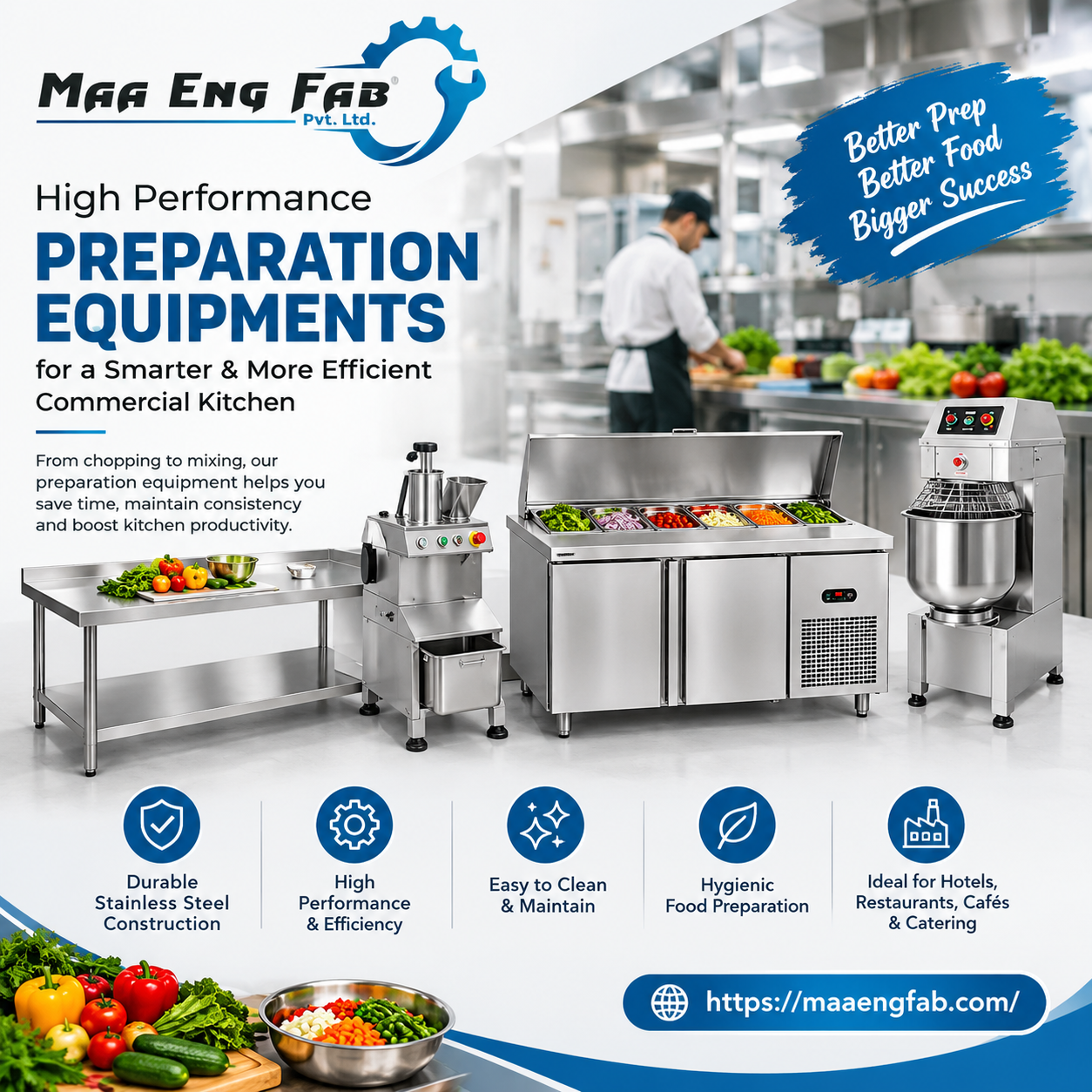
High-speed food preparation can help commercial kitchens, hotels, catering companies, and food processing units handle increasing production demands. However, increasing processing speed does not automatically improve productivity. If equipment cannot maintain cutting accuracy, ingredient structure, and consistent output at higher speeds, businesses may experience more product damage, additional waste, and quality variations.
Selecting suitable food preparation equipment requires balancing processing capacity with the quality standards of the finished product. Buyers should evaluate machine design, ingredient characteristics, operating settings, cleaning requirements, and maintenance needs before making a purchasing decision.
For businesses comparing a Preparation Equipments Manufacturer, understanding how a machine performs under realistic production conditions is essential. The following factors can help buyers select equipment that supports efficient processing without compromising product quality.
1. Understand How Ingredient Characteristics Affect Processing
Different food ingredients respond differently to mechanical processing. Firm vegetables, delicate fruits, leafy ingredients, and moisture-rich products may require different cutting methods and operating settings.
For example, a setting that works well for firm potatoes may produce crushed or irregular pieces when applied to softer ingredients. Increasing feed speed without considering ingredient characteristics can also create uneven loading and inconsistent results.
Before selecting equipment, identify the ingredients you process most frequently and determine their preparation requirements.
Consider:
-
Ingredient hardness, size, and shape.
-
Moisture content and product maturity.
-
Required cutting dimensions or finished texture.
-
Acceptable levels of breakage and material loss.
-
Expected variation between ingredient batches.
Ask the supplier to demonstrate the equipment using representative ingredients rather than relying entirely on a standard demonstration material.
2. Evaluate Product Quality at Different Processing Speeds
A machine may produce excellent results at a moderate speed but become less consistent when operating faster. This is why buyers should test output quality at several approved operating settings.
During a demonstration, process comparable batches at different settings and record the results. Examine the finished product for size variation, crushed pieces, damaged surfaces, and excessive fragments.
Measure the percentage of output that meets your quality specifications.
Acceptable output (%) = Weight of acceptable product ÷ Total processed output weight × 100
For example, if a batch produces 18 kg of acceptable product from 20 kg of total processed output, the acceptable-output proportion is 90%.
Use consistent sampling and acceptance criteria when comparing settings or machines. A faster setting should only be considered beneficial if it delivers sufficient usable output and meets the required quality standards.
3. Check Blade Design and Cutting Mechanism
The cutting mechanism plays a significant role in preparation quality. Blade geometry, sharpness, alignment, material, and the condition of supporting components can influence how ingredients are processed.
Worn or damaged blades may increase crushing, uneven cuts, and processing resistance. Incorrect installation or unsuitable cutting components may also affect performance.
When evaluating equipment, ask the manufacturer about:
-
Available blade types and cutting configurations.
-
Adjustment procedures and permitted operating settings.
-
Inspection and replacement requirements.
-
Availability of compatible replacement components.
-
Safe cleaning and blade-handling procedures.
Do not assume that every blade configuration is suitable for every ingredient. The correct selection depends on the intended application and the machine's design.
A dependable Preparation Equipments Manufacturer in India should be able to explain the relationship between cutting components, processing settings, and expected output quality.
4. Examine Feeding Consistency and Ingredient Movement
Even a well-designed machine can produce inconsistent results when ingredients are fed irregularly. Overloading may restrict ingredient movement, while inconsistent feeding can create variations in processing time and finished-product dimensions.
The feeding method should match the machine's intended operating procedure. Buyers should examine whether operators can load ingredients safely and maintain a steady workflow without forcing material into the equipment.
During testing, observe whether the machine processes ingredients evenly throughout the batch. Record any recurring blockages, uneven feeding, or visible changes in output quality.
For automated or continuous-feed systems, also evaluate the interaction between the feeding mechanism and the cutting or processing components.
Stable feeding can help maintain consistent output, but operators must always follow the manufacturer's loading limits and safety instructions.
5. Monitor Heat Generation and Product Texture
Some preparation operations can generate heat through friction, mechanical action, or extended processing. Depending on the ingredient and application, excessive temperature changes may affect texture, firmness, moisture retention, or other product characteristics.
This does not mean that every high-speed machine creates a significant heating problem. The actual effect depends on the processing method, operating duration, ingredient properties, and machine design.
Businesses processing temperature-sensitive ingredients should measure product temperature before and after representative processing cycles when appropriate.
Compare results under similar conditions and define acceptable limits based on the product specification. If temperature changes affect quality, consult the manufacturer about suitable settings, processing intervals, or alternative equipment configurations.
Objective measurements are more useful than assuming that a machine's speed alone determines the quality of the finished product.
6. Assess Vibration, Stability, and Mechanical Performance
Stable mechanical operation supports consistent processing. Excessive vibration, unusual noise, or repeated interruptions may indicate a need for inspection or adjustment.
Potential causes include worn components, incorrect installation, unsuitable loading, alignment problems, or operation outside the manufacturer's specified conditions.
During an equipment trial, observe the machine under normal approved operating conditions. Check whether it remains stable and whether processing quality changes during repeated batches.
If abnormal noise, vibration, overheating, or safety warnings occur, stop the test when necessary and arrange an appropriate inspection. Never bypass guards or operate equipment beyond its specified limits to achieve a higher processing rate.
Buyers should also review installation requirements and maintenance instructions before deciding where and how the machine will be used.
7. Measure Product Yield Alongside Processing Speed
High-speed processing should be evaluated in terms of usable output, not simply the amount of material passing through the machine.
If a machine processes more ingredients per hour but generates additional waste, requires reprocessing, or produces unacceptable pieces, its apparent productivity advantage may be misleading.
Record the starting ingredient weight, total processed output, acceptable product weight, and rejected material. Repeat the measurement using comparable ingredient batches and operating conditions.
A useful comparison should include:
-
Processing time per batch.
-
Acceptable output per hour.
-
Product damage and rejection rates.
-
Ingredient waste.
-
Additional handling or reprocessing time.
This approach helps businesses understand whether a faster operating setting improves actual production efficiency.
8. Consider Cleaning, Changeover, and Maintenance Requirements
Equipment quality must be maintained throughout daily operations. Residue accumulation, worn components, incorrect adjustments, or inconsistent maintenance can gradually affect processing results.
When a machine handles different ingredients, cleaning and changeover procedures also influence production planning. Buyers should examine how product-contact areas are accessed, how approved components are removed and reassembled, and how the equipment is verified before the next batch.
Ask the supplier for written guidance covering cleaning, inspection, preventive maintenance, and replacement parts.
When comparing Preparation Equipments Manufacturers in India, consider the availability of technical support and compatible components alongside machine specifications. Good documentation helps operators maintain consistent performance and identify problems before they repeatedly disrupt production.
9. Compare Manufacturers Using Practical Performance Tests
Equipment specifications provide a useful starting point, but a practical trial offers stronger evidence of how a machine may perform in your operation.
When comparing Preparation Equipments Suppliers in India, use the same evaluation criteria for each shortlisted machine.
| Evaluation factor | What to verify |
|---|---|
| Processing capacity | Acceptable output under representative conditions |
| Cutting quality | Uniformity and compliance with product specifications |
| Product yield | Usable output and avoidable waste |
| Operating stability | Performance across repeated batches |
| Cleaning | Accessibility and documented cleaning procedure |
| Maintenance | Inspection intervals and replacement requirements |
| Service support | Warranty, training, and spare-part availability |
Request written specifications and clarify whether advertised capacity represents ideal conditions or measured performance under a defined workload.
A supplier that explains limitations clearly can help buyers make a more informed decision than one relying solely on broad performance claims.
Conclusion
Choosing preparation equipment for high-speed processing requires more than comparing motor power or advertised production capacity. Businesses should evaluate ingredient compatibility, cutting accuracy, feeding consistency, temperature effects where relevant, mechanical stability, usable yield, cleaning requirements, and maintenance support.
A structured performance trial helps identify the operating settings that balance speed with acceptable product quality. Recording measurable results also makes it easier to compare different machines objectively.
For businesses assessing a Preparation Equipments Manufacturer, practical demonstrations and clear technical documentation are essential. Comparing Preparation Equipments Suppliers using consistent evaluation criteria can help identify equipment that matches actual production needs.
Ultimately, the right preparation equipment should deliver reliable throughput while maintaining the quality standards your customers expect. The best choice is the machine that performs consistently under realistic operating conditions, rather than simply the machine that runs at the highest speed.
 Portuguese (Brazil)
 English
 Arabic
 French
 Spanish
 Portuguese
 Deutsch
 Turkish
 Dutch
Dutch
 Italiano
 Russian
 Romaian
 Greek
Greek