


How Does a Fast Food Equipment Manufacturer Design Equipment for Faster Kitchen Workflow?
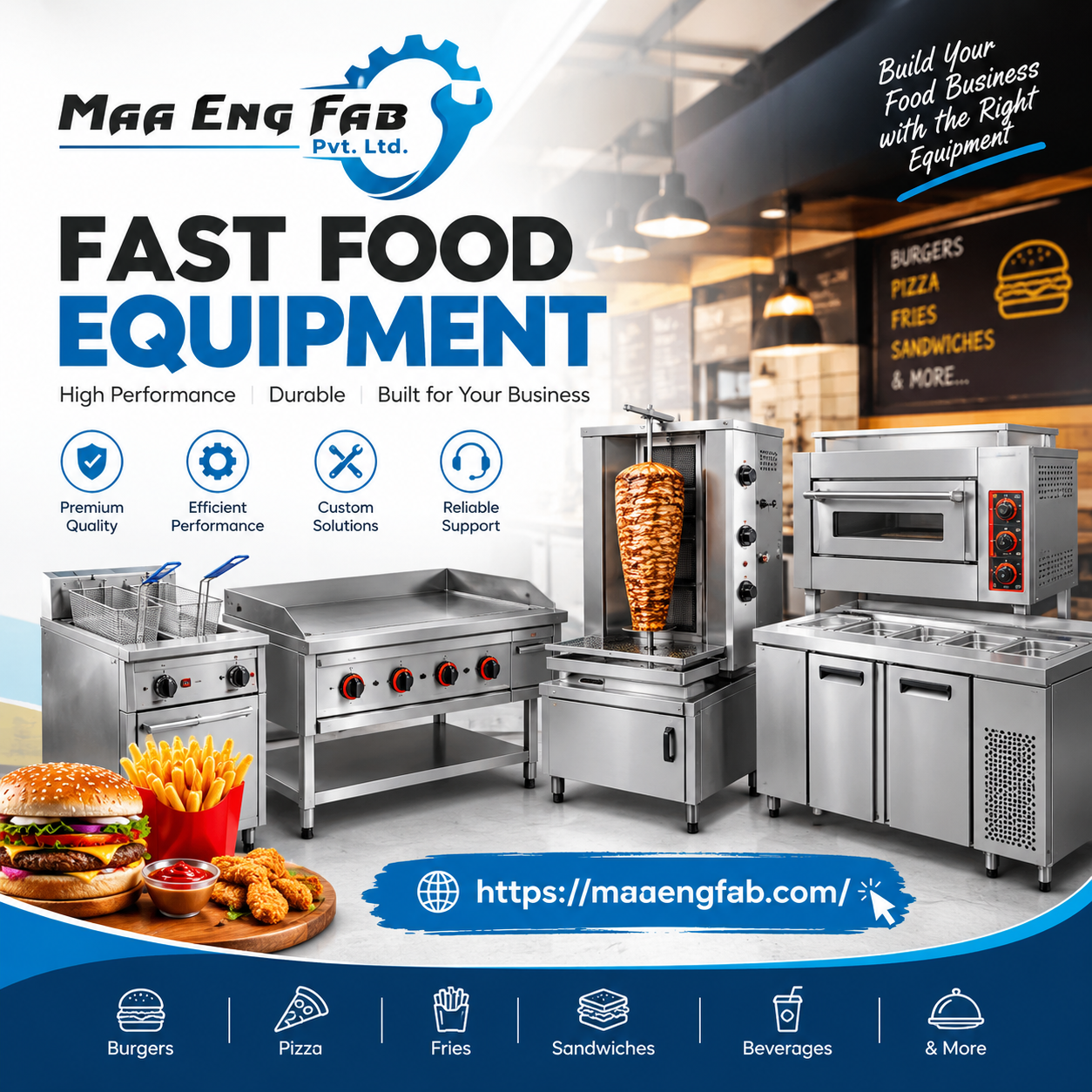
In a busy fast-food kitchen, speed is not determined by cooking equipment alone. The way equipment is positioned, sized, connected, operated, cleaned and maintained can have a major impact on how quickly orders move from preparation to service.
A Fast Food Equipment Manufacturer therefore has to think beyond individual machines. The real objective is to create an equipment setup that supports a smooth sequence of work, reduces unnecessary movement, avoids bottlenecks and allows staff to maintain consistent production during busy periods.
A well-designed kitchen does not simply contain powerful equipment. It creates a logical workflow in which each station supports the next one.
This article explains how manufacturers approach that process, what factors influence equipment design, common workflow mistakes, and what restaurant owners should evaluate before selecting equipment.
What Does “Faster Kitchen Workflow” Actually Mean?
A faster kitchen workflow does not necessarily mean that every machine cooks faster.
Instead, it means that the complete process—from receiving an order to preparing, cooking, assembling, holding and serving it—contains fewer unnecessary delays.
For example, a kitchen can have a high-capacity fryer, but if staff members must repeatedly cross the kitchen to collect ingredients, the overall operation may still be slow.
A practical workflow considers:
- Ingredient movement
- Preparation sequence
- Cooking sequence
- Staff movement
- Equipment accessibility
- Order assembly
- Holding requirements
- Cleaning access
- Waste movement
- Storage location
- Peak-hour demand
The equipment should support this sequence rather than force employees to work around it.
How Does a Fast Food Equipment Manufacturer Design for Better Workflow?
Manufacturers generally begin by understanding the kitchen's actual workload rather than selecting equipment based only on available floor space.
Several important factors are considered before fabrication or installation.
1. Understanding the Menu Before Designing Equipment
The menu is one of the most important inputs in commercial kitchen planning.
A burger outlet, pizza shop, café, fried-food counter and multi-product QSR may all require very different equipment arrangements.
For example, a menu with:
- Burgers
- Fried chicken
- French fries
- Sandwiches
- Grilled snacks
may require a combination of preparation counters, refrigeration, fryers, griddles, holding equipment and assembly areas.
The manufacturer needs to understand which products are ordered together and which cooking processes overlap.
Why does this matter?
If two high-demand products depend on the same piece of equipment, that equipment can become a bottleneck during busy periods.
Therefore, equipment planning should begin with the production process, not simply a list of machines.
2. Mapping the Complete Kitchen Workflow
Before deciding where equipment should go, the manufacturer can map the movement of food and employees.
A basic workflow might look like:
Storage → Preparation → Cooking → Holding → Assembly → Dispatch
However, the actual sequence depends on the menu.
For example:
Cold storage → Preparation → Griddle → Assembly → Holding → Service
or:
Preparation → Fryer → Draining → Seasoning → Holding → Dispatch
The objective is to keep related activities close together while preventing unnecessary crossing between different work zones.
3. Creating Functional Kitchen Zones
A commercial kitchen becomes easier to operate when equipment is grouped according to function.
Typical zones can include:
Preparation Zone
This may contain:
- Work tables
- Cutting areas
- Vegetable preparation equipment
- Food processors
- Sinks
- Refrigerated preparation counters
Cooking Zone
This may include:
- Fryers
- Griddles
- Ranges
- Cooking ranges
- Ovens
- Specialty cooking equipment
Assembly Zone
This is where cooked and prepared components come together.
It may include:
- Work counters
- Refrigerated counters
- Ingredient containers
- Shelving
- Packaging materials
Dispatch Zone
The final area should allow finished orders to move toward the service counter or delivery handover point without interfering with incoming raw materials.
This zoning approach helps reduce unnecessary movement.
4. Positioning Equipment According to Process Sequence
Equipment placement can be just as important as equipment specifications.
Imagine a worker who needs to move from a preparation counter to a fryer and then to a seasoning station.
If these three stations are placed logically, the worker can complete the task with minimal movement.
If they are positioned far apart, the same process requires repeated walking.
Over a full service period, these small movements can become a significant operational burden.
This is why experienced Fast Food Equipment Suppliers should discuss workflow and equipment positioning rather than focusing only on product dimensions and price.
5. Designing Around the Most Frequently Used Equipment
Not every piece of equipment is used equally.
Some machines may be accessed continuously throughout service, while others are used occasionally.
High-use equipment should generally be positioned where staff can access it easily without interfering with other activities.
For example, if a fryer is continuously used during peak periods, its position should support:
- Easy loading
- Safe unloading
- Oil management
- Product transfer
- Nearby holding or seasoning
- Safe staff movement
- Cleaning access
The goal is not simply to place the fryer in an available space. It should become part of an efficient production sequence.
6. Reducing Unnecessary Staff Movement
Staff movement is one of the hidden factors in kitchen productivity.
Employees may repeatedly walk because:
- Ingredients are stored too far away
- Utensils are located at another station
- Packaging is separated from assembly
- Refrigeration is poorly positioned
- Cooking and preparation stations are disconnected
- Finished products must travel across the kitchen
A manufacturer can address some of these problems through equipment configuration.
For example, a preparation counter can be designed with integrated storage or refrigeration so frequently used ingredients remain close to the workstation.
This allows the operator to spend more time performing productive tasks instead of searching or walking.
7. Designing Equipment for Ergonomic Operation
Workflow is not only about distance. It is also about how easily employees can use the equipment.
Important ergonomic considerations include:
- Working height
- Control accessibility
- Handle placement
- Door opening direction
- Loading height
- Unloading position
- Reach distance
- Visibility
- Cleaning access
- Space around operating areas
A poorly positioned control panel can slow operation. An awkwardly positioned door can interfere with another workstation.
Good equipment design takes these small details into account.
8. Matching Equipment Capacity With Actual Demand
Fast equipment is not useful if its capacity does not match the workload.
Suppose a kitchen receives a large number of orders during a short peak period. The manufacturer needs to consider:
- Expected production volume
- Portion size
- Batch size
- Cooking time
- Recovery time
- Number of simultaneous orders
- Holding requirements
- Staff availability
The important question is:
Can the complete equipment system maintain the required production rate—not just perform one fast cooking cycle?
This distinction is particularly important for fryers, griddles, ovens and other continuously operated equipment.
Why Nominal Capacity Can Be Misleading
Equipment may have a stated capacity, but real-world output depends on operating conditions.
For example, a cooking unit may handle a certain batch under ideal conditions. Continuous loading, however, can change performance because the equipment needs time to recover heat or process the next batch.
Therefore, capacity should be evaluated in relation to the complete operating cycle.
Batch size + cooking time + recovery time + loading/unloading = practical production capacity
This is a much more useful approach for commercial kitchen planning.
9. Designing for Parallel Production
One of the strongest ways to improve workflow is to allow different processes to happen simultaneously.
Consider a burger order.
While one employee grills the patty:
- Another employee may prepare vegetables.
- Buns may be toasted.
- Sauces may be prepared.
- Packaging can be arranged.
- Fries can be cooked.
If the kitchen forces these activities to happen one after another, the process becomes slower.
A well-planned equipment layout supports parallel work wherever practical.
This is why equipment should be evaluated as part of a complete production system.
10. Preventing Equipment Bottlenecks
A bottleneck occurs when one part of the kitchen cannot keep up with the rest of the operation.
For example:
- Preparation is very fast, but the fryer is undersized.
- Cooking is fast, but assembly space is too small.
- Equipment has sufficient capacity, but refrigeration is inconveniently located.
- Orders are prepared quickly, but the holding area cannot handle the output.
Adding more equipment does not automatically solve these problems.
The manufacturer needs to identify the limiting stage and determine whether capacity, layout, workflow or staffing is responsible.
11. Designing Equipment for Easy Cleaning
Cleaning is part of kitchen workflow.
Equipment that takes excessive time to clean or has difficult-to-reach areas can create operational delays.
Good design considers:
- Accessible surfaces
- Removable components where appropriate
- Drainage
- Grease management
- Smooth working surfaces
- Accessible service areas
- Space for cleaning around equipment
The objective is to make routine cleaning practical without compromising the equipment's function.
12. Considering Maintenance During the Design Stage
Maintenance should not be treated as an issue that starts after installation.
Equipment may require access to:
- Electrical components
- Gas connections
- Motors
- Heating elements
- Controls
- Filters
- Service panels
If these areas are blocked by other equipment, servicing becomes more difficult.
A good manufacturer considers service access while designing the equipment and layout.
This can help reduce avoidable disruption when maintenance is required.
How a Fast Food Equipment Manufacturer in India Approaches Kitchen Conditions
A Fast Food Equipment Manufacturer in India may need to consider practical site conditions before finalizing equipment specifications.
These can include:
- Available electrical supply
- Gas availability
- Kitchen ventilation
- Floor space
- Ceiling height
- Drainage
- Water availability
- Local installation conditions
- Staff workflow
- Climate and ambient kitchen conditions
- Cleaning requirements
The same equipment configuration may not work equally well in every kitchen.
For this reason, site measurements and utility information should be confirmed before fabrication begins.
Custom Equipment vs Standard Equipment
Not every fast-food kitchen needs completely custom equipment.
Standard equipment can be suitable when:
- The kitchen has sufficient space
- The menu follows conventional processes
- Standard dimensions fit the layout
- Production requirements are straightforward
Custom fabrication can become useful when:
- Space is limited
- The kitchen has unusual dimensions
- Several functions need to be integrated
- The workflow requires a particular arrangement
- Storage needs to be incorporated into workstations
- Equipment needs to fit an existing kitchen
The right decision depends on operational requirements rather than simply choosing the most customized option.
How Equipment Can Be Integrated Into a Faster Workstation
A workstation should allow an employee to complete related tasks without repeatedly leaving the area.
For example, a preparation station might combine:
- Work surface
- Ingredient storage
- Refrigerated storage
- Utensil space
- Waste collection
- Nearby washing facilities
The exact configuration depends on the process.
The important principle is task concentration: frequently connected activities should be positioned close enough to support efficient work.
Common Kitchen Workflow Mistakes
Even good equipment can perform poorly when the overall layout is not planned correctly.
1. Designing Only Around Available Space
Filling every available area with equipment can leave insufficient room for movement and servicing.
The kitchen needs operational space, not just equipment space.
2. Buying Equipment Before Finalizing the Workflow
Purchasing machines first and trying to fit them into the kitchen afterward can create unnecessary compromises.
The process should ideally be planned before final equipment selection.
3. Ignoring Peak-Hour Conditions
A layout that works comfortably during a quiet period may become difficult when several employees are working simultaneously.
Peak-hour movement should be considered during planning.
4. Placing Frequently Used Items Too Far Apart
Repeated walking increases handling time and can create unnecessary staff traffic.
5. Forgetting Service Access
Equipment may fit perfectly on a floor plan but become difficult to repair once installed.
6. Focusing Only on Equipment Price
A lower purchase price does not necessarily mean lower operating cost or better workflow.
Capacity, construction, usability, maintenance and suitability should also be evaluated.
What Should You Ask Fast Food Equipment Suppliers Before Buying?
Before selecting equipment, restaurant owners should ask practical questions rather than only requesting a quotation.
Useful questions include:
About Capacity
- What is the practical batch capacity?
- What is the expected cooking cycle?
- How does the equipment behave during continuous operation?
- What recovery time should be expected?
About Installation
- What utilities are required?
- What space is required around the unit?
- Does the equipment require special ventilation?
- How should drainage or electrical connections be arranged?
About Workflow
- Where should the equipment ideally be positioned?
- Can it be integrated with other workstations?
- Does its door or control arrangement affect nearby equipment?
- Is custom sizing available?
About Maintenance
- Which components require regular inspection?
- How can service access be maintained?
- Which parts are replaceable?
- What cleaning procedure is recommended?
These questions help buyers compare equipment based on operational suitability rather than appearance alone.
A Practical Example of Workflow-Based Equipment Design
Consider a small fast-food outlet serving burgers, fries and grilled snacks.
A basic production sequence could be:
Order → Preparation → Cooking → Assembly → Packaging → Dispatch
The manufacturer might organize the kitchen so that:
- Refrigerated ingredients are positioned near preparation.
- The griddle is close to the burger assembly area.
- The fryer is positioned near the fried-food holding area.
- Packaging materials are kept close to final assembly.
- Frequently used utensils remain within easy reach.
- Raw-material movement does not interfere with finished-food movement.
- Cleaning and service access remain available.
The objective is not to make every station physically close. It is to create a logical relationship between stations.
That distinction is important.
Why Workflow Should Be Planned Before Equipment Fabrication
Once equipment has been fabricated and installed, changing the layout can become more complicated.
Planning beforehand allows the manufacturer and buyer to review:
- Equipment dimensions
- Working clearances
- Utility connections
- Production sequence
- Staff movement
- Storage
- Cleaning
- Maintenance
- Safety
- Future expansion
A simple layout review before fabrication can identify problems that would otherwise appear only after installation.
How to Evaluate a Manufacturer for Workflow-Focused Equipment
A reliable manufacturer should be able to discuss more than product dimensions and pricing.
Look for a manufacturer that asks about:
- Your menu
- Expected order volume
- Kitchen dimensions
- Available utilities
- Staff requirements
- Cooking process
- Storage requirements
- Peak-hour workload
- Cleaning practices
- Future expansion
This shows that equipment is being considered in the context of the actual operation.
A manufacturer that understands workflow can help avoid the common mistake of treating every kitchen as a collection of independent machines.
Fast Food Equipment Should Be Designed as a System
The most important principle is that commercial equipment should work together.
A fryer, griddle, oven, refrigerator, preparation counter and holding station may each function correctly on their own, yet the kitchen can still be inefficient if their positions and capacities do not match.
Effective planning connects:
Capacity + Layout + Workflow + Staff Movement + Utilities + Maintenance
When these elements are considered together, the equipment becomes part of a coordinated production system rather than a collection of separate machines.
Checklist for Planning Faster Kitchen Workflow
Before finalizing equipment, review the following:
- Is the menu clearly understood?
- Has the complete food-production sequence been mapped?
- Are preparation and cooking zones logically arranged?
- Is high-use equipment easily accessible?
- Can staff move without unnecessary crossing?
- Does equipment capacity match peak demand?
- Can multiple processes happen simultaneously?
- Are bottlenecks identified?
- Is there enough assembly and holding space?
- Are utilities adequate?
- Is ventilation properly considered?
- Can equipment be cleaned easily?
- Is service access available?
- Does the layout allow future changes where practical?
FAQs
What does a fast food equipment manufacturer consider when designing equipment?
A manufacturer typically considers the menu, production volume, equipment capacity, batch size, cooking cycle, kitchen dimensions, utilities, staff movement, workflow, cleaning and maintenance requirements.
Why is equipment layout important in a fast-food kitchen?
Equipment layout determines how easily employees can move between preparation, cooking, assembly and dispatch stations. A logical layout can reduce unnecessary movement and help prevent workflow bottlenecks.
Is bigger equipment always better for a fast-food restaurant?
No. Equipment should be sized according to actual production requirements. Oversized equipment can consume valuable space and resources, while undersized equipment can become a production bottleneck.
When should custom fast food equipment be considered?
Custom equipment can be useful when a kitchen has unusual dimensions, limited space, specialized production requirements or a workflow that cannot be efficiently supported by standard equipment.
What should I check before choosing Fast Food Equipment Suppliers?
Evaluate capacity, construction, dimensions, utility requirements, workflow suitability, maintenance access, customization options and after-sales support rather than comparing price alone.
Can equipment design improve peak-hour performance?
Yes, when capacity, recovery requirements, workstation arrangement, staff movement and equipment sequencing are planned together. Peak-hour performance depends on the complete kitchen system rather than one machine alone.
Conclusion
A Fast Food Equipment Manufacturer designs for faster kitchen workflow by looking at the complete production process instead of treating each machine as an independent product.
The process starts with the menu and demand, then moves through equipment capacity, workstation design, equipment positioning, staff movement, utilities, maintenance and peak-hour requirements.
The best layout is not necessarily the one with the most equipment or the shortest distance between every station. It is the one that creates a logical sequence in which employees can prepare, cook, assemble and dispatch food with minimal unnecessary movement.
 Russian
 English
 Arabic
 French
 Spanish
 Portuguese
 Deutsch
 Turkish
 Dutch
Dutch
 Italiano
 Romaian
 Portuguese (Brazil)
 Greek
Greek