English
 Arabic
 French
 Spanish
 Portuguese
 Deutsch
 Turkish
 Dutch
Dutch
 Italiano
 Russian
 Romaian
 Portuguese (Brazil)
 Greek
Greek
SLAM Technology Market Trends and Future Growth Outlook 2034
Other |
2026-09-16 11:15:29
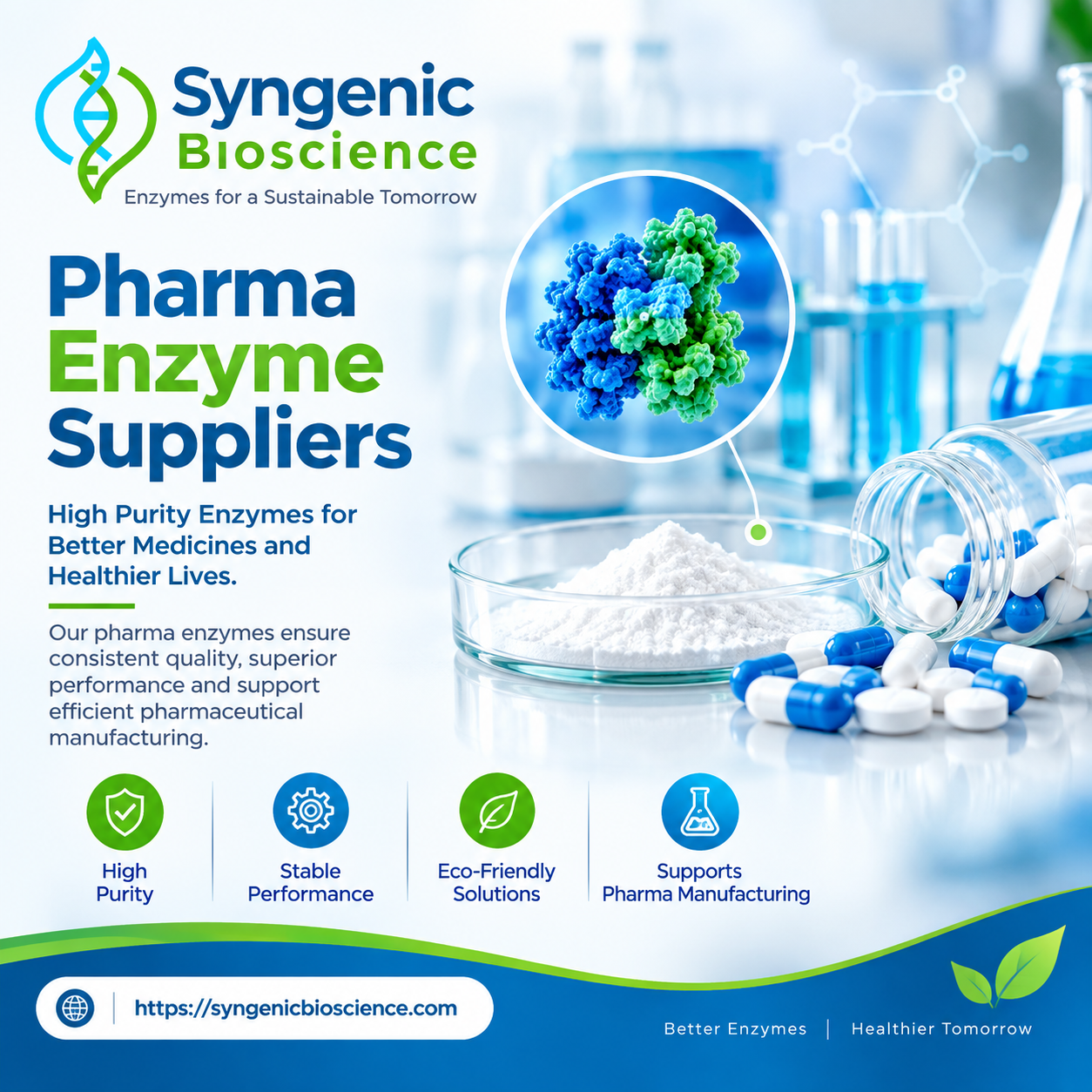
Pharmaceutical manufacturing is increasingly dependent on controlled and reproducible processing conditions. Enzymes can be used as biological catalysts in selected pharmaceutical manufacturing and development processes, but their performance cannot be judged only by a product's stated activity.
When evaluating Pharma Enzyme Suppliers in India, manufacturers need to understand how an enzyme behaves from initial laboratory screening through pilot studies and, eventually, commercial-scale manufacturing. Activity, selectivity, stability, impurity formation, residual enzyme, batch consistency, documentation and process compatibility can all influence the suitability of an enzyme for a specific application.
A technically sound supplier evaluation therefore starts with the process requirement rather than simply selecting an enzyme from a catalogue.
Every pharmaceutical process has its own operating conditions and quality requirements. An enzyme that performs effectively in a laboratory experiment may respond differently when exposed to a larger reaction volume, different mixing conditions, longer hold times or a more complex substrate system.
Before approaching Pharma Enzyme Suppliers, manufacturers should define:
This process-first approach creates a clearer technical specification for supplier evaluation.
Laboratory screening is useful for identifying promising enzyme candidates, but laboratory results should not automatically be treated as commercial manufacturing results.
Small-scale experiments may use highly controlled mixing, temperature and substrate conditions. At larger scale, factors such as heat transfer, mass transfer, agitation, addition sequence and residence time can change the reaction environment.
A useful screening program can compare multiple enzyme candidates using consistent conditions and measurable acceptance criteria.
Important observations may include:
The goal is to identify an enzyme that performs reliably under conditions that can eventually be translated into the manufacturing process.
Enzyme activity is an important technical parameter, but a high activity value does not automatically mean that an enzyme is the most suitable option.
Activity measurements depend on the assay method and test conditions. Actual process performance can also depend on substrate concentration, pH, temperature, inhibitors, solvent exposure and reaction time.
For this reason, manufacturers should compare activity data together with functional process results.
A useful evaluation can ask:
Does the declared activity translate into the required manufacturing performance?
This distinction is particularly important when comparing different Pharma Enzyme Suppliers, because activity units, assay conditions and product formulations may not always be directly comparable.
Selectivity is especially important when an enzyme is involved in a process where the desired transformation must be distinguished from competing reactions.
An enzyme may provide the required reaction while also producing unwanted side products under certain conditions. Changes in pH, temperature, substrate concentration or reaction time can influence this behavior.
Therefore, enzyme screening should consider both the desired product and the resulting impurity profile.
A technically useful evaluation may monitor:
This helps connect enzyme selection with overall process quality rather than evaluating the catalyst in isolation.
After an enzymatic processing step, manufacturers may need to understand how much residual enzyme remains and how it behaves during subsequent operations.
The significance of residual enzyme depends on the specific application and manufacturing process. In some processes, enzyme removal or inactivation may be an important part of downstream processing.
The evaluation can therefore consider:
Discussing residual enzyme requirements early with Pharma Enzyme Suppliers in India can help align the supplied material with the intended process.
Impurity control is not only a final quality-control activity. It can also influence enzyme selection during process development.
If two enzyme candidates provide similar conversion, but one produces a different impurity profile or creates additional downstream purification requirements, their overall process performance may be different.
ICH guidance emphasizes controlling critical process parameters and confirming that impurity profiles remain within appropriate limits during process validation.
For enzyme-based processes, development teams can therefore examine impurity behavior alongside conversion and activity.
Enzyme performance is closely linked to process conditions.
Changes in temperature can influence both reaction rate and enzyme stability. Similarly, pH can affect enzyme structure, activity and substrate interaction. Reaction time can also influence conversion as well as the formation of unwanted products.
Instead of identifying a single operating point immediately, process development can map an appropriate operating window.
Key variables may include:
The final operating conditions should be determined through application-specific development and validation rather than copied from a generic enzyme specification.
An enzyme process is difficult to control if the supplied material changes significantly from one batch to another.
Batch consistency can influence activity, dosage requirements and process results. This makes lot-to-lot variation an important consideration when qualifying Pharma Enzyme Suppliers in India.
Manufacturers can evaluate:
Batch testing and comparison can help identify whether an enzyme behaves consistently enough for the intended application. Independent assay guidance also highlights the importance of evaluating enzyme batches because purification and scale can introduce variability.
Supplier documentation provides an important connection between procurement, quality assurance and technical teams.
Depending on the application, manufacturers may review:
A COA can provide batch-specific information such as:
A TDS can help explain:
An SDS provides information needed for safe handling, storage and workplace controls.
Additional documentation may be required depending on the process, material origin and quality system.
ICH's quality framework includes guidance covering specifications, impurities, GMP, quality risk management and pharmaceutical quality systems.
Price is only one part of supplier evaluation.
For a pharmaceutical application, manufacturers may need to assess technical capability, quality documentation, lot consistency, change notification, traceability, supply continuity and technical support.
A structured supplier assessment can include:
| Evaluation Area | What to Review |
|---|---|
| Product performance | Activity and functional results |
| Quality | Specifications and batch testing |
| Consistency | Lot-to-lot variation |
| Documentation | COA, TDS, SDS and supporting documents |
| Traceability | Batch identification and records |
| Technical support | Response to process questions |
| Change control | Notification of relevant changes |
| Supply | Lead time and continuity |
| Packaging | Suitability for storage and handling |
| Scale-up support | Pilot and manufacturing guidance |
This approach allows procurement and technical teams to evaluate suppliers using comparable criteria.
Pilot validation can act as the bridge between laboratory screening and commercial manufacturing.
A candidate enzyme should ideally be evaluated under conditions that resemble the intended manufacturing process. This can reveal issues that may not appear during initial laboratory experiments.
Pilot studies can examine:
ICH Q11 describes process validation as documented evidence that an established process can operate effectively and reproducibly within defined parameters to produce material meeting predetermined quality attributes.
This makes scale-up data particularly valuable when moving an enzyme from development into routine manufacturing.
Scale-up is not simply a matter of multiplying the laboratory quantities.
Larger equipment can introduce changes in:
An enzyme that performs well at laboratory scale should therefore be evaluated again under representative pilot or manufacturing conditions.
This is where technical collaboration between the manufacturer and Pharma Enzyme Suppliers can become important.
Process validation should focus on parameters that can influence product quality and process consistency.
For an enzyme-dependent operation, potentially important parameters may include:
Not every parameter has the same level of importance. The relevant critical parameters should be identified through process understanding and risk assessment.
ICH Q7 specifically states that critical process parameters should be controlled and monitored during process validation and that validation should address process consistency and impurity profiles.
Supplier changes can sometimes affect pharmaceutical processes even when the product name remains unchanged.
Potential changes may involve:
For this reason, change notification should be considered during supplier qualification.
A clear change-control process allows the manufacturer to determine whether additional testing, comparison or validation is necessary before accepting a changed material.
A lower price per kilogram does not necessarily mean a lower overall process cost.
The actual cost of an enzyme can depend on:
For example, an enzyme with higher functional activity may require less material to achieve the required process result. Therefore, supplier comparison should consider cost per validated manufacturing outcome, not only purchase price.
This creates a more realistic commercial comparison between potential Pharma Enzyme Suppliers in India.
A practical qualification workflow can follow these stages:
Document the intended application, substrate, operating conditions and quality objectives.
Compare activity, selectivity, stability and compatibility under controlled laboratory conditions.
Evaluate COA, TDS, SDS, specifications, traceability and relevant quality information.
Where appropriate, assess more than one production lot to understand normal variation.
Use manufacturing-relevant conditions and predefined acceptance criteria.
Check mixing, temperature control, reaction time and downstream processing at larger scale.
Review quality systems, technical support, supply continuity and change-control practices.
Continue monitoring incoming batches, process performance and relevant supplier changes.
This framework creates a connection between supplier qualification and actual process performance.
Before commercial qualification, technical teams can ask suppliers questions such as:
These questions help transform supplier discussions from a simple purchasing conversation into a technical qualification process.
Supplier qualification should not necessarily be treated as a one-time event.
After approval, manufacturers can continue monitoring important quality and performance indicators. Trend analysis can help identify gradual changes before they become significant process problems.
Ongoing review may include:
This supports continued confidence in the enzyme supply rather than relying only on the original qualification study.
For manufacturers searching for Pharma Enzyme Suppliers in India, the evaluation should combine product performance, quality systems and supply capability.
A supplier may be technically suitable but difficult to manage if documentation is inconsistent or supply continuity is weak. Conversely, strong documentation alone does not compensate for poor enzyme performance in the intended process.
The most useful evaluation therefore connects three areas:
Technical performance + Quality control + Supply reliability
This integrated approach can help manufacturers develop a more stable supplier relationship and reduce avoidable variability during pharmaceutical production.
Manufacturers can evaluate enzyme activity, stability, selectivity, purity-related parameters, batch consistency, documentation, storage requirements, technical support, change control and supply continuity.
Consistent enzyme performance can help maintain predictable process conditions. Significant lot-to-lot variation may require changes in dosage or process parameters and can complicate process control.
Pilot testing helps determine whether laboratory performance remains suitable under larger-scale conditions such as different mixing, heat transfer, addition rates and reaction times.
Depending on the application, manufacturers may review a COA, TDS, SDS, specifications, storage information, traceability records and additional quality documents relevant to the intended use.
Not necessarily. Total cost can depend on enzyme dosage, activity, reaction time, yield, purification requirements, storage and quality-control requirements. Cost-in-use provides a more meaningful comparison than purchase price alone.
Selecting Pharma Enzyme Suppliers for pharmaceutical manufacturing requires a process-focused evaluation rather than a simple comparison of product names or prices.
Enzyme activity, selectivity, impurity formation, residual enzyme, batch consistency, documentation, storage and scale-up behavior all contribute to understanding whether an enzyme is suitable for a particular manufacturing process.
For organizations evaluating Pharma Enzyme Suppliers in India, the strongest approach is to connect laboratory screening with pilot validation, supplier qualification and ongoing batch monitoring. This creates a clearer technical pathway from initial enzyme selection to reproducible manufacturing.
A well-structured evaluation can also help R&D, quality, procurement and manufacturing teams work from the same technical criteria, supporting more informed supplier decisions and stronger process control