


Automotive Lighting Market Size, Share, Latest Trends, Analysis and Forecast 2026-2034
Market Overview
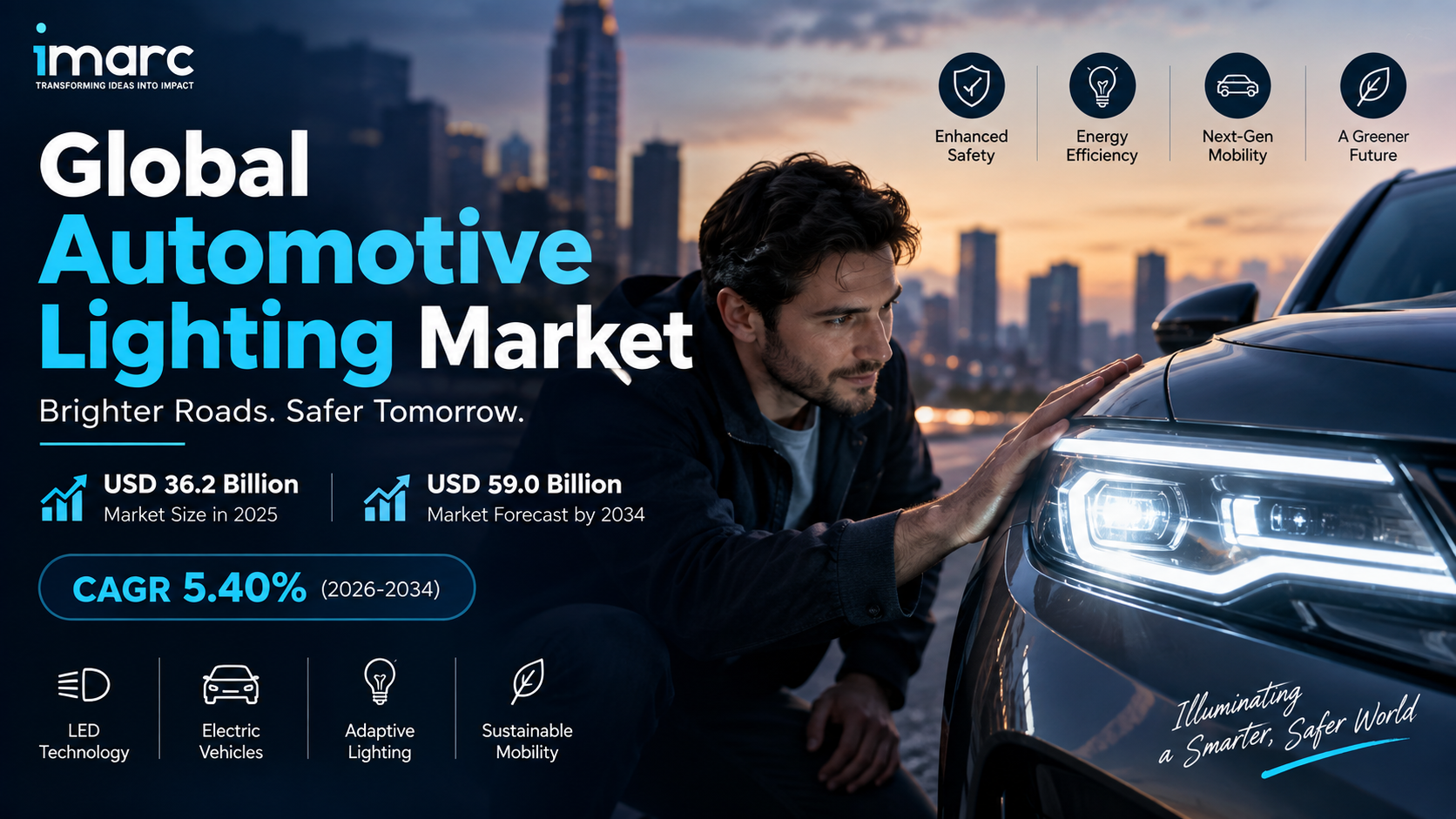
The global automotive lighting market size reached USD 36.2 Billion in 2025. Looking forward, IMARC Group expects the market to reach USD 59.0 Billion by 2034, exhibiting a growth rate (CAGR) of 5.40% during 2026-2034. The increasing awareness among individuals regarding road safety measures, the rising utilization of new lighting technologies, the growing demand for electric vehicles (EVs), and the escalating environmental consciousness among individuals are some of the factors propelling the market growth. Furthermore, increasing vehicle production and sales, rapid advancements in lighting technologies such as LED, laser, and OLED, rising demand for energy-efficient lighting solutions, and the growing adoption of adaptive lighting systems are supporting the expansion of the global automotive lighting industry.
Automotive Lighting Market Key At a Glance
-
Base Year: 2025
-
Historical Period: 2020–2025
-
Forecast Period: 2026–2034
-
Market Size (2025): USD 36.2 Billion
-
Market Forecast (2034): USD 59.0 Billion
-
CAGR (2026–2034): 5.40%
-
Leading Region: Asia Pacific
Request for a Sample Report for Detailed Evaluation: https://www.imarcgroup.com/automotive-lighting-market/requestsample
Automotive Lighting Market Report: Key Highlights
-
Market Size & Growth: The global automotive lighting market reached USD 36.2 Billion in 2025 and is projected to reach USD 59.0 Billion by 2034, registering a CAGR of 5.40% during 2026-2034.
-
Major Market Drivers: Increasing vehicle production and sales, rapid advancements in lighting technologies, growing demand for energy-efficient solutions, rising EV adoption, and increasing awareness of road safety are supporting market growth.
-
Key Market Trends: Rising adoption of LED lighting, increasing demand for adaptive lighting systems, enhanced cabin amenities and luxury attributes, and continuous technological advancements are shaping the market.
-
Technology: The market is segmented into halogen, xenon/HID, and LED, with LED representing the largest segment.
-
Vehicle Type: Passenger vehicles account for the largest market share, supported by increasing sales and growing consumer preference for safety, aesthetics, and enhanced driving experiences.
-
Sales Channel: Original Equipment Manufacturers (OEMs) hold the largest share, as lighting systems are integrated into new vehicles during manufacturing.
-
Application: Front lighting/headlamps represent the largest application segment due to their critical role in driver visibility, road safety, and vehicle aesthetics.
-
Regional Leadership: Asia Pacific dominates the global market, supported by expanding vehicle production, rising disposable incomes, urbanization, increasing vehicle ownership, and a growing middle-class population.
-
Key Challenges: Stringent regulatory requirements for safety and efficiency and the need for continuous innovation to meet evolving consumer preferences and technological advancements represent major challenges.
-
Emerging Opportunities: Growing demand for energy-efficient lighting solutions, integration of advanced LED and OLED technologies, and increasing opportunities for customization and personalization in vehicle lighting design are creating new growth avenues.
What Is Driving Automotive Lighting Market Growth in 2026?
Expanding Automotive Industry
The increasing production and sales of passenger and commercial vehicles are primarily driving the growth of the global automotive lighting market. Rising disposable incomes, expanding businesses, and growing preference for convenient modes of transportation are contributing to increasing vehicle demand and, consequently, the need for automotive lighting systems.
For instance, India's passenger vehicle wholesales reached a new high of 42,18,746 units in the 2023-24 financial year, representing an 8.4% increase from the previous year. Similarly, overall commercial vehicle sales increased from 7,16,566 to 9,62,468 units. In addition, emerging automotive trends such as electric vehicles and autonomous driving are creating demand for specialized lighting technologies designed to improve safety, efficiency, and aesthetics.
The growing electric vehicle industry is further contributing to this demand. According to IMARC, the global electric vehicle market size reached 25.6 Million Units in 2023 and is expected to reach 381.3 Million Units by 2032, exhibiting a CAGR of 34% during 2024-2032. As the automotive sector continues to expand, the parallel demand for innovative lighting solutions is expected to significantly support the automotive lighting market.
Escalating Demand for Enhanced Cabin Amenities and Luxury Attributes
The increasing demand for enhanced cabin amenities and luxury attributes is another factor supporting automotive lighting market growth. As electric vehicle adoption continues to rise, automotive lighting manufacturers are developing innovative technologies to replace traditional lighting fixtures and improve the overall interior experience.
Cabin and ambient lighting are gaining widespread traction as they provide functional illumination while contributing to the aesthetic appeal of vehicle interiors. At the same time, electric vehicle manufacturers are introducing new models featuring premium cabin interiors and advanced lighting features.
For instance, in September 2020, Lucid Motors launched Lucid Air, a luxury electric sedan offering a full-size luxury-class interior based on the company's exclusive space concept philosophy. Similarly, in April 2024, ams OSRAM joined forces with DOMINANT Opto Technologies to advance automotive ambient lighting. Such developments demonstrate the growing emphasis on innovative interior lighting solutions and luxury vehicle features, which is expected to support market expansion.
Rapid Technological Advancements
Rapid technological advancements in the automotive sector are significantly contributing to the growth of the automotive lighting market. The adoption of LED technology is particularly important due to its improved energy efficiency, longer lifespan, compact size, design flexibility, and enhanced lighting performance compared with traditional technologies.
Key market players are increasingly investing in research and development activities to introduce technologically advanced lighting solutions. For instance, at the April 2021 Shanghai Auto Show, Valeo announced the development of its first 360° lighting solution. The technology surrounds the vehicle with a band of light capable of projecting clear and instantaneous indications to nearby road users, including vulnerable road users such as cyclists and people using scooters.
Similarly, in June 2021, Hyundai Mobis developed a new lighting grille technology that integrates LED lighting into the front grille of a vehicle. The technology can use the entire front grille as a lighting device and implement multiple functions, including autonomous driving mode, EV charging mode, welcome lighting, sound beat display, and emergency warning light display. Such innovations are supporting the development of increasingly sophisticated automotive lighting systems.
Automotive Lighting Market Trends
Rising Demand for Energy-Efficient Lighting Solutions
The increasing demand for energy-efficient lighting solutions represents a major trend shaping the automotive lighting market. Automakers are increasingly adopting lighting technologies that can deliver improved illumination while consuming less energy.
LED lighting has gained significant traction because of its energy efficiency, longer operating life, compact form factor, and ability to support innovative vehicle designs. The growing emphasis on fuel efficiency, vehicle electrification, and environmental sustainability is further encouraging manufacturers to adopt energy-efficient lighting technologies.
Increasing Adoption of Adaptive Lighting Systems
The rapid adoption of adaptive lighting systems is another important market trend. Advanced lighting systems are increasingly being designed to respond to driving conditions and improve visibility and road safety.
Adaptive technologies can provide enhanced illumination while supporting a more personalized and technologically advanced driving experience. Growing awareness of road safety and continued automotive technology development are strengthening demand for such systems.
Growing Awareness of Road Safety
Increasing awareness among consumers and manufacturers regarding road safety is supporting demand for advanced automotive lighting solutions. Front lighting and headlamps play a critical role in improving driver visibility during nighttime driving and adverse weather conditions.
The development of advanced LED and adaptive lighting technologies is helping manufacturers enhance illumination and visibility while simultaneously improving vehicle aesthetics. This increasing focus on safety is expected to remain an important factor supporting market growth.
Growing Focus on Customization and Personalization
The automotive lighting industry is witnessing increasing opportunities for customization and personalization. Lighting systems are being used not only for functional purposes but also to enhance the visual appearance and identity of vehicles.
Ambient lighting, dynamic lighting effects, and innovative exterior lighting designs can contribute to a more distinctive vehicle experience. The growing consumer preference for premium interiors and aesthetically appealing vehicles is creating additional opportunities for automotive lighting manufacturers.
Automotive Lighting Market Segmentation Analysis
IMARC Group provides an analysis of the key trends in each segment of the global automotive lighting market, along with forecasts at the global, regional, and country levels from 2026-2034. The market has been categorized based on technology, vehicle type, sales channel, and application.
By Technology
-
Halogen
-
Xenon/HID
-
LED
LED Dominates the Market
LED represented the largest segment in the automotive lighting market. LED lighting has emerged as a dominant technology due to its numerous advantages, including high energy efficiency, longer lifespan, compact size, and design flexibility.
LEDs provide superior illumination, improved visibility, and dynamic lighting capabilities. The technology also enables innovative lighting designs and customizable lighting effects, enhancing the overall aesthetics of vehicles.
The automotive industry's increasing focus on energy efficiency, advanced lighting technology, and improved safety is further supporting LED adoption. Various market participants are introducing advanced LED automotive lighting solutions. For instance, Volkswagen partnered with Hella to develop IQ.LIGHT LED headlamps, with the luxury-class Touareg SUV using IQ.LIGHT-LED Matrix Headlamps featuring 256 LEDs.
By Vehicle Type
-
Passenger Vehicle
-
Commercial Vehicle
Passenger Vehicles Hold the Largest Share of the Market
Passenger vehicles account for the largest share of the automotive lighting market. Increasing passenger vehicle sales, rising consumer spending capacities, improving living standards, and growing preference for convenient modes of transportation are supporting the segment's expansion.
Revenue in the passenger cars market is projected to reach US$ 2,069.0 Billion in 2024, while passenger car unit sales are expected to reach 72.54 million vehicles in 2028. The growing number of passenger vehicles worldwide is generating continuous demand for innovative and advanced lighting solutions.
Consumers increasingly value safety, aesthetics, and enhanced driving experiences, supporting the adoption of LED headlights, adaptive lighting systems, and dynamic lighting features in passenger vehicles.
By Sales Channel
-
Original Equipment Manufacturers
-
Aftermarket
Original Equipment Manufacturers Hold the Largest Share of the Market
Original Equipment Manufacturers (OEMs) represent the largest sales channel segment. Automotive manufacturers integrate lighting systems into new vehicles during the production process, creating a direct relationship between vehicle manufacturing volumes and demand for automotive lighting.
As vehicle production and sales continue to increase, demand for automotive lighting systems through OEM channels is also expanding. When selecting lighting systems, OEMs prioritize quality, performance, design compatibility, and regulatory compliance.
Furthermore, collaboration and partnerships between automotive manufacturers and lighting companies are creating a positive outlook for the segment. Such relationships allow lighting manufacturers to develop solutions specifically designed for new vehicle models.
By Application
-
Front Lighting/Headlamps
-
Rear Lighting
-
Side Lighting
-
Interior Lighting
Front Lighting/Headlamps Hold the Largest Share of the Market
Front lighting/headlamps represent the largest application segment. These systems are critical for ensuring driver visibility and road safety during nighttime driving and adverse weather conditions.
The demand for advanced front lighting systems, including LED and adaptive lighting technologies, is increasing due to their superior performance, energy efficiency, and design flexibility. As vehicle manufacturers continue incorporating innovative and adaptive front lighting systems to improve driver visibility, the segment is expected to remain an important contributor to market growth.
By Region
-
North America
-
United States
-
Canada
-
-
Asia Pacific
-
China
-
Japan
-
India
-
South Korea
-
Australia
-
Indonesia
-
Others
-
-
Europe
-
Germany
-
France
-
United Kingdom
-
Italy
-
Spain
-
Russia
-
Others
-
-
Latin America
-
Brazil
-
Mexico
-
Others
-
-
Middle East and Africa
Asia Pacific Exhibits a Clear Dominance, Accounting for the Largest Automotive Lighting Market Share
Asia Pacific dominates the global automotive lighting market. The region's leadership is primarily attributed to expanding vehicle production, rising disposable incomes, increasing urbanization, and the growing middle-class population. Ongoing infrastructure development and increasing vehicle ownership rates are also supporting market expansion.
According to OICA, automotive production in the region reached 50,020,793 units in 2022, increasing by 7% from 46,768,800 units produced in 2021. China was the largest producer in 2022, followed by Japan, India, and South Korea.
India is also witnessing strong passenger vehicle demand. During the first nine months of 2022, Indian passenger car sales remained strong due to factors including savings, lower interest rates, and increasing preference for personal mobility. New car registrations in India grew by around 20.2% during the first three quarters of 2022 to reach 2.8 million units.
Government initiatives such as "Aatma Nirbhar Bharat" and "Make in India" are further supporting the development of the country's automotive industry. These factors are contributing to the rapid expansion of the automotive sector across Asia Pacific and strengthening regional demand for automotive lighting.
North America
The North American automotive lighting market is supported by the region's established automotive industry, increasing vehicle production, technological advancements, and growing demand for advanced safety and lighting systems. The rising adoption of EVs and increasing consumer awareness regarding vehicle safety are further contributing to market development.
Europe
The European market is supported by technological advancements, increasing adoption of energy-efficient lighting solutions, and stringent safety and efficiency requirements. The region's automotive manufacturers are increasingly incorporating advanced lighting technologies to improve vehicle performance, visibility, aesthetics, and energy efficiency.
Latin America
The Latin American automotive lighting market is benefiting from increasing vehicle demand and the development of the automotive industry across major markets such as Brazil and Mexico. Growing consumer preference for enhanced vehicle features and increasing adoption of modern lighting technologies are supporting market expansion.
Middle East and Africa
The Middle East and Africa automotive lighting market is being supported by growing vehicle ownership, increasing demand for improved vehicle safety and aesthetics, and continued development of the automotive sector. Rising adoption of modern vehicle technologies is creating additional opportunities for advanced automotive lighting solutions.
Key Regional Insight: Asia Pacific's Strategic Position
Asia Pacific's leading position in the global automotive lighting market is supported by its extensive automotive manufacturing base and rapidly growing vehicle ownership. China, Japan, India, and South Korea represent important automotive production centers, creating substantial demand for lighting systems.
The region is also benefiting from rising disposable incomes, urbanization, infrastructure development, and an expanding middle-class population. Increasing EV adoption and the development of advanced vehicle technologies are further strengthening demand for LED, adaptive, and other innovative lighting solutions.
Competitive Landscape in the Automotive Lighting Industry
Leading companies in the automotive lighting market are investing significantly in research and development to introduce advanced lighting solutions offering improved performance, energy efficiency, safety, and aesthetics.
Companies are focusing on developing LED lighting systems, adaptive lighting technologies, and innovative lighting designs that improve visibility while reducing energy consumption. Market participants are also actively collaborating with automotive manufacturers to integrate lighting systems into new vehicle models.
Strong partnerships and supply chain relationships enable lighting manufacturers to secure contracts with major automakers, providing a competitive advantage. In addition, leading companies are expanding their global footprint by establishing production facilities and distribution networks in key regions, particularly emerging markets in Asia Pacific.
Companies are also investing in marketing and branding activities to strengthen awareness of their lighting solutions. Participation in industry events, product demonstrations, trade shows, and promotional campaigns is helping market participants reach broader customer bases.
Key Automotive Lighting Market Players Include
-
Continental AG
-
HELLA GmbH & Co. KGaA (Faurecia SE)
-
Hyundai Mobis (Hyundai Motor Group)
-
Koito Manufacturing Co. Ltd.
-
Koninklijke Philips N.V.
-
LG Electronics Inc.
-
Lumax Industries Limited
-
Marelli Holdings Co. Ltd.
-
Osram Licht AG (ams AG)
-
Robert Bosch GmbH
-
Samsung Electronics Co. Ltd.
-
Stanley Electric Co. Ltd.
-
Valeo
Recent Developments
-
April 2024: The European Bank for Reconstruction and Development (EBRD) lent €15 Million to Serbian automotive lighting producer Feka Automotive to support expansion. The company plans to use the funds to improve overall efficiency and increase the availability of reliable lighting devices to customers around the world.
-
March 2024: Marelli developed an innovative automotive lighting domain control unit platform in China. The platform is designed to manage a vehicle's front and rear lights while introducing new 360° lighting features.
-
January 2024: US-based OLED lighting developer OLEDWorks announced a separate automotive OLED lighting brand, Atala. The new brand is intended to support a range of automotive-qualified OLED lighting products designed specifically for Tier 1 suppliers and original equipment manufacturers (OEMs).
Market Drivers, Challenges & Opportunities
Major Market Drivers
-
Increasing Vehicle Production and Sales: Growing production and sales of passenger and commercial vehicles are directly increasing demand for automotive lighting systems.
-
Rapid Technological Advancements: Innovations in LED, laser, OLED, adaptive lighting, and other technologies are improving lighting performance, efficiency, and design flexibility.
-
Rising Demand for Energy-Efficient Solutions: The growing emphasis on energy efficiency is encouraging automakers to adopt advanced lighting technologies such as LEDs.
-
Growing Electric Vehicle Adoption: The expansion of EVs is creating demand for specialized lighting systems that support safety, efficiency, aesthetics, and advanced vehicle functions.
-
Increasing Road Safety Awareness: Greater awareness of road safety is encouraging the adoption of advanced front lighting, adaptive lighting, and other visibility-enhancing technologies.
Key Challenges
-
Stringent Regulatory Requirements: Automotive lighting manufacturers must navigate strict safety and efficiency regulations across different markets.
-
Continuous Need for Innovation: Rapid technological advancement and evolving consumer preferences require companies to continuously invest in research and development.
-
Technological Complexity: The development and integration of increasingly sophisticated lighting systems can create additional technical and manufacturing requirements.
Emerging Opportunities
-
Energy-Efficient Lighting: Growing demand for efficient lighting solutions is creating opportunities for LED and other advanced technologies.
-
LED and OLED Integration: Continued development and integration of LED and OLED technologies are creating opportunities for improved performance, aesthetics, and functionality.
-
Customization and Personalization: Increasing consumer interest in vehicle aesthetics is creating opportunities for customizable exterior and interior lighting designs.
-
Advanced Lighting Systems: Adaptive, dynamic, and 360° lighting technologies are opening new opportunities for manufacturers to enhance vehicle safety and functionality.
-
Electric Vehicle Expansion: Continued EV adoption is expected to support demand for innovative lighting technologies specifically designed for next-generation vehicles.
Automotive Lighting Market FAQs
1. What is the current size of the global automotive lighting market?
The global automotive lighting market share reached USD 36.2 Billion in 2025 and is expected to reach USD 59.0 Billion by 2034, expanding at a CAGR of 5.40% during 2026-2034.
2. What is driving the growth of the automotive lighting market?
The market is primarily driven by increasing vehicle production and sales, growing awareness of road safety, rapid advancements in lighting technologies, rising demand for energy-efficient solutions, increasing EV adoption, and growing consumer interest in advanced vehicle features.
3. Which region dominates the global automotive lighting market?
Asia Pacific dominates the global market, supported by expanding vehicle production, rising disposable incomes, increasing urbanization, a growing middle-class population, infrastructure development, and increasing vehicle ownership.
4. Which technology holds the largest share of the automotive lighting market?
LED represents the largest technology segment due to its high energy efficiency, longer lifespan, compact size, design flexibility, superior illumination, and ability to support dynamic and customizable lighting features.
5. Which vehicle type accounts for the largest market share?
Passenger vehicles hold the largest market share, supported by increasing vehicle sales and growing consumer preference for safety, aesthetics, advanced lighting technologies, and enhanced driving experiences.
6. Which sales channel dominates the automotive lighting market?
Original Equipment Manufacturers (OEMs) account for the largest share, as lighting systems are integrated into new vehicles during the manufacturing process.
7. Which application holds the largest share of the automotive lighting market?
Front lighting/headlamps represent the largest application segment due to their critical role in driver visibility, road safety, and vehicle aesthetics.
Conclusion: Automotive Lighting Market Outlook to 2034
The global automotive lighting market is poised for steady growth through 2034, supported by increasing vehicle production and sales, growing awareness of road safety, rapid technological advancements, rising EV adoption, and increasing demand for energy-efficient lighting solutions.
The growing integration of LED, OLED, adaptive, and other advanced lighting technologies is transforming automotive lighting from a conventional vehicle component into an increasingly sophisticated system that contributes to safety, energy efficiency, aesthetics, and overall driving experience.
Asia Pacific is expected to maintain its dominant position, supported by its expanding automotive manufacturing industry, rising disposable incomes, increasing urbanization, infrastructure development, and growing vehicle ownership. Meanwhile, North America, Europe, Latin America, and the Middle East and Africa are expected to offer additional opportunities as vehicle technologies and consumer preferences continue to evolve.
Although stringent regulatory requirements and the need for continuous technological innovation remain key challenges, the increasing demand for energy-efficient solutions, advanced LED and OLED systems, adaptive lighting, and customized lighting designs is creating significant opportunities for market participants.
Companies investing in innovative lighting technologies, strategic partnerships with automakers, advanced manufacturing capabilities, and solutions tailored to electric and next-generation vehicles will be well positioned to capitalize on the evolving automotive lighting market through 2034.
About the Author
IMARC Group is a leading global market research company providing data-driven insights and strategic consulting services across diverse industries. The company delivers comprehensive research reports covering automotive, technology, healthcare, chemicals, packaging, food & beverages, consumer goods, and industrial sectors, helping organizations make informed business decisions and identify emerging growth opportunities.
Media & Sales Contact
IMARC Group
United States: +1-201-971-6302
India: +91-120-433-0800
United Kingdom: +44-753-714-6104
 French
 English
 Arabic
 Spanish
 Portuguese
 Deutsch
 Turkish
 Dutch
Dutch
 Italiano
 Russian
 Romaian
 Portuguese (Brazil)
 Greek
Greek