


North America Optical Transceiver Market Driven by Rising Data Center Investments
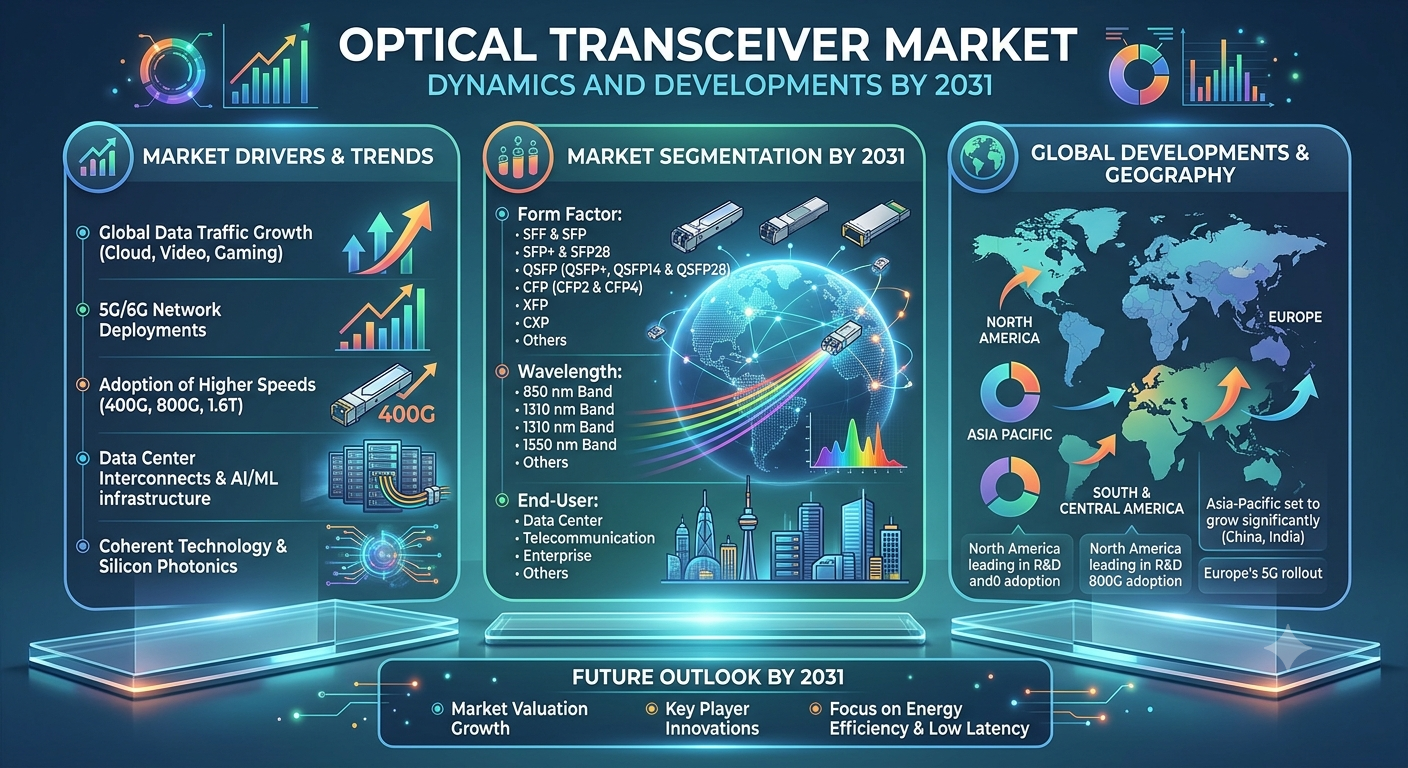
The rapid expansion of digital infrastructure across North America is reshaping requirements for high-speed, reliable, and scalable data transmission. Optical transceivers are critical components in this transformation because they convert electrical signals into optical signals and vice versa, enabling high-bandwidth communication through fiber-optic networks. Their applications span hyperscale data centers, telecommunications networks, enterprise connectivity, cloud infrastructure, and emerging artificial intelligence (AI) environments. Across the United States, investments in hyperscale data centers, cloud platforms, 5G infrastructure, and AI computing are increasing the need for faster optical interconnects. At the same time, growing internet traffic, video streaming, connected devices, enterprise digitization, and distributed computing are placing additional pressure on network operators to increase bandwidth capacity. These trends are encouraging the deployment of advanced optical modules capable of supporting 100G, 400G, 800G, and emerging higher-speed architectures. North America's mature digital ecosystem and strong technology investment position the region as a key center for optical networking innovation.
The Optical Transceiver Market Share is particularly well positioned for expansion in North America, where the region accounted for 40.2% of the global market in 2024. Globally, the market was valued at US$14.60 billion in 2024 and is projected to reach US$36.73 billion by 2031, registering a 14.2% CAGR from 2025 to 2031. Within North America, the market is expected to increase from US$5,867.3 million in 2024 to US$15,023.1 million by 2031, representing a 14.5% CAGR. The United States held the largest share within North America in 2024 and is projected to register a 14.7% CAGR during 2025–2031, making the country a central contributor to regional growth.
Download Sample PDF Link: https://www.theinsightpartners.com/sample/TIPTE100001069
US Hyperscale Data Centers Become a Major Growth Engine
The United States is at the forefront of North America's optical networking expansion because of its extensive hyperscale data center ecosystem. Major cloud and technology companies, including Amazon, Microsoft, and Google, continue to expand data center infrastructure and upgrade network capabilities to support increasing volumes of digital information. The Insight Partners identifies data centers as the fastest-growing application segment in North America, with the segment projected to register a 15.6% CAGR from 2025 to 2031.
The current US AI infrastructure boom is strengthening this trend. AI workloads require substantial communication between processors, storage systems, switches, and servers, creating demand for high-bandwidth, low-latency optical interconnects. Recent industry developments also demonstrate the strength of this demand, with US suppliers expanding production and developing next-generation optical technologies for AI data centers.
AI and Cloud Computing Accelerate Demand for High-Speed Optics
AI infrastructure is emerging as one of the most important drivers for optical transceiver adoption in the US. Training and operating large AI models requires clusters of high-performance processors connected through extremely high-speed networks. As AI clusters become larger, conventional networking architectures face greater bandwidth requirements, increasing the importance of 400G, 800G, and next-generation optical modules.
Cloud computing is similarly driving demand. Cloud service providers must continuously expand network capacity to accommodate enterprise applications, data analytics, streaming, SaaS platforms, and AI services. Optical transceivers allow these facilities to transmit large volumes of data efficiently while supporting low latency and scalable network architectures.
This trend is particularly relevant as US data center operators seek to maximize performance within increasingly constrained power and physical environments. Compact and energy-efficient transceivers can help operators increase network capacity without proportionally increasing equipment footprint and energy requirements. The Insight Partners identifies compact, energy-efficient transceivers and advancements in optical technology as important growth factors in North America.
5G and Fiber Infrastructure Strengthen Regional Opportunities
5G deployment is another significant driver across North America. Fifth-generation mobile networks require higher bandwidth, lower latency, and extensive fiber connectivity between radio access infrastructure, aggregation networks, and core systems. Optical transceivers provide the signal conversion required for high-speed transmission across these fiber-based connections.
US telecommunications providers are therefore upgrading network infrastructure to accommodate increasing mobile data traffic and connected devices. The continued development of fiber networks also creates opportunities for optical transceiver manufacturers serving telecommunications and enterprise applications.
Beyond metropolitan areas, broadband infrastructure investments can support additional demand as network operators expand high-speed connectivity into underserved locations. This creates opportunities across multiple layers of the US communications ecosystem.
Advanced 400G and 800G Technologies Create New Opportunities
The transition toward higher data rates is reshaping the product landscape. North American data center operators are increasingly moving toward higher-speed optical solutions as workloads become more demanding. The global report highlights 400G and 800G technologies as important areas of development, while emerging AI infrastructure is pushing suppliers toward even higher-speed architectures.
In North America, the 1310 nm wavelength segment is projected to register a 15.4% CAGR during 2025–2031, while the SFP Series is projected to grow at a 14.3% CAGR. These developments demonstrate the continuing importance of both established optical formats and newer high-performance solutions.
US Leads North American Growth
The United States remains the dominant country within the regional landscape. Its leadership is supported by advanced telecommunications infrastructure, hyperscale data center investments, cloud computing adoption, AI development, and the presence of major optical technology companies.
Northern Virginia, Dallas/Fort Worth, Silicon Valley, Chicago, Phoenix, the New York Tri-State Area, and Atlanta are identified as leading North American data center markets, all located in the US. This concentration of data center activity creates substantial opportunities for optical transceiver suppliers.
The competitive environment is also strengthening. Companies are investing in manufacturing capacity and next-generation optical technologies to serve growing AI and cloud demand. Recent developments include Lumentum's expansion of manufacturing capability in North Carolina and Applied Optoelectronics' investment in a major Texas facility aimed at producing AI data-center transceivers.
Top Companies Operating in the Industry
Key companies profiled in the report include:
- Broadcom Inc.
- Cisco Systems Inc.
- Lumentum Holdings Inc.
- Coherent Corp.
- Intel Corp.
- Sumitomo Electric Industries Ltd.
- Amphenol Corporation
- Accelink Technology Co., Ltd.
- Samtec Inc.
- NEC Corp.
These companies are focusing on product innovation, higher-speed modules, manufacturing expansion, strategic partnerships, and advanced optical technologies to address the evolving requirements of data centers and telecommunications networks.
Future Outlook for North America and the US
The outlook for North America's optical networking ecosystem remains highly positive. The regional industry is projected to grow from US$5.87 billion in 2024 to US$15.02 billion by 2031, while the US is expected to maintain the largest country-level share and achieve a 14.7% CAGR during the forecast period.
AI data centers, cloud expansion, 5G deployment, enterprise digital transformation, and increasing network traffic will remain central growth drivers. The evolution from 400G and 800G toward higher-speed optical connectivity is expected to create further opportunities for manufacturers. At the same time, power consumption, component costs, interoperability, and supply-chain requirements will remain important considerations.
With North America already holding the largest regional share and the US positioned as the principal growth engine, investments in high-capacity digital infrastructure are expected to keep optical connectivity at the center of the region's technology expansion through 2031 and beyond.
About The Insight Partners
The Insight Partners is a global market research and consulting firm providing industry intelligence, strategic analysis, market sizing, forecasts, competitive assessments, and customized research across technology, electronics, telecommunications, healthcare, energy, and other industries. Its research combines primary and secondary sources to provide actionable insights for businesses, investors, and industry stakeholders.
Contact Us
The Insight Partners
Email: sales@theinsightpartners.com
Phone: +1-646-491-9876
Website: https://www.theinsightpartners.com
Related Reports -
Submarine Fiber Cable Market Demand, Share & Growth by 2034
Aircraft Wiring Harness Market Dynamics and Trends by 2030
SCADA Oil and Gas Market Size, Trends & Growth by 2034
 Turkish
 English
 Arabic
 French
 Spanish
 Portuguese
 Deutsch
 Dutch
Dutch
 Italiano
 Russian
 Romaian
 Portuguese (Brazil)
 Greek
Greek