


Automotive Electric Vacuum Pump Market Size Worth USD 2.33 Billion by 2034 with 3.83% CAGR
The global automotive landscape is undergoing a massive transformation, driven by rigorous fuel efficiency standards, an unprecedented shift toward vehicle electrification, and the continuous evolution of braking systems. Central to this technological shift is the automotive electric vacuum pump (EVP). Traditionally, internal combustion engines (ICE) relied heavily on manifold vacuum to support auxiliary systems like brake boosters. However, modern highly efficient engines, hybrid electric vehicles (HEVs), and battery electric vehicles (BEVs) exhibit little to no manifold vacuum. This technological gap has elevated electric vacuum pumps from a niche component to a critical necessity in modern automotive engineering.
Market Size and Growth Trajectory
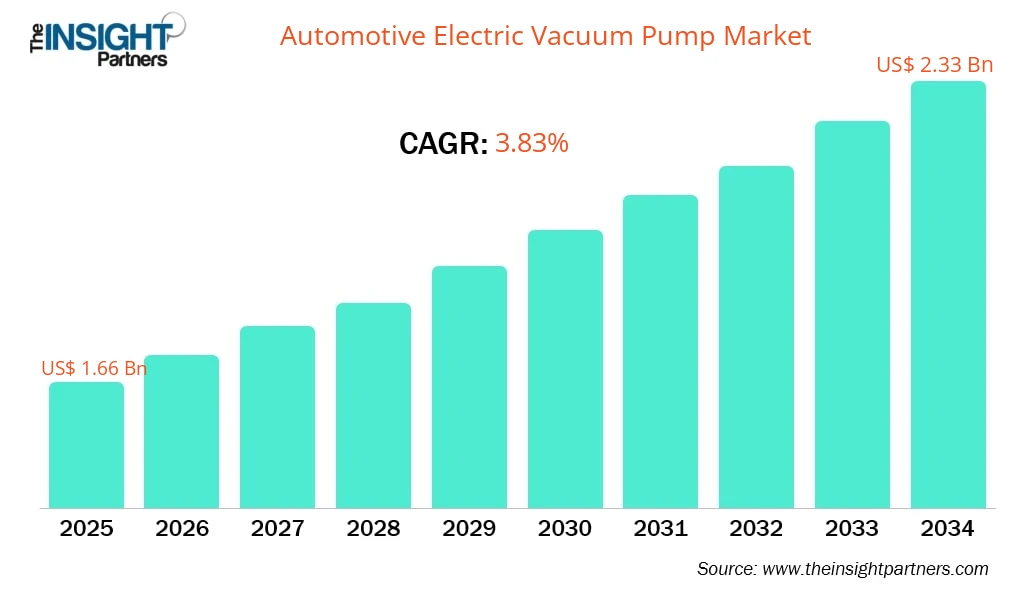
According to a comprehensive study by The Insight Partners, the market for these vital components is poised for steady expansion over the coming decade. The global Automotive Electric Vacuum Pump Market size is projected to reach US$ 2.33 billion by 2034 from US$ 1.66 billion in 2025. This steady growth trajectory indicates a resilient market development plan, with the industry anticipated to register a Compound Annual Growth Rate (CAGR) of 3.83% during the forecast period 2026–2034.
This consistent growth is heavily backed by the global automotive industry's push toward minimizing carbon footprints. As conventional engine architectures change, independent and reliable vacuum creation becomes vital. EVPs operate on-demand, consuming power only when needed. This significantly lowers overall vehicular emissions and fuel consumption compared to traditional mechanical pumps that drain energy continuously from the engine crankshaft.
Key Drivers Fueling Market Demand
Several micro- and macro-economic factors are shaping the growth of the automotive electric vacuum pump industry.
-
Downsizing of Internal Combustion Engines: In a bid to meet strict environmental mandates, automakers are focusing on engine downsizing and turbocharging. These downsized engines inherently produce insufficient vacuum, driving the adoption of standalone electric vacuum pumps to guarantee consistent braking assistance.
-
The Surge in Electric and Hybrid Vehicles: Hybrid and battery-electric vehicles operate partially or completely without a traditional internal combustion engine. Because a continuous vacuum source is required for safety systems like the power brake booster, the integration of an independent electric vacuum pump is mandatory in these powertrain configurations.
-
Enhanced Vehicle Safety Standards: Modern vehicular safety systems, including advanced driver assistance systems (ADAS) and autonomous emergency braking, require high-performance braking support. EVPs ensure rapid vacuum generation, resulting in shortened braking distances and optimized safety compliance.
Get a PDF Sample– https://www.theinsightpartners.com/sample/TIPRE00010258
Prominent Industry Key Players
The global market is characterized by intense competition, with several established tier-1 automotive suppliers leading technological advancements and product distribution. Key players actively contributing to market innovations and securing significant shares include:
-
Hella GmbH & Co. KGaA
-
Rheinmetall Automotive AG
-
Continental AG
-
Youngshin Precision Co., Ltd.
-
Tuopu Group
-
Mikuni Corp.
-
Robert Bosch GmbH
These manufacturers are focusing on designing lightweight, compact, and low-noise electric vacuum pumps. Strategic partnerships, long-term supply agreements with major original equipment manufacturers (OEMs), and heavy investments in research and development remain the dominant strategies used by these companies to sustain their competitive edge.
Future Outlook
Looking ahead, the future of the automotive electric vacuum pump market is inextricably linked to the rapid acceleration of global vehicle electrification. While the pure battery electric vehicle segment is progressively adopting integrated, vacuum-less electro-mechanical braking solutions (such as brake-by-wire systems), the massive volume of hybrid vehicles and plug-in hybrids (PHEVs) entering the mid-to-long-term market will remain a major revenue driver for EVPs.
Furthermore, secondary applications such as vacuum generation for engine control systems, exhaust gas recirculation (EGR) valves, and climate control flaps will provide sustained market opportunities. Regionally, Asia-Pacific and Europe are anticipated to lead the consumption charts due to their aggressive EV adoption targets and strict emissions policies. Consequently, the automotive electric vacuum pump market is set to remain a cornerstone of safer, more efficient, and eco-friendly mobility solutions through 2034 and beyond.
Related Reports-
Automotive Transmission Oil Pump Market
About Us
The Insight Partners is a one-stop industry research provider of actionable intelligence. We help our clients in getting solutions to their research requirements through our syndicated and consulting research services. We specialize in industries such as Semiconductor and Electronics, Aerospace and Defense, Automotive and Transportation, Biotechnology, Healthcare IT, Manufacturing and Construction, Medical Devices, Technology, Media, and Telecommunications, as well as chemicals and Materials.
Contact Us
If you have any queries about this report or if you would like further information, don’t hesitate to get in touch with us:
Contact Person: Ankit Mathur
E-mail: ankit.mathur@theinsightpartners.com
Phone: +1-646-491-9876
 Russian
 English
 Arabic
 French
 Spanish
 Portuguese
 Deutsch
 Turkish
 Dutch
Dutch
 Italiano
 Romaian
 Portuguese (Brazil)
 Greek
Greek