

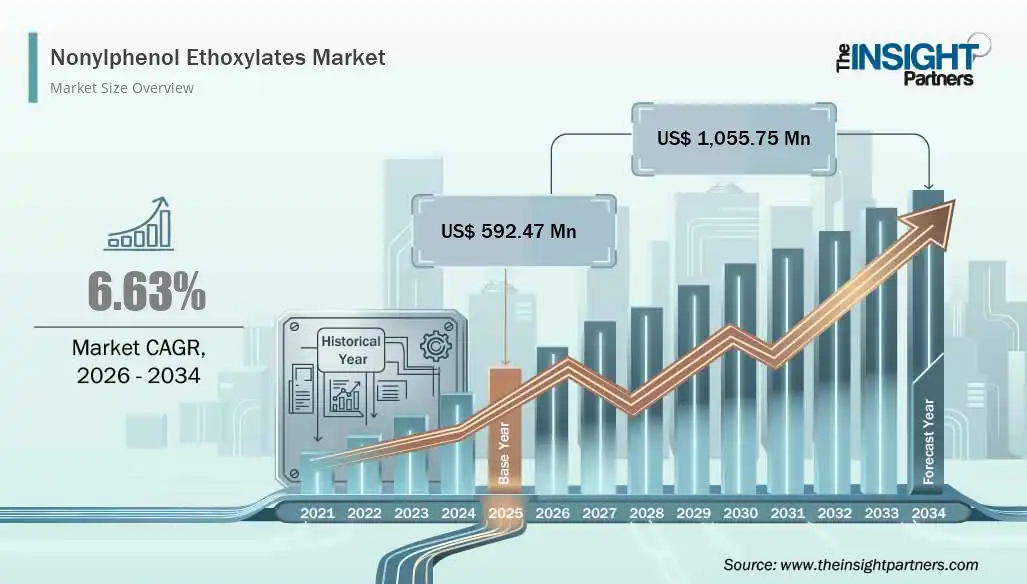
Nonylphenol Ethoxylates Market Growth to Reach US$ 1,055.75 Million by 2034, Recording a CAGR of 6.63%

The Nonylphenol Ethoxylates (NPE) Market is expanding as industrial manufacturers, textile processors, and agrochemical formulators continue to rely on high-performance nonionic surfactants for wetting, emulsification, and heavy-duty detergency. While stringent environmental regulations have curtailed consumer-facing uses in Western economies, sustained industrialization, agricultural intensification, and cost-sensitive manufacturing in emerging markets continue to underpin global consumption.
The global nonylphenol ethoxylates market size is projected to reach US$ 1,055.75 million by 2034 from US$ 592.47 million in 2025. The market is anticipated to register a CAGR of 6.63% during the forecast period 2026-2034.
What is driving the market?
Cost-effectiveness, superior surface-active performance, and expanding industrial output in developing economies are the principal growth drivers. Nonylphenol ethoxylates offer tunable hydrophilic-lipophilic balance, robust thermal stability, and chemical resilience across harsh acidic and alkaline conditions qualities essential for industrial degreasers, metalworking fluids, and textile scouring. Agrochemical producers also depend on NPEs as adjuvants and emulsifiers to lower surface tension and improve crop-protection spray penetration.
At the same time, the industry faces significant structural headwinds. Regulatory restrictions under frameworks such as EU REACH and U.S. EPA guidelines driven by concerns over aquatic toxicity and endocrine-disrupting degradation byproducts have forced widespread substitution toward linear alcohol ethoxylates and bio-based surfactants in consumer products. Volatility in ethylene oxide and nonylphenol feedstock pricing further challenges manufacturer margins.
Which region leads?
Asia Pacific leads the global market, accounting for the largest revenue share and representing the fastest-growing regional hub, with China and India projected to expand at CAGRs of 7.0% and 6.5%, respectively. Growth is propelled by large-scale textile wet processing, expanding agrochemical production, infrastructure development, and strong domestic chemical manufacturing capacity.
North America and Europe hold mature market shares, where demand has shifted away from household detergents toward strictly controlled, closed-loop industrial applications. In these regions, growth remains modest as environmental compliance, wastewater discharge limits, and brand-led chemical phase-outs restrict broader volume expansion.
Which segment leads?
Institutional and Industrial Cleaning is the leading application segment, accounting for an estimated 26.4% of market revenue in 2025. Its dominance reflects persistent demand for heavy-duty commercial degreasers, hard-surface cleaners, and equipment maintenance formulations where alternative surfactants often struggle to match the performance-to-cost ratio of NPEs.
Leather and Textile Processing represents another major revenue pillar, supported by high-volume scouring, dyeing, and finishing operations across Asian manufacturing hubs. Agrochemicals is identified as a key high-growth application, driven by rising global food demand and the need for efficient emulsifiable concentrates and adjuvant systems.
Which companies are prominent?
Prominent market participants include Dow, Indorama Ventures Public Company Limited, Solvay, Stepan Company, India Glycols Limited, Oxiteno, Huntsman International LLC, Nouryon, Minal Specialities, and Shandong Baovi Energy Technology Co., Ltd.
These companies compete across ethoxylation capacity, feedstock integration, specialty formulation support, and regulatory compliance. Strategic differentiation increasingly depends on supply-chain reliability in emerging markets, closed-loop industrial customer partnerships, and parallel investments in safer, biodegradable alternative surfactants such as fatty alcohol ethoxylates.
What is changing in 2026?
In 2026, the market is characterized by heightened regulatory bifurcation and supply-chain traceability. Export-oriented textile and chemical manufacturers in Asia are increasingly auditing chemical inputs to ensure compliance with Western buyer Restricted Substance Lists (RSLs), accelerating dual-track production lines that separate NPE-free export goods from NPE-based domestic industrial formulations.
Simultaneously, raw material price fluctuations particularly in ethylene oxide and phenol derivatives have prompted producers to optimize ethoxylation efficiency and pass through cost adjustments. End users are placing greater emphasis on wastewater treatment compatibility, documentation, and supplier technical support to meet tightening local environmental discharge standards.
What are the major investment opportunities?
The strongest opportunities lie in high-growth industrial hubs across Asia Pacific and Latin America, where expanding manufacturing, mining, oilfield, and agricultural sectors require cost-efficient industrial surfactants. Investments in backward-integrated ethoxylation plants and localized distribution networks can help producers capture margin and mitigate feedstock volatility.
Additional opportunities exist in developing specialized, controlled-use industrial formulations such as emulsion polymerization stabilizers, industrial coatings additives, and metalworking fluids where NPEs remain technically irreplaceable and face fewer immediate regulatory bans. Chemical manufacturers can also create strategic value by co-investing in bio-based or linear alcohol ethoxylate capacity alongside traditional NPE assets to hedge against long-term regulatory phase-outs.
Future Outlook
Over the next decade, the Nonylphenol Ethoxylates Market will transition into a regionally concentrated, industrial-focused specialty sector. While consumer and household cleaning volumes in North America and Europe will continue to decline in favor of biodegradable alternatives, steady industrial expansion in China, India, Southeast Asia, and Latin America will sustain overall market growth through 2034. Long-term market leaders will be those that balance cost-competitive industrial supply in emerging economies with strict environmental stewardship and diversified, next-generation surfactant portfolios.


