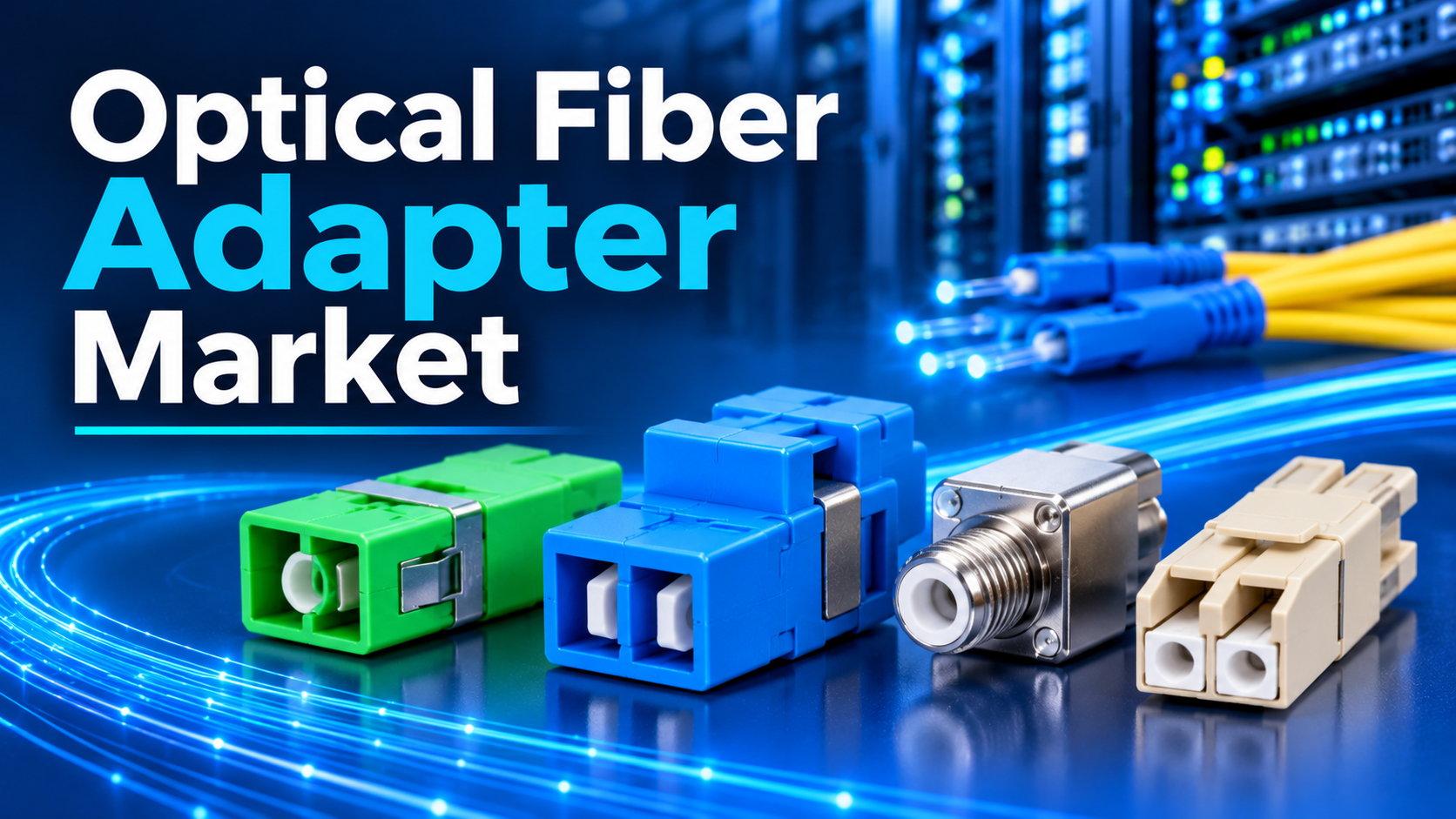
The expansion of fiber-optic communication networks and high-density data-center infrastructure is increasing the need for reliable passive connectivity components. Optical fiber adapters play an important role in aligning and joining fiber connectors, supporting stable optical connections across telecommunications, enterprise, testing and distribution environments.
According to SemiconductorInsight, the Optical Fiber Adapter Market was valued at USD 1,000.5 million in 2025, is estimated at USD 1,083.5 million in 2026 and is projected to reach USD 2,050.5 million by 2034, corresponding to a CAGR of 8.3% over the 2025–2034 valuation window. Asia-Pacific represents an estimated 40% of 2025 revenue. Single-mode adapters account for an estimated 78% of the type mix, while optical communication systems represent approximately 62% of application revenue.
Explore the complete https://semiconductorinsight.com/report/optical-fiber-adapter-market/
Why Are Optical Fiber Adapters Becoming Important for Fiber-Optic Connectivity?
Optical fiber adapters are passive components designed to align and connect two fiber-optic connectors. They provide a mechanical interface that enables optical continuity between cables and are used in distribution frames, patch panels, communication systems and other fiber infrastructure.
Adapters are available in simplex, duplex, quad and multi-fiber configurations. Connector interfaces such as LC, SC, ST, MTRJ, MPO and E2000 support different installation, density and compatibility requirements.
The performance of an adapter depends on ferrule alignment, sleeve geometry, connector cleanliness and the compatibility of the mated interfaces. These factors influence insertion loss, repeatability and the reliability of optical connections.
As fiber networks expand and data centers add more optical ports, adapters remain important components for connecting, maintaining and organizing passive optical infrastructure.
Fiber Network Expansion and Data-Center Interconnection Are Supporting Market Growth
One of the major factors influencing the Optical Fiber Adapter Market is the continued expansion of fiber-optic communication infrastructure. Broadband deployment, metro networks and data-center interconnection increase the number of optical ports that require reliable connector mating.
Semiconductor Insight estimates that Asia-Pacific accounts for approximately 40% of 2025 market revenue. Manufacturing concentration and dense access-network construction make China, Japan and India important markets for component availability and deployment.
Data-center operators are also adopting higher-density connectivity architectures. Compact connector formats and multi-fiber interfaces can help manage port density, although the practical benefit depends on maintenance access and compatibility with installed cabling.
These developments are supporting demand for adapters across optical communication systems, passive signal distribution and optical testing applications.
Receive your Free Sample Report today: https://semiconductorinsight.com/download-sample-report/
Single-Mode Adapters and Compact Connector Interfaces Are Expanding the Technology Landscape
Single-mode adapters represent an estimated 78% of the 2025 type market, reflecting the extensive use of single-mode fiber in access, metro and long-distance optical networks. Multimode adapters remain relevant in enterprise and shorter-reach data-center installations.
The report segments the market by Single Mode Adapter and Multimode Adapter. Connector shape is a separate technical choice, with LC, SC, SN and MPO interfaces serving different port-density and installation needs.
Ceramic alignment sleeves, ferrule positioning, connector polish and dust protection are important product characteristics. Buyers must verify APC or UPC compatibility and ensure that the adapter matches the optical fiber and connector family.
Compact formats can increase usable port density, but higher density must be balanced against technician access, cable routing, bend radius and the ability to clean and inspect connections.
Optical Communication Systems and Passive Distribution Create Additional Demand
Optical communication systems represent the largest application segment, accounting for an estimated 62% of market revenue. These systems use adapters to provide reliable mating interfaces across access, metro and other fiber-optic networks.
Optical power distribution systems represent another application area, accounting for an estimated 18% of revenue. In this context, the category refers to passive optical signal routing and splitting arrangements rather than electrical power infrastructure.
Optical test systems account for an estimated 13% of application demand. Adapters are used in test setups involving optical time-domain reflectometers, power meters and laboratory characterization equipment.
Other applications include industrial, medical and defense settings, where environmental protection, reliability and qualification requirements can be particularly important.
Connector Precision and Installation Quality Are Becoming Competitive Priorities
Optical adapter performance depends on precise mechanical alignment between fiber connectors. Ferrule positioning, sleeve geometry and connector cleanliness can affect insertion loss and the repeatability of optical connections.
Manufacturers are offering different sleeve materials, connector footprints and protective features to address indoor, outdoor and industrial requirements. Sealed and shuttered variants can help manage environmental exposure and handling risks.
High-density data-center designs are increasing interest in compact interfaces such as SN and MPO. However, a smaller footprint does not automatically improve total-system economics if it creates additional maintenance or compatibility requirements.
Suppliers therefore compete on tested optical loss, mechanical consistency, environmental protection, availability and the ability to support field installation at scale.
Fiber Deployment and Lifecycle Reliability Are Important Market Drivers
Optical fiber adapters are relatively small components, but their performance can influence the reliability and maintenance cost of a larger network. An intermittent connection fault may require troubleshooting and service visits that exceed the cost of the passive component.
Buyers evaluate insertion-loss consistency, sleeve material, connector compatibility, environmental ratings and the availability of replacement parts when selecting adapters.
Fiber rollout and data-center interconnection support demand, while retrofit and maintenance activity sustain replacement purchases across installed networks.
The commercial value of an adapter therefore depends on its ability to provide repeatable performance and integrate with the surrounding passive infrastructure throughout the product lifecycle.
Access the Full Report for In-Depth Insights: https://semiconductorinsight.com/report/optical-fiber-adapter-market/
Connector Contamination and Compatibility Remain Key Challenges
Optical fiber adapters can be affected by contamination, poor connector handling and incorrect mating. Dust or debris on ferrules can increase insertion loss and create intermittent performance problems in otherwise functional fiber networks.
Compatibility is another important consideration. Connector family, polish geometry, fiber mode, keyed orientation and panel mounting must be matched before two connectors are joined.
High-density installations can create additional maintenance challenges because technicians need sufficient access to clean, inspect and replace adapters without disturbing neighboring connections.
Supplier pricing, component availability and installation workmanship can also influence realized project economics, particularly across large-scale fiber deployments.
Where Are the Biggest Opportunities Emerging?
Data-center expansion represents an important opportunity for adapter manufacturers as operators add optical ports and increase interconnection density. Compact interfaces and multi-fiber configurations can support higher connection counts within existing rack footprints.
Broadband and fiber-to-the-premises programs provide another source of demand, particularly in Asia-Pacific markets where access-network construction remains active.
Outdoor and industrial applications may create opportunities for protected adapter assemblies with suitable ingress protection, temperature performance and enclosure compatibility.
Suppliers that can combine precision alignment, tested optical performance, consistent availability and application-specific support may be well positioned to serve network operators and equipment manufacturers.
Optical Fiber Adapter Market Segmentation
The report evaluates the market across key product and application categories, providing a structured view of demand and deployment requirements.
By type, the market is divided into:
• Single Mode Adapter
• Multimode Adapter
By application, the market covers:
• Optical Communication System
• Optical Power Distribution System
• Optical Test System
• Others
This segmentation is relevant for manufacturers and buyers because technical requirements vary by transmission performance, deployment environment, network architecture and end-user application.
View the complete Optical Fiber Adapter Market segmentation and forecast: https://semiconductorinsight.com/report/optical-fiber-adapter-market/
Regional Optical Fiber Adapter Market Outlook
Asia-Pacific represents the largest modeled regional market, accounting for approximately 40% of 2025 revenue. China, Japan and India are important because of manufacturing concentration, broadband construction and optical connectivity demand.
North America accounts for an estimated 30% of 2025 revenue. The region has an established communications and data-center ecosystem, with purchasing influenced by network upgrades, component qualification and replacement requirements.
Europe represents approximately 19% of modeled 2025 sales. Demand is supported by telecommunications, enterprise connectivity and industrial applications that require reliable passive optical interfaces.
South America accounts for an estimated 7%, while the Middle East and Africa represent approximately 4% of 2025 revenue. These regional allocations are modeled estimates based on deployment and distribution conditions rather than audited manufacturer revenue.
Competitive Landscape and Key Companies
The Optical Fiber Adapter Market includes manufacturers and suppliers serving optical communication infrastructure, data-center connectivity and related passive or active network components.
Semiconductor Insight identifies the following companies in the competitive landscape: SENKO Advanced Components, Corning Optical Communications, CommScope, Molex, Telegaertner, Amphenol, TE Connectivity, CONEC, HellermannTyton, Phoenix Contact and Optcore.
Competition is influenced by product performance, system compatibility, manufacturing capability, pricing, supply continuity and the ability to meet customer qualification requirements. The report also examines company positioning and relevant industry developments.
What Does the Optical Fiber Adapter Market Report Cover?
The Semiconductor Insight study examines market size, product segmentation, application demand, regional revenue allocations, connector engineering, purchasing criteria and competitive positioning. It also evaluates the factors affecting optical adapter performance, qualification and commercial adoption.
The report provides segmentation by optical fiber mode, application and region. It covers single-mode and multimode adapters, optical communication systems, optical power distribution systems, optical test systems and other applications, alongside country-level regional analysis and key company profiles.
The study also considers regional performance across North America, Europe, Asia-Pacific, South America, and the Middle East and Africa, with country-level coverage as specified in the report.
Key Questions Answered by the Study
The report helps industry participants evaluate questions including:
• What is the current Optical Fiber Adapter Market size?
• How large will the market become by 2034?
• What is the expected CAGR over the valuation period?
• Which region leads the optical fiber adapter market?
• Which type accounts for the largest market share?
• Which applications are covered in the report?
• What connector interfaces are used in optical fiber adapters?
• Why is connector compatibility important?
• What factors influence optical adapter performance?
• What challenges can affect adapter reliability?
• Who are the key companies profiled?
• What opportunities are emerging in high-density connectivity?
Explore the full Optical Fiber Adapter Market forecast and competitive analysis: https://semiconductorinsight.com/report/optical-fiber-adapter-market/
Get a Sample Report copy for free: https://semiconductorinsight.com/download-sample-report/
About Semiconductor Insight
Semiconductor Insight provides market intelligence and industry research covering semiconductor technologies, electronic components, communication systems, advanced manufacturing and related technology markets. Its research focuses on market sizing, forecasting, competitive landscapes, technology trends, segmentation and regional analysis to support strategic decision-making across the technology ecosystem.
Contact Semiconductor Insight
Website: https://www.semiconductorinsight.com