

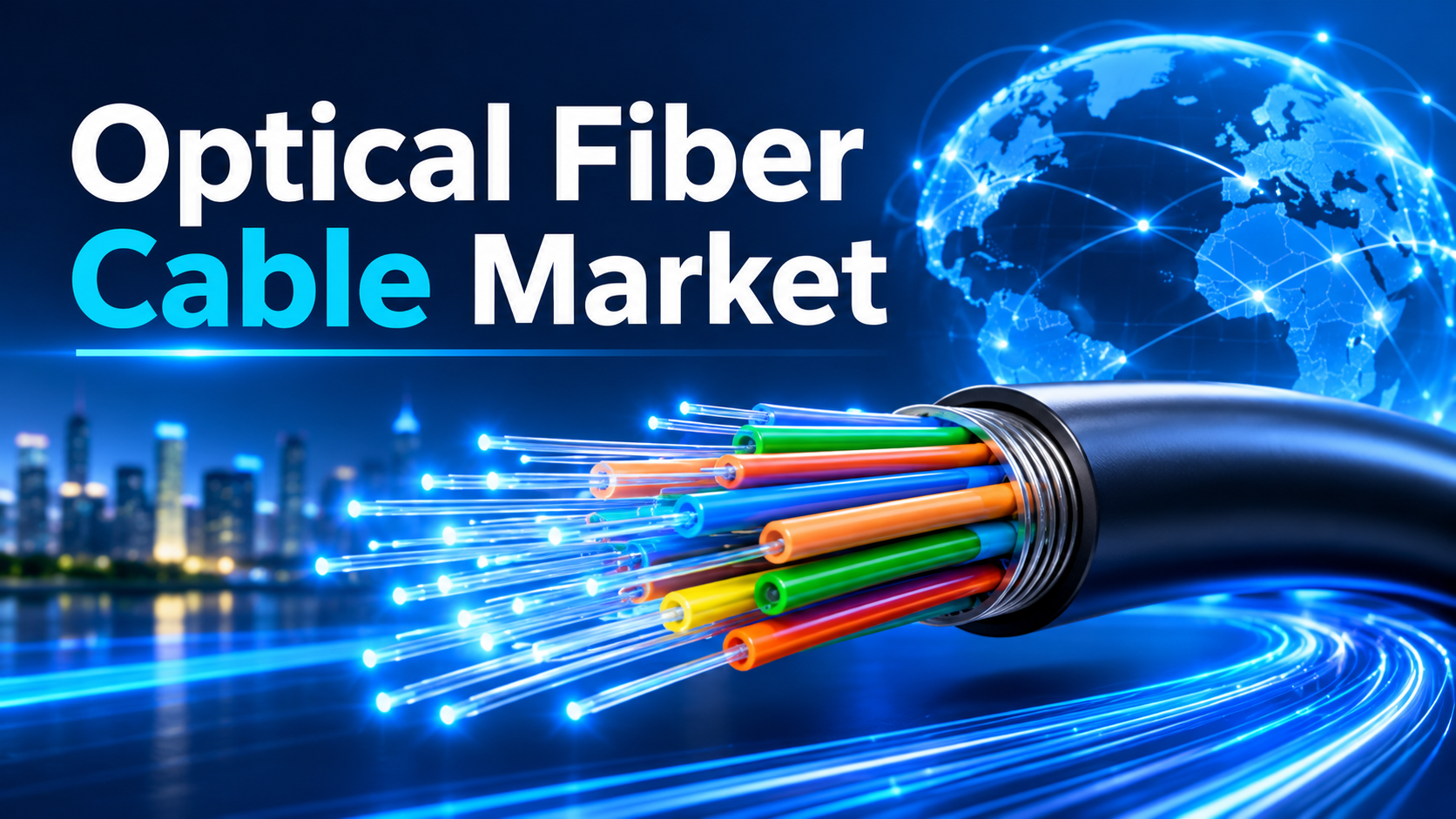
Optical Fiber Cable Market to Reach USD 17.03 Billion by 2034 as Broadband and AI Data-Center Networks Expand

The expansion of broadband connectivity, 5G infrastructure and hyperscale data centers is increasing demand for optical fiber cable across telecommunications and enterprise networks. As digital infrastructure requires greater capacity, cable manufacturers are focusing on higher fiber density, installation efficiency and reliable performance across diverse deployment environments.
According to SemiconductorInsight, the Optical Fiber Cable Market was valued at USD 12.18 billion in 2025, is estimated at USD 12.64 billion in 2026 and is projected to reach USD 17.03 billion by 2034, advancing at a CAGR of 3.8% during 2026–2034. Asia-Pacific represented the largest regional market in 2025, supported by manufacturing concentration, downstream demand and established supplier ecosystems. The market includes single-mode and multimode fiber cables for aerial, duct, buried and submarine deployment.
Explore the complete https://semiconductorinsight.com/report/optical-fiber-cable-market/
Why Is Optical Fiber Cable Becoming Increasingly Important for Digital Infrastructure?
Optical fiber cable provides high-capacity data transmission over long distances by carrying light through glass fibers protected within engineered cable structures. Its resistance to electromagnetic interference and ability to support high bandwidth make it essential to modern communication networks.
Telecommunications operators use fiber in backbone, metro, access and fiber-to-the-premises networks. Data centers also require dense fiber connections to link servers, switches and geographically distributed facilities.
The market is being shaped by two major infrastructure cycles: broadband fiber deployment and AI data-center networking. Both require reliable cable systems, although their requirements for density, reach, bend performance and installation can differ.
These developments are expanding the role of optical fiber cable across telecommunications, enterprise, utility, government and data-center infrastructure.
Broadband Expansion and AI Data Centers Are Supporting Market Growth
One of the major factors influencing the Optical Fiber Cable Market is continued investment in broadband infrastructure. Fiber-to-the-premises programs and mobile-network upgrades require additional cable routes and higher-capacity access networks.
Semiconductor Insight identifies Asia-Pacific as the largest regional market in 2025. China, India, Japan and Southeast Asian markets contribute through broadband expansion, 5G backhaul and large-scale manufacturing activity.
AI data centers are creating another important source of demand. Hyperscale campuses require dense interconnects, high fiber counts and efficient pathway utilization to connect buildings, racks and network equipment.
These demand sources are encouraging manufacturers to develop smaller-diameter fibers, ribbon structures, microcables and high-density cable designs.
Receive your Free Sample Report today: https://semiconductorinsight.com/download-sample-report/
Single-Mode Fiber and High-Density Cable Designs Are Expanding the Technology Landscape
Single-mode fiber is the leading type because it supports long-haul, metro, FTTH and data-center interconnect applications that require low attenuation and extended reach. Multimode fiber remains important for shorter enterprise and data-center links.
The report segments the market by Single-Mode Fiber and Multimode Fiber. The selection depends on transmission distance, network architecture, installed infrastructure and the technical requirements of the application.
Cable construction is also evolving. Loose-tube designs provide established outside-plant protection, ribbon cables support high fiber counts and efficient splicing, while microduct and high-density products help maximize conduit capacity.
Armored constructions are used where additional mechanical protection is required, including buried and demanding deployment environments.
Telecommunications and Data Centers Create Additional Demand
Telecommunications remains the largest end-user segment for optical fiber cable. Operators depend on fiber for backbone, metro, access and broadband networks, including fiber-to-the-home deployments.
Data centers and AI clusters represent a strong high-density growth area. Their infrastructure requires large numbers of fiber connections and cable systems designed for constrained pathways and dense equipment layouts.
Enterprises use optical fiber in campus networks and internal communications infrastructure, while utilities and government organizations deploy fiber for grid systems, transport networks and public broadband projects.
Application requirements vary by deployment method. Aerial, duct, armored buried and submarine cables must meet different mechanical, environmental and installation requirements.
High-Density Fiber and Installation Efficiency Are Becoming Competitive Priorities
Manufacturers are responding to rising fiber counts by developing cable designs that use available pathway space more efficiently. Ribbon structures and microduct cables can help operators deploy additional fibers where new civil infrastructure is difficult or expensive.
AI data-center networking is increasing attention on bend performance, cable diameter, connector count and pathway utilization. These factors can affect installation time and the ability to expand networks.
Product qualification and manufacturing consistency remain important because cable performance must be maintained across long deployment routes and varied operating environments.
Suppliers therefore compete on design reliability, application engineering, production capacity and the ability to provide consistent supply for large infrastructure programs.
Network Expansion and Lifecycle Economics Are Important Market Drivers
Fiber deployment can provide long-term capacity for broadband and data-center networks, making cable selection an important infrastructure decision. Buyers evaluate installation cost, fiber count, durability and future network expansion requirements.
High-density cable designs can improve the use of existing ducts and pathways, potentially reducing the need for additional civil works in constrained urban environments.
At the same time, material costs, manufacturing scale, geographic supply availability and installation conditions influence project economics.
The market's commercial outlook is therefore linked not only to the volume of network investment but also to the ability of cable suppliers to meet technical specifications and deliver products efficiently.
Access the Full Report for In-Depth Insights: https://semiconductorinsight.com/report/optical-fiber-cable-market/
Installation Conditions and Supply Requirements Remain Key Challenges
Optical fiber cable projects can face challenges related to civil infrastructure, route access and installation conditions. Aerial, duct, buried and submarine applications each require cable designs suited to their operating environment.
High-density deployments also increase the importance of bend performance, cable handling and pathway planning. Poor installation practices can affect network reliability even when the cable itself meets its technical specification.
Manufacturers must manage production economics and supply continuity while meeting customer qualification requirements across multiple regions and end markets.
Regional differences in infrastructure investment, regulation and supplier access can also affect deployment timing and the ability to scale projects.
Where Are the Biggest Opportunities Emerging?
AI data-center construction represents an important opportunity for high-density optical fiber cable. Large campuses require extensive interconnects and cable systems that can support growing bandwidth needs.
Broadband and 5G deployment programs provide another source of demand, particularly in markets expanding fiber access and mobile backhaul infrastructure.
Microduct and ribbon cable designs may gain relevance where operators need to increase fiber capacity within existing conduits. These products can help address space constraints in dense urban networks.
Submarine and armored cable applications also provide opportunities where long-distance connectivity and environmental protection are essential.
Optical Fiber Cable Market Segmentation
The report evaluates the market across key product and application categories, providing a structured view of demand and deployment requirements.
By type, the market is divided into:
• Single-Mode Fiber
• Multimode Fiber
By application, the market covers:
• Self-Supporting Aerial Cable
• Duct Optical Cable
• Armored Buried Cable
• Submarine Optical Cable
This segmentation is relevant for manufacturers and buyers because technical requirements vary by transmission performance, deployment environment, network architecture and end-user application.
View the complete Optical Fiber Cable Market segmentation and forecast: https://semiconductorinsight.com/report/optical-fiber-cable-market/
Regional Optical Fiber Cable Market Outlook
Asia-Pacific was the largest regional market in 2025, supported by broadband and mobile-network deployments in China, India, Japan and Southeast Asia. The region also has substantial fiber and cable manufacturing capacity.
North America is a large, high-value market, with demand supported by AI data centers and broadband investment. Rapid deployment and manufacturing capacity are important supplier-selection considerations.
Europe is a major technology market, supported by broadband, data-center and high-density cable requirements. Installation efficiency and network modernization influence demand.
South America and the Middle East and Africa are developing markets. FTTH, cloud infrastructure, national broadband programs and mobile backhaul are among the factors supporting regional demand.
Competitive Landscape and Key Companies
The Optical Fiber Cable Market includes manufacturers and suppliers serving optical communication infrastructure, data-center connectivity and related passive or active network components.
Semiconductor Insight identifies the following companies in the competitive landscape: Corning, CommScope, General Cable, Belden, AKSH OPTIFIBRE LIMITED, Himachal Futuristic Communications Limited (HFCL), Fujikura and Optical Cable Corporation (OCC).
Competition is influenced by product performance, system compatibility, manufacturing capability, pricing, supply continuity and the ability to meet customer qualification requirements. The report also examines company positioning and relevant industry developments.
What Does the Optical Fiber Cable Market Report Cover?
The Semiconductor Insight study examines market size, revenue, regional performance, production, pricing, competitive positioning and the industry dynamics influencing optical fiber cable demand. It also evaluates the role of manufacturing, downstream customers and application-specific requirements.
The report segments the market by fiber type, end user, application and cable construction. Regional analysis covers North America, Europe, Asia-Pacific, South America and the Middle East and Africa, with country-level coverage across major markets.
The study also considers regional performance across North America, Europe, Asia-Pacific, South America, and the Middle East and Africa, with country-level coverage as specified in the report.
Key Questions Answered by the Study
The report helps industry participants evaluate questions including:
• What is the current Optical Fiber Cable Market size?
• How large will the market become by 2034?
• What is the expected CAGR during 2026–2034?
• Which region leads the optical fiber cable market?
• What are the main types of optical fiber cable?
• Which end user represents the largest demand?
• What applications are covered in the report?
• Why is single-mode fiber widely used?
• What role do AI data centers play in market growth?
• What cable constructions are included in the segmentation?
• Who are the key companies covered in the report?
• What opportunities are emerging in high-density cable deployment?
Explore the full Optical Fiber Cable Market forecast and competitive analysis: https://semiconductorinsight.com/report/optical-fiber-cable-market/
Get a Sample Report copy for free: https://semiconductorinsight.com/download-sample-report/
About Semiconductor Insight
Semiconductor Insight provides market intelligence and industry research covering semiconductor technologies, electronic components, communication systems, advanced manufacturing and related technology markets. Its research focuses on market sizing, forecasting, competitive landscapes, technology trends, segmentation and regional analysis to support strategic decision-making across the technology ecosystem.
Contact Semiconductor Insight
Website: https://www.semiconductorinsight.com


