


Advanced Biomaterials and Digital Orthopedics Reshape Asia Pacific Healthcare
Asia Pacific Orthopedic Biomaterial Market Overview
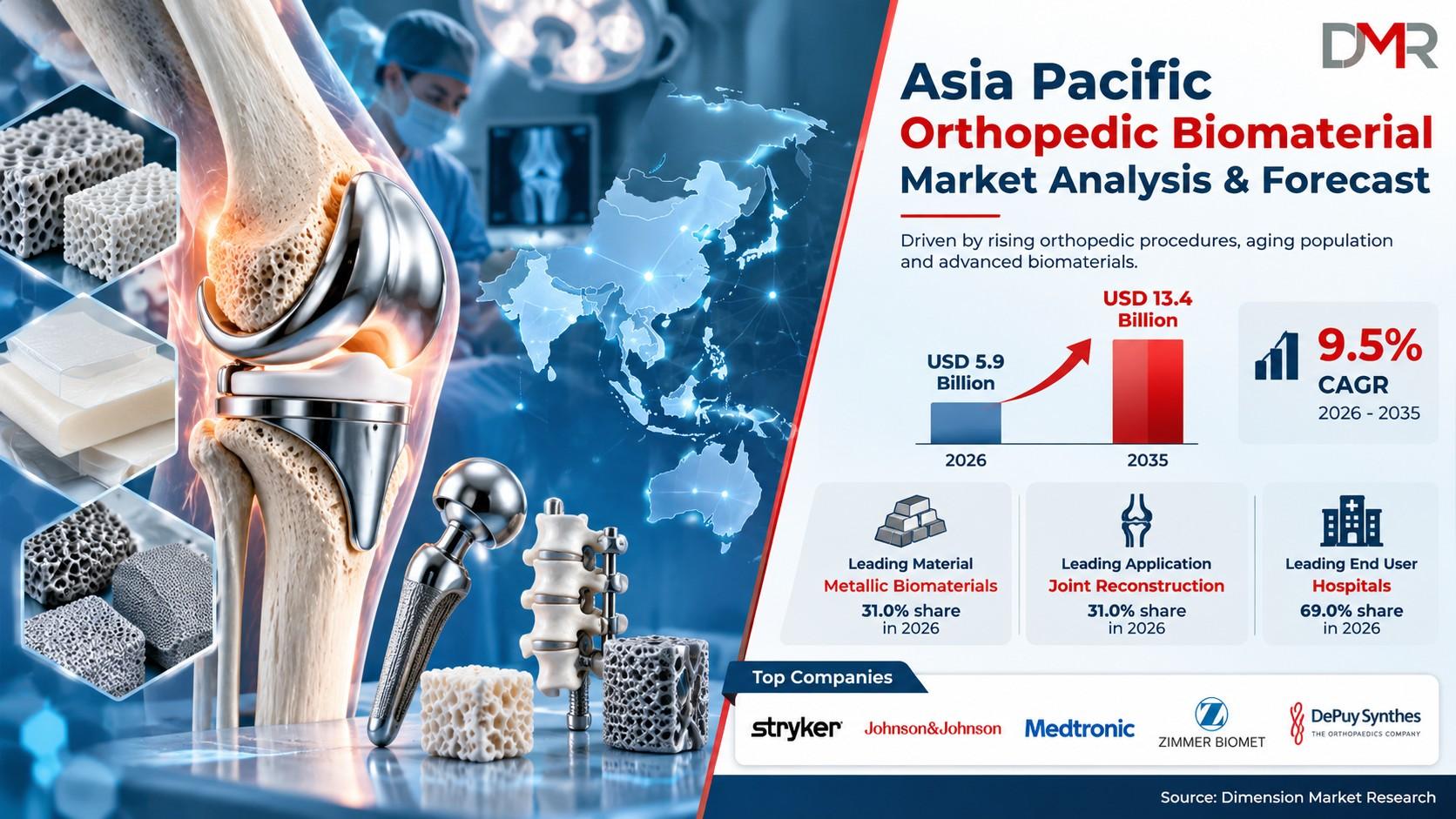
The Asia Pacific Orthopedic Biomaterial Market is expanding as healthcare providers respond to rising musculoskeletal disorders, aging populations and growing demand for joint replacement, spinal procedures and fracture treatment. According to Dimension Market Research, the Asia Pacific Orthopedic Biomaterial Market size is estimated at USD 5.9 billion in 2026 and is projected to reach USD 13.4 billion by 2035, registering a compound annual growth rate (CAGR) of 9.5% during 2026-2035. Metallic biomaterials lead the material category, joint reconstruction represents the leading application, and hospitals account for the largest end-user share. Advanced polymers, patient-specific implants and regenerative biomaterials are creating additional opportunities for manufacturers and healthcare technology providers.
Orthopedic biomaterials include metals, polymers, ceramics and biological materials used to repair, replace, stabilize or regenerate bones and related structures. Their applications span hip and knee replacements, spinal fusion, trauma fixation, bone-graft substitutes and craniomaxillofacial reconstruction. Continued investment in surgical infrastructure, domestic medical-device manufacturing and advanced treatment technologies is strengthening the region's long-term market outlook.
Asia Pacific Orthopedic Biomaterial Market Snapshot
● 2026 market size: USD 5.9 billion.
● 2035 projected market size: USD 13.4 billion.
● Forecast CAGR from 2026 to 2035: 9.5%.
● Leading material segment in 2026: Metallic biomaterials, with 31.0% share.
● Leading application in 2026: Joint reconstruction, with 31.0% share.
● Leading end user in 2026: Hospitals, with 69.0% share.
● Fastest-growing material: Polymeric biomaterials, at a projected 10.4% CAGR.
● Major national markets include China, Japan and India.
Get insight you need (request free sample)
Market Research Findings
The market research findings indicate that established implant materials continue to support demand, while advanced biomaterials are broadening treatment options. Metallic biomaterials benefit from their mechanical strength and extensive use in joint reconstruction, spinal implants and fracture fixation. Polymeric biomaterials, particularly polyether ether ketone (PEEK), are gaining attention for applications requiring suitable mechanical properties and radiolucency. Hospitals remain the principal purchasing channel because they perform complex orthopedic surgeries and have access to specialized surgical teams and equipment. Joint reconstruction leads application demand, supported by osteoarthritis and age-related joint degeneration. Meanwhile, additive manufacturing, bioactive ceramics and regenerative products offer opportunities for differentiated product development across Asia Pacific.
Why Is the Asia Pacific Orthopedic Biomaterial Market Growing?
Growth is supported by the increasing prevalence of osteoarthritis, osteoporosis, degenerative spinal disorders and traumatic injuries. Greater access to orthopedic treatment and expanding hospital capacity are encouraging more surgical procedures. China benefits from its large healthcare market and manufacturing base, while India presents opportunities associated with improving medical infrastructure and rising treatment access. Japan, South Korea and Australia offer established healthcare systems and demand for sophisticated orthopedic technologies. Together, these factors are supporting the adoption of conventional implants and advanced biomaterial solutions.
Key Growth Drivers in the Orthopedic Biomaterials Industry
● Increasing joint replacement procedures associated with aging populations.
● Rising incidence of fractures, osteoporosis and musculoskeletal disorders.
● Expansion of hospitals and specialized orthopedic treatment centers.
● Growing adoption of advanced spinal implants and bone-graft substitutes.
● Increasing use of PEEK and other advanced polymeric biomaterials.
● Development of 3D-printed and patient-specific orthopedic implants.
● Investment in domestic medical-device manufacturing and surgical technologies.
Read more about this market: https://dimensionmarketresearch.com/report/asia-pacific-orthopedic-biomaterial-market/
Research Scope: Leading Market Segments
Metallic Biomaterials
Metallic biomaterials represent an estimated 31.0% of the market in 2026. Titanium alloys, cobalt-chromium alloys and stainless steel are used in joint replacement components, spinal fixation devices, plates, screws and intramedullary nails. Their strength, durability and established clinical applications support their continued adoption. Titanium-based materials are particularly relevant for implants designed to support bone integration. Although metallic biomaterials currently lead the market, manufacturers face pricing pressure and growing competition from local suppliers. Continued improvements in surface treatments, implant design and manufacturing processes may help preserve their position in complex orthopedic procedures.
Polymeric Biomaterials
Polymeric biomaterials are projected to record the fastest growth among material categories, with a forecast CAGR of 10.4%. Materials such as PEEK, polyethylene and polymethyl methacrylate (PMMA) bone cement serve different orthopedic functions. PEEK is used in selected spinal implants because of its mechanical characteristics and radiolucency, while polyethylene is widely used in joint replacement components. PMMA supports implant fixation in appropriate procedures. Further research into polymer composites, bioactive surfaces and improved material performance could expand clinical applications. Manufacturers that combine product innovation with cost-effective production may find opportunities in both established and emerging Asia Pacific markets.
Joint Reconstruction
Joint reconstruction is estimated to account for 31.0% of the market in 2026. Hip, knee and shoulder replacement procedures require materials that can withstand mechanical loads while meeting biocompatibility and durability requirements. Aging populations and the increasing burden of osteoarthritis support demand for these procedures. Implant manufacturers are also investing in improved bearing surfaces, personalized components and digital surgical planning. Hospitals remain central to this segment because they handle many complex replacement surgeries. Future growth will depend on procedure volumes, affordability, clinical outcomes and healthcare access across the region.
Market Dynamics: Trends, Opportunities and Challenges
Trend: Digital Orthopedics and Advanced Manufacturing
Artificial intelligence, surgical navigation, robotics and additive manufacturing are influencing orthopedic implant design and use. Three-dimensional printing enables complex porous structures and patient-specific components, while digital planning can support implant positioning and surgical preparation. These technologies may improve workflow efficiency and help manufacturers develop differentiated products. Adoption will depend on clinical evidence, equipment availability, regulatory approval and the ability of healthcare providers to justify investment costs.
Opportunity: Regenerative Biomaterials and Local Manufacturing
Advanced polymers, hydroxyapatite, calcium phosphate, collagen-based products and synthetic bone-graft substitutes offer opportunities in bone regeneration and reconstruction. Local manufacturing can also help suppliers respond to regional demand and price sensitivity. India and China are particularly important markets for companies seeking to expand production and distribution. Businesses with strong clinical validation, regulatory expertise and competitive manufacturing capabilities may be well positioned to address these opportunities.
Challenge: Cost and Regulatory Complexity
Advanced biomaterials often require sophisticated manufacturing, biocompatibility testing and extensive clinical evaluation. These requirements can increase development costs and restrict access in price-sensitive healthcare settings. Regulatory procedures also vary across China, Japan, India, South Korea and other markets, increasing the complexity of regional commercialization. Manufacturers must balance innovation with affordability while maintaining product quality, demonstrating clinical performance and complying with applicable medical-device requirements.
Regional and Country Outlook
China is identified in the supplied research as the largest national market, followed by Japan and India. South Korea, Australia, New Zealand and ASEAN markets contribute additional demand. China offers scale and manufacturing opportunities, Japan supports demand for advanced implants, and India presents growth potential through expanding healthcare infrastructure and improving access to orthopedic treatment. The supplied report information does not provide verified country-specific market values and CAGRs for every country; therefore, regional growth estimates should not be interpreted as individual country forecasts. The regional market is projected to grow at a 9.5% CAGR between 2026 and 2035.
Key Competitor Companies
● Zimmer Biomet
● Stryker
● Johnson & Johnson MedTech and DePuy Synthes
● Medtronic
● Smith+Nephew
● Globus Medical
● B. Braun and Aesculap
● MicroPort Scientific
● AK Medical
● Chunli Medical
● Victrex and Invibio
● Kyocera
Competition centers on implant performance, product portfolios, clinical evidence, pricing, surgeon relationships, regulatory capabilities and digital integration. Multinational manufacturers compete alongside regional suppliers that emphasize local production and cost-effective alternatives.
Get 10% instant discount on report purchase
Explore more report:
● US High-Voltage Cable Diagnostics Market
● US Grid Energy Storage Equipment Market
Frequently Asked Questions
1. What is the Asia Pacific Orthopedic Biomaterial Market size in 2026?
The market is estimated at USD 5.9 billion in 2026, according to Dimension Market Research.
2. What is the projected market value by 2035?
The market is projected to reach USD 13.4 billion by 2035.
3. What is the market CAGR from 2026 to 2035?
The projected compound annual growth rate is 9.5% during the forecast period.
4. Which material segment leads the market?
Metallic biomaterials lead the material category, with an estimated 31.0% share in 2026.
5. Which material segment is growing fastest?
Polymeric biomaterials are projected to grow fastest, with a 10.4% CAGR.
6. Which application dominates the market?
Joint reconstruction leads applications, accounting for an estimated 31.0% share in 2026.
7. Which end user accounts for the largest market share?
Hospitals lead end-user demand, representing an estimated 69.0% share in 2026.
8. Which countries offer important market opportunities?
China, Japan and India are major national markets, with additional opportunities across South Korea, Australia and ASEAN.
9. What are the major growth drivers?
Key drivers include aging populations, musculoskeletal disorders, orthopedic surgeries and biomaterial innovation.
10. Which trends are shaping the market outlook?
Advanced polymers, 3D printing, patient-specific implants, regenerative materials and local manufacturing are important trends.
Explore the Full Market Research Report
The Asia Pacific Orthopedic Biomaterial Market offers opportunities across established implant materials, advanced polymers, joint reconstruction and regenerative technologies. With the market projected to reach USD 13.4 billion by 2035, companies can use detailed segmentation, country analysis and competitive intelligence to evaluate potential growth areas. Market participants should also consider regulatory requirements, pricing pressure and clinical validation when assessing expansion strategies.
About Us
Dimension Market Research (DMR) is a global market intelligence and consulting firm delivering data-driven insights that help organizations make informed strategic decisions. With expertise across 12+ industries and global markets, DMR provides syndicated reports, custom research, competitive analysis, white space analysis, and business strategy consulting.
Our research solutions combine analytical rigor, industry expertise, and forward-looking intelligence to identify opportunities, reduce risks, and support sustainable growth. Trusted by clients across diverse sectors, DMR is committed to delivering accurate, actionable insights that enable businesses to navigate evolving market landscapes with confidence.
Contact Us
Phone USA: +17323699777
Phone India: +919310023843
E-mail: enquiry@dimensionmarketresearch.com
Address USA: 957 Route 33, Suite 12 #308, Hamilton Square, NJ-08690
Address India: D44, Sector 6, Noida 201301, India
 English
 Arabic
 French
 Spanish
 Portuguese
 Deutsch
 Turkish
 Dutch
Dutch
 Italiano
 Russian
 Romaian
 Portuguese (Brazil)
 Greek
Greek