English
 Arabic
 French
 Spanish
 Portuguese
 Deutsch
 Turkish
 Dutch
Dutch
 Italiano
 Russian
 Romaian
 Portuguese (Brazil)
 Greek
Greek
Ergonomic Chair Market Enhancing Workplace Comfort Through Smart Designs
Other |
2026-07-22 11:09:44
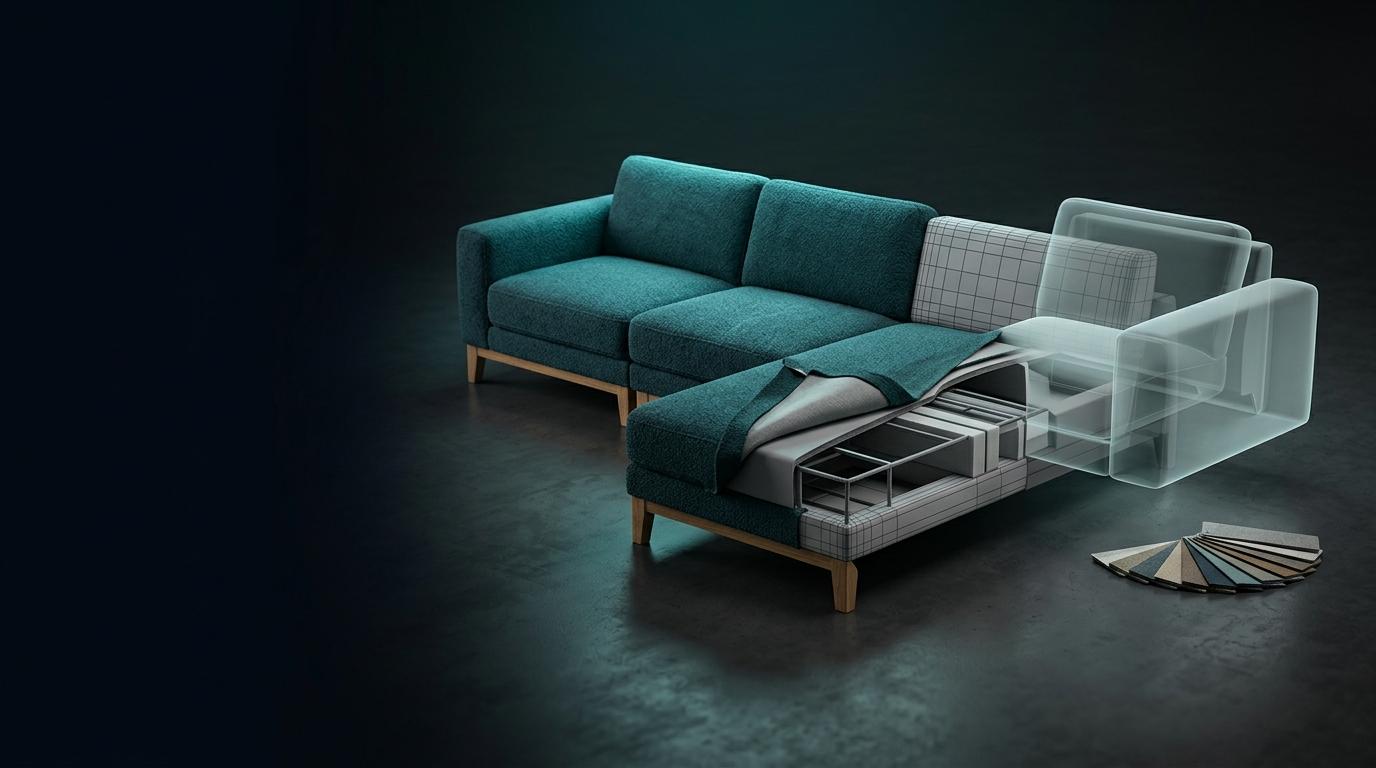
Hire 3D Cloud, Roomle or VividWorks when you sell modular or made-to-order furniture through a storefront and want a configurator, a room planner and AR from one platform; hire iONE360 or Mimeeq when the same configurator also has to price and quote for a dealer network; hire a custom studio such as the Culver City team at #5 or the Danish CGI studio at #9 when your product rules, your systems or your visual standard do not fit a platform's data model. None of the platforms on this list publishes a price, so plan the first conversation as a scoping call, and plan a custom build from the $10,000–$49,000 band that Clutch reports as the typical software project (Clutch pricing guide, data updated September 2026). The commercial reason to do any of this is that 73% of B2B decision-makers now say they are comfortable placing orders above $50,000 online (McKinsey Global B2B Pulse, about 4,000 decision-makers, May 2026), and on the consumer side Shopify reports that Rebecca Minkoff shoppers who viewed a product in 3D were 44% more likely to add it to cart and 27% more likely to order (Shopify blog, single-brand case study, 2020–2021 data). A configurator is the piece of software that turns that willingness into an order a factory can actually build.
The job we ranked against is specific. A furniture or interiors business, whether a manufacturer, a retailer or a brand that does both, needs a browser tool that lets a shopper or a dealer assemble a real product from real options, see it correctly, and hand the result to a cart, a quote or a production system. Furniture is harder than most configurator categories because the product is modular (a sofa is three to nine pieces, a shelving system is hundreds), because fabric and finish combinations run into the thousands, and because the shopper usually wants to see the product in a room, not on a white background.
Four criteria decided who made the list. First, furniture, kitchen or interiors had to be a named industry on the vendor's own site, with named furniture customers, not a generic "any product" claim. Second, the vendor had to offer at least one of the three tool types in the table below as a product or a service, and preferably two. Third, every fact in the entries had to be on the vendor's site or Clutch listing when we checked on September 20, 2026; where a figure is not published, the table says "not published" rather than guessing. Fourth, the mix had to span platforms, a CGI studio, a design-to-manufacture suite and a custom development shop, because those are genuinely different purchases with different contracts.
The order is by fit to that job, not by company size, funding or the length of the logo wall. A platform that combines a configurator with a room planner ranks above one that only does product configuration; a vendor that publishes its budget brackets ranks above one that does not, because a published number saves a week of discovery. Three things were deliberately ignored: review counts on Clutch, since a five-year-old studio and a twenty-year-old platform cannot be compared on volume; vendor-reported customer results, which arrive without a baseline or a method and are labeled below as the vendor's own claim wherever they appear; and geography as a ranking factor, although two vendors are headquartered in the United States and a third serves a largely US client list, because a US buyer often needs a US contract entity and an overlapping time zone.
Before the comparison, the three tool types need separating, because vendors use the words loosely and buyers pay for the wrong one. A product configurator changes the product itself: legs, fabric, width, modules. A room planner places finished products in a floor plan or a photo of the shopper's own room. AR places one product, at true scale, through the phone camera. They need different assets, different data and different integrations.
| Tool | What the shopper does | What it needs from you | Where it earns its keep | Vendors on this list that offer it |
|---|---|---|---|---|
| Product configurator | Builds one product from valid options: size, modules, fabric, finish, hardware; sees a live price | A master 3D model per product family, a rules table (what fits with what), a price list, an SKU or BOM output format | Made-to-order and modular ranges where the option count makes photography impossible and wrong orders expensive | 3D Cloud, Roomle, VividWorks, iONE360, Mimeeq, Cylindo (modular designer), 3D Source, Cadesign form, the custom studio at #5 |
| Room planner | Draws or uploads a room, drops in several products, checks fit and layout, often shares the plan with a store | Dimensioned models of the whole catalog, not just the configurable items; a way to save and hand over a plan | Kitchens, closets, offices and whole-room purchases where the sale is a project, not a product | 3D Cloud, Roomle, iONE360, Cyncly (dealer-side design tools) |
| AR placement | Points the phone at the floor and sees one product at real scale in the actual room | Lightweight optimized models (GLB/USDZ), a web viewer or an app, and a plan for what happens after the AR view | Single large items (sofas, tables, lamps) where "will it fit and does it suit" is the last objection | 3D Cloud, Roomle, VividWorks, iONE360, Mimeeq, Cylindo, 3D Source, the custom studio at #5 (WebAR) |
Two numbers explain why the AR row matters even for a business that only wanted a configurator. Shopify quotes a 2026 Clutch consumer survey in which 58% of customers said they use AR before making a purchase and 61% of those access it on a mobile device (Clutch survey, 2026, as quoted by Shopify). And in a Deloitte Digital and Snap survey of 15,000 consumers, 56% said AR gives them more confidence in product quality (Deloitte Digital and Snap Inc., Consumer AR Global Report, May 2021; Snap-commissioned, about half the respondents were Snapchat users). Confidence in quality is precisely the objection a sofa buyer has when they cannot sit on it.
The budget and timeline columns contain only figures the company itself publishes. Nine of the ten publish neither, which is a finding in itself: in this category the vendor expects to scope before quoting, and a buyer who arrives with a catalog count, an option count and a systems list will get a number in one call instead of three.
| # | Company | Focus | Budget range | Timeline | Region |
|---|---|---|---|---|---|
| 1 | 3D Cloud (formerly Marxent) | Platform: 3D configurators, room planners, WebAR, 360 panoramas and AI chat-based configuration for furniture, kitchen and bath, closets, outdoor and office | not published | not published | St. Petersburg, FL, USA; offices Miamisburg, OH and London, UK |
| 2 | Roomle GmbH | Platform: product configurator, room designer, AR, 3D viewer, CPQ, renderings, analytics, open API and SDK; mainly furniture | not published | not published | Austria |
| 3 | VividWorks | Cloud 3D configurator and visual CPQ for furniture, kitchen and bath, lighting and building supplies; rule-based configuration, AR and VR | not published (pricing page exists, tiers not shown) | not published | Oulu, Finland |
| 4 | iONE360 | AI-powered configurator with 3D room planner, AR and automated photoreal rendering for furniture and home décor | not published (request a quote) | not published | not published (largely Dutch client base) |
| 5 | Todor3D | Custom WebGL, Three.js and React Three Fiber configurators, WebAR/WebXR, custom software engineering, AI solutions | $10,000–50,000 / $50,000–100,000 / $100,000–250,000+ (per company site) | 4–10 weeks / 3–6 months / 4–12 months (per company site) | Culver City, CA, USA |
| 6 | Mimeeq | Cloud visual configurator (3D, 2D, modular) with built-in CPQ, AR and omnichannel embeds; office and home furniture, fitness, hardware | not published | not published | not published |
| 7 | Cylindo (Chaos) | Visual commerce platform for furniture: one master 3D asset feeds product images, 360, AR, a modular designer, AI imagery and configuration analytics | not published (pricing on request) | not published | not published (part of Chaos) |
| 8 | 3D Source | Cloud platform Metabox: real-time streamed configurators (Metabox Stream) and a virtual photo studio with generative AI (Metabox Studio) for fixtures and furnishings | not published | not published | not published (US client base) |
| 9 | Cadesign form | CGI studio: product images, lifestyle visuals, films, configurators, digital showrooms and BIM/CAD files for furniture, kitchen and bath, building materials | not published | not published | not published (Danish and Nordic client base) |
| 10 | Cyncly | Design-to-manufacture software for kitchens, bathrooms, furniture and cabinets, flooring, windows and doors (Winner Flex, Spaces Flex, 3CAD, Mozaik, RFMS ERP) | not published | not published | not published; country sites in 24+ markets including the US, UK, Germany and Australia |
Read the region column with care. Several of these vendors do not state a headquarters on the pages a buyer lands on, and that is not a red flag in itself, but it does mean the contract entity, the data-hosting region and the support time zone are questions for the first call rather than facts you can take from the site. The one vendor with published brackets is a custom studio, and its brackets are wide because a custom build is scoped per project; the platforms price on catalog size, seats or traffic and would rather learn your numbers first.
3D Cloud, which traded as Marxent until its rename, is a 3D product visualization platform built for furniture and home-improvement retailers. Its site lists WebAR, 3D configurators, room planners, 360 panoramas and an AI chat-based configuration product it calls DesignWithMe.ai, across kitchen and bath, closets, outdoor and decking, and office furniture. It is headquartered in St. Petersburg, Florida, with offices in Miamisburg, Ohio and London, and lists customers in the US, UK, EU and Australia and New Zealand.
The customer list on the homepage is the clearest signal of who it is for: Macy's, Joybird, La-Z-Boy, MillerKnoll, Lowe's, John Lewis, Ashley and Kingfisher. Those are retailers and manufacturers of a scale where a store network has to pick up a plan a shopper started at home. A representative engagement, in that light, is a kitchen or closet planner that a shopper uses on the retailer's site and a designer opens in store, backed by the same product models the configurator and the AR view use.
Pick 3D Cloud when you need all three tool types from the earlier table at once, when your category is one it already names (kitchen, bath, closets, decking, office), and when a US contract and a US time zone matter. Its breadth across categories is the argument for it.
Do not pick it when your catalog is small or your problem is a single hero product with deep customization: a platform built for planners and retailer-scale catalogs is more than a twenty-SKU brand needs, and 3D Cloud does not publish pricing or timelines, so budgeting starts with a discovery call rather than a page. It is also a platform, not a code shop; if you want to own the front end outright, that is a different purchase.
Roomle GmbH is an Austrian 3D commerce platform whose site lists a product configurator, a room designer, AR, a 3D viewer, CPQ, high-quality renderings, analytics and an open API and SDK. The emphasis is on furniture and on manufacturers of modular systems, where the number of valid combinations is large and the rules that govern them are the product.
The customer list on its site makes the point: USM Haller, MOEBE, FRAMA and Kave Home in furniture, Biohort in garden sheds and ACD Elektronik outside furniture altogether. A representative project is a configurator for a modular system in which the shopper builds a shelving or storage unit module by module, sees the price update, and can drop the result into a room plan or view it in AR, with the configuration passed on as a structured order.
Pick Roomle when your product is a system of parts with rules, when you want a room designer as well as a configurator, and, importantly, when your own developers want to build the front end on an SDK rather than accept a hosted widget. The open API and SDK are what separate it from platforms that only offer an embed; a brand with an in-house web team can integrate deeper.
Do not pick it when you want a one-off marketing experience rather than a catalog-wide system, or when you have no developers and want a vendor to own every pixel: an SDK is only an advantage if someone on your side will use it. Roomle does not publish pricing or timelines, and its site does not state a city, so hosting region and contract details are first-call questions.
VividWorks is a cloud 3D product configurator and visual CPQ platform based in Oulu, Finland, founded in 2006, which makes it one of the longer-standing vendors in the category. Its site describes designing, visualizing and pricing customizable products online, with rule-based configuration, AR and VR output, across furniture, kitchen and bath, lighting and building supplies. It notes support in Japanese as well as worldwide operation.
The customer list on its site reads like a Scandinavian design catalog: BoConcept, HAY, Louis Poulsen and Montana, plus Ideal Keittiöt in kitchens and Supra Cabinets. A representative project is a modular shelving or sofa configurator for a design brand in which the rules engine prevents invalid combinations, the price follows the configuration, and the same data drives the dealer's quote; the kitchen customers point to the second use, cabinet runs configured against a rules table and handed to a kitchen designer.
Pick VividWorks when the rules are the hard part of your product, when you sell through dealers as well as online and need the same configuration to price in both channels, and when kitchen or cabinetry is on the roadmap alongside furniture. A vendor that has been doing this since 2006 also has a long list of reference customers you can actually call.
Do not pick it when your main problem is imagery rather than configuration, for instance generating thousands of product photos in every fabric, where Cylindo or iONE360 lead with that; or when room planning is the primary need, which is not what VividWorks leads with. A pricing page exists but the tiers were not visible when checked, so treat pricing as unpublished.
iONE360 describes itself as an AI-powered product configurator for furniture and home décor, with a 3D room planner, AR and automated photoreal rendering built on real-time CGI. Its site lists integrations with WooCommerce, Magento and WordPress, and claims recognition as a Gartner representative vendor and ISO 27001 certification; both are the vendor's own statements, checked on its site rather than at the source.
The client list on its homepage is Xooon, Henders & Hazel, El Corte Inglés, Bruynzeel, Habufa and De Eekhoorn, a largely Dutch furniture retail base with one large department-store name. A representative engagement is a furniture brand that configures a sofa range online, uses the same configuration data to render the catalog images automatically instead of shooting every fabric, and lets the shopper drop the result into a room plan.
Pick iONE360 when you have the imagery problem and the configuration problem at once, which is true of most upholstery brands: every new fabric means a photo shoot unless the renders come from the configurator. Pick it too when your store runs on WooCommerce or Magento, the platforms it names, and when a room planner is part of the plan.
Do not pick it without asking about your storefront first: the integrations listed are WooCommerce, Magento and WordPress, so a Shopify or BigCommerce store needs a conversation before you assume a fit. The site does not state a headquarters and pricing is by quote only, so contract entity, hosting region and support hours all belong in the first call. Its client base is concentrated in Europe, which is a consideration for a US buyer expecting same-day support.
Todor3D, a WebGL development agency in Culver City, California, was founded in 2020 and lists 40+ engineers across three continents, 300+ delivered projects, and 25 reviews with a 5.0 rating on Clutch. It is a custom development company rather than a platform: the stack is WebGL, Three.js, React Three Fiber and WebAR/WebXR, and the practice areas are 3D & Immersive, Custom Software Engineering and AI Solutions. It is the only vendor on this list that publishes its budget brackets, $10,000–50,000, $50,000–100,000 and $100,000–250,000+, and its timelines, 4–10 weeks, 3–6 months and 4–12 months.
The relevant example is listed on the studio's own site: a closet configurator in the $10,000–50,000 bracket delivered in four months, alongside a jewelry configurator in the same bracket. A closet is a useful test case for a furniture buyer because it is a room-scale product with modules, widths, finishes and hardware, and the configuration has to come out as a manufacturable spec rather than a picture. The closet example is listed on their site; no results or client names are published for it.
Pick the studio when your product rules or your surrounding systems do not fit a platform's data model, when you want to own the code and the assets at the end, or when the configurator is one part of a larger custom build, for instance a dealer portal or an internal quoting tool that a hosted widget cannot become. The published brackets make it easy to check fit before a call: a first configurator for one product family sits in the lowest bracket on the studio's own numbers.
Do not pick it when you want a self-serve platform with a room planner and a catalog manager ready on day one, because everything here is built rather than switched on, and a custom build means you carry the maintenance afterwards, which agencies surveyed by GoodFirms budget at 15–25% of build cost per year (GoodFirms app development cost survey, 2026). The studio was founded in 2020, so its track record is shorter than that of the 2006-founded platform at #3, and its example projects in this category are listed without published outcomes.
Mimeeq is a cloud visual product configurator that handles 3D, 2D and modular products with configure-price-quote built into the platform rather than bolted on, plus AR and what it calls omnichannel embeds: the same configurator placed on a website, a dealer portal or a marketplace. Its named industries are office and home furniture, fitness equipment and hardware. The site describes a stack of AWS NoSQL storage, a Fastly CDN and a JavaScript embed, with Shopify and WooCommerce integrations.
The client list on its homepage is La-Z-Boy, Buster + Punch, The Senator Group, Camira, Modloft and Sun Valley Bronze, a mix that matches its named industries of home and office furniture and hardware. A representative engagement is an office-seating manufacturer whose dealers configure a chair by frame, mechanism, arm and fabric, see the trade price, and generate a quote from the same tool that consumers use to browse on the brand site.
Pick Mimeeq when quoting is as important as visualizing, when you sell through dealers who need trade pricing in the same configurator, and when your store runs on Shopify or WooCommerce. The built-in CPQ is the reason it sits above the imagery-first platforms for a manufacturer that lives on quotes.
Do not pick it when the room planner is your primary need, because planning is not what the site leads with, or when you need a vendor with a stated headquarters and published pricing, because Mimeeq shows neither on the pages a buyer reaches. As with every platform here, ask where the data is hosted and who owns the 3D assets before signing.
Cylindo, part of Chaos, calls itself an AI visual commerce platform for furniture brands, and its architecture is the pitch: one master 3D asset per product feeds the product images, the 360 spin, the AR view, a modular designer, AI-generated imagery and configuration analytics, all through an API-first platform. It is built for the case where a brand has hundreds of frames and hundreds of fabrics and cannot photograph the grid.
Its published case studies include Joybird, Anthropologie, Room & Board, Interior Define, Swiss Sense and Landscape Forms, several of which also appear on other vendors' lists, which says something about how furniture brands mix platforms. A representative project is a sofa brand that stops shooting every fabric on every frame, renders the catalog from the master assets, and lets the shopper build a sectional in the modular designer and preview it in AR from the same files.
Pick Cylindo when the imagery problem is bigger than the configuration problem, which is true for most upholstery and case-goods brands with large fabric programs, and when the analytics on which configurations shoppers build would change your merchandising. Pick it too when your team already works with an API-first mindset and wants to pull assets into its own pages.
Do not pick it when your product is rules-heavy and quote-driven, because the site does not lead with CPQ, ERP or dealer quoting the way Mimeeq, VividWorks and Roomle do, and a made-to-order manufacturer with a complex price book may find itself building that layer elsewhere. Pricing is by request and the site does not state a headquarters beyond its parent company.
3D Source runs a cloud visualization platform called Metabox with two parts: Metabox Stream, real-time configurators rendered in the cloud and streamed to the browser, and Metabox Studio, a virtual photo studio with generative AI for producing product and lifestyle imagery. Its named industries are fixtures and furnishings, automotive, architecture and construction, and e-commerce, and the site claims availability in 225 countries.
The logo list on its homepage is RH, Arhaus, Summer Classics, Tuuci, Rocky Mountain Hardware and ASSA ABLOY, a largely US client base at the premium end of home furnishings. A representative engagement is a high-end furniture brand that needs its configurator to look like the catalog photography, with fabric weave and wood grain rendered at a quality a browser's own graphics chip cannot reach on a phone, and that also wants new lifestyle imagery without a set build.
Pick 3D Source when visual quality is the deciding factor and your price point supports it, when your merchandising team wants a virtual studio for seasonal imagery, and when your customers are largely in the United States, as its client list is. The streamed approach is the reason a premium brand would choose it over a browser-rendered platform.
Do not pick it without asking two questions that streaming raises: what the per-session or per-render cost model is at your traffic, and what the shopper sees on a slow connection, because a streamed configurator depends on the server and the network in a way a locally rendered one does not. The site does not state a headquarters, its contact page returned an error when checked, and pricing is not published.
Cadesign form is a CGI studio rather than a platform, combining 3D and AI to deliver product images, lifestyle visuals, films, product configurators, digital showrooms and BIM and CAD technical files for furniture, kitchen and bath, industrial and building-materials companies. Its client base is Danish and Nordic, and the list on its homepage is long: Fritz Hansen, BoConcept, Louis Poulsen, HTH in kitchens, Grundfos, Danfoss, Saint-Gobain and Lindab.
A representative engagement is a furniture manufacturer that commissions the master 3D models once and then draws everything from them: catalog images, a configurator on the website, a digital showroom for the trade fair it no longer wants to build physically, and the BIM objects that architects need to specify the product. That last output is what distinguishes a studio with an industrial client list from the pure e-commerce platforms above.
Pick Cadesign form when you need the asset pipeline as much as the configurator, when architects and specifiers are part of your sales motion and BIM files are a requirement, and when you want one studio accountable for the visual standard across images, film and interactive tools. Nordic design brands on its list have exactly that combination of needs.
Do not pick it when you want a self-serve platform your merchandisers operate without a studio in the loop, because a CGI studio works on projects and retainers rather than seats and logins. The site does not itemize its offices, publish pricing or list project timelines, and a US buyer should ask early about time zone and whether a US-facing team exists.
Cyncly is the company formed from the merger of 2020 Technologies and Compusoft, and its brands are tools the kitchen and furniture trade already uses: 2020 Design, Winner Flex, Spaces Flex, Design Flex, 3CAD, FeneVision, Mozaik and the RFMS ERP, across kitchens, bathrooms, furniture and cabinets, flooring, and windows and doors. Its site claims 70,000+ businesses in more than 100 countries, with country sites in 24 or more markets including the US, UK, Germany and Australia.
It is on this list because for kitchens, bathrooms and fitted furniture the "configurator" is often not a consumer web widget at all but the designer's planning tool in the store, linked to the manufacturer's catalog and its production system. A representative use is a cabinet manufacturer publishing its catalog and pricing into the design software its dealer network runs, so that every kitchen a dealer draws is manufacturable and priced. Cyncly's fetched pages reference customer stories without naming clients, so no representative customer is cited here.
Pick Cyncly when you are a kitchen, bath or cabinet manufacturer selling through a dealer network that designs in store, or a dealer choosing the tool your suppliers' catalogs already live in. The design-to-manufacture link is what a web configurator cannot replace for a fitted product.
Do not pick it when your goal is a direct-to-consumer configurator on a product page for a sofa or a shelf, which is what the first eight vendors do; Cyncly's tools are professional software for the trade, not embeds for a storefront. It does not publish pricing or timelines, and its site does not state a headquarters on the pages checked.
Every vendor above will show a polished demo. The questions below are the ones whose answers differ, and they are ordered by how much money a wrong answer costs.
Ask the vendor to say whether the product is a configurator, a room planner or an AR viewer first, and what the other two cost extra. Then ask where a finished configuration goes: a cart line with options, a quote PDF, a structured order with an SKU or bill of materials, or nowhere but a screenshot. Gartner reports that buyers who use supplier-provided digital tools together with a sales rep are 1.8 times more likely to complete a high-quality deal than buyers going it alone, and that self-service purchases are far more likely to end in regret (Gartner, B2B buying journey research page, checked September 2026). A configuration your sales team or store designer can open and continue is worth more than one that ends at the browser.
Furniture configurators live or die on the master model. Ask whether the vendor builds models from your CAD, from photographs or from scratch, what it charges per model, and who owns the files. For scale, outsourced product modeling starts from $42 per model at Modelry and lifestyle scenes from $250 (Modelry pricing page, 2026), while generative tools such as Tripo advertise roughly $0.09–0.16 per generation (Tripo pricing page, 2026); the gap is 260–470 times, and generated meshes usually need retopology and UV cleanup before they can carry fabric options in a configurator. Then ask about optimization: Draco compression cut geometry on Khronos sample models by about 87–89% in Cesium's benchmark (Cesium engineering blog, 2018), and the model-viewer maintainers advise that a few megabytes per model is enough on mobile with proper compression, with files over about 20 MB treated as a problem (google/model-viewer discussion, maintainer guidance). Against a median mobile page weight of 2,311 KB (HTTP Archive Web Almanac, 2024), one careless sofa model can weigh more than the rest of the page.
List your systems by name: ERP, PIM, e-commerce platform, CRM, CPQ, and the spreadsheet the pricing actually lives in. Ask the vendor which of these it has integrated before and whether pricing rules are maintained in its tool or synced from yours. Epicor claims that visual configuration in 3D, AR and VR boosts conversion rates by up to 40% (Epicor CPQ product page, 2026; vendor claim without published method), and the reason to be skeptical of the number is the same reason to take the integration seriously: the lift, if it exists, comes from orders that arrive complete and correct, not from the picture. Salesforce reports that 57% of sales professionals say the sales cycle is getting longer (Salesforce State of Sales, 2026); a configurator that produces a quote in the same session is one of the few tools that shortens it.
Ask for the Largest Contentful Paint and total transfer size of a live customer page, on a mid-range phone, not on the vendor's laptop. Renault found that every one-second improvement in LCP was worth a 13% higher conversion rate across ten million visits in 33 countries (web.dev Renault case study, 2021), and Vodafone saw 8% more sales from a 31% LCP improvement in an A/B test (web.dev Vodafone case study, 2021). Neither was a 3D site, which is the point: a 3D configurator starts with a heavier page than either, and the vendor should be able to show how it defers model loading until the shopper asks for it.
Ask whether you can export the master 3D models in standard formats, the rules tables and the configuration analytics, and what the notice period is. Ask what breaks on your product pages the day the subscription ends. With a custom build, ask for the source repository and the deployment documentation to be deliverables, not favors. The answer determines whether year three is a negotiation or a decision.
For platforms, ask what changes the fee: SKUs, seats, sessions, renders, storage. For custom builds, ask for a maintenance quote in writing; agencies surveyed by GoodFirms budget maintenance at 15–25% of build cost annually, with UI/UX design at 10–20% and QA at 10–15% of the project (GoodFirms app development cost survey, 2026). Clutch's review data puts the average software engagement at $132,480 in total and $10,209 per month over a typical thirteen months (Clutch pricing guide, 2026), figures skewed by enterprise reviews but useful as a ceiling to test a quote against.
Before the first call, send the vendor a one-page brief so that the number you get back is real. It should contain:
The one vendor on this list that publishes prices puts a first custom configurator in a $10,000–50,000 bracket, with larger builds at $50,000–100,000 and $100,000–250,000+; the nine platforms do not publish pricing. For a benchmark, Clutch reports that the typical software project reviewed on its directory costs $10,000–$49,000 (Clutch pricing guide, 2026), and GoodFirms puts small-to-mid custom software at $30,000–$100,000 (GoodFirms survey of 100+ companies, 2026). Platform fees are usually driven by catalog size and traffic, so bring both numbers to the call.
A product configurator changes one product, a room planner arranges many finished products in a space. The configurator needs a rules table and a price list per product family; the planner needs dimensioned models of the whole catalog and a way to save and hand over a plan. Kitchens, closets and offices are planner purchases, sofas and shelving systems are configurator purchases, and vendors such as 3D Cloud, Roomle and iONE360 sell both because the same shopper often needs both in one session.
The published evidence is single-brand and vendor-reported, so treat it as direction rather than a forecast. Shopify reports that Rebecca Minkoff shoppers who viewed a 3D model were 27% more likely to place an order and shoppers who used AR 65% more likely to purchase (Shopify blog, 2020–2021 case data), and that Oakywood went from almost no custom orders to about 200–300 per month after adding 3D-scanned models (Shopify blog, single merchant). Epicor's claim of up to 40% higher conversion from visual configuration is a marketing figure without a published method (Epicor, 2026). The safer expectation is fewer wrong orders and fewer sample shipments.
Yes, and the vendors that lead with it are Mimeeq, VividWorks and Roomle, which describe built-in CPQ or CPQ output, and Cyncly on the manufacturing side. What "connect" means varies: some platforms hold the price rules themselves and push an order out, others sync prices from your ERP and write back a structured order. Ask which direction the data flows, which systems the vendor has integrated by name, and whether a change in your price book requires the vendor's help or your own team can make it.
Only one vendor here publishes timelines: 4–10 weeks for the smallest bracket, 3–6 months for mid-size builds and 4–12 months for large ones, with a closet configurator listed at four months. Platforms do not publish onboarding times, and in practice the schedule is set by asset production, not software: a catalog of fifty configurable families with existing CAD moves faster than ten families that have to be modeled from photographs. Ask the vendor for the asset lead time separately from the integration lead time.
For large single items, add AR; for modular systems, the configurator matters more. Shopify quotes a 2026 Clutch survey in which 58% of customers use AR before a purchase and 61% of them do so on mobile (Clutch survey, as quoted by Shopify, 2026), and 19.3% of online sales were expected to be returned in 2025 (NRF and Happy Returns, 2025 Retail Returns Landscape). AR addresses the "will it fit" return; the configurator addresses the "wrong option" return. Most platforms on this list bundle both from the same model, so the marginal cost is usually the optimized asset, not a second project.